
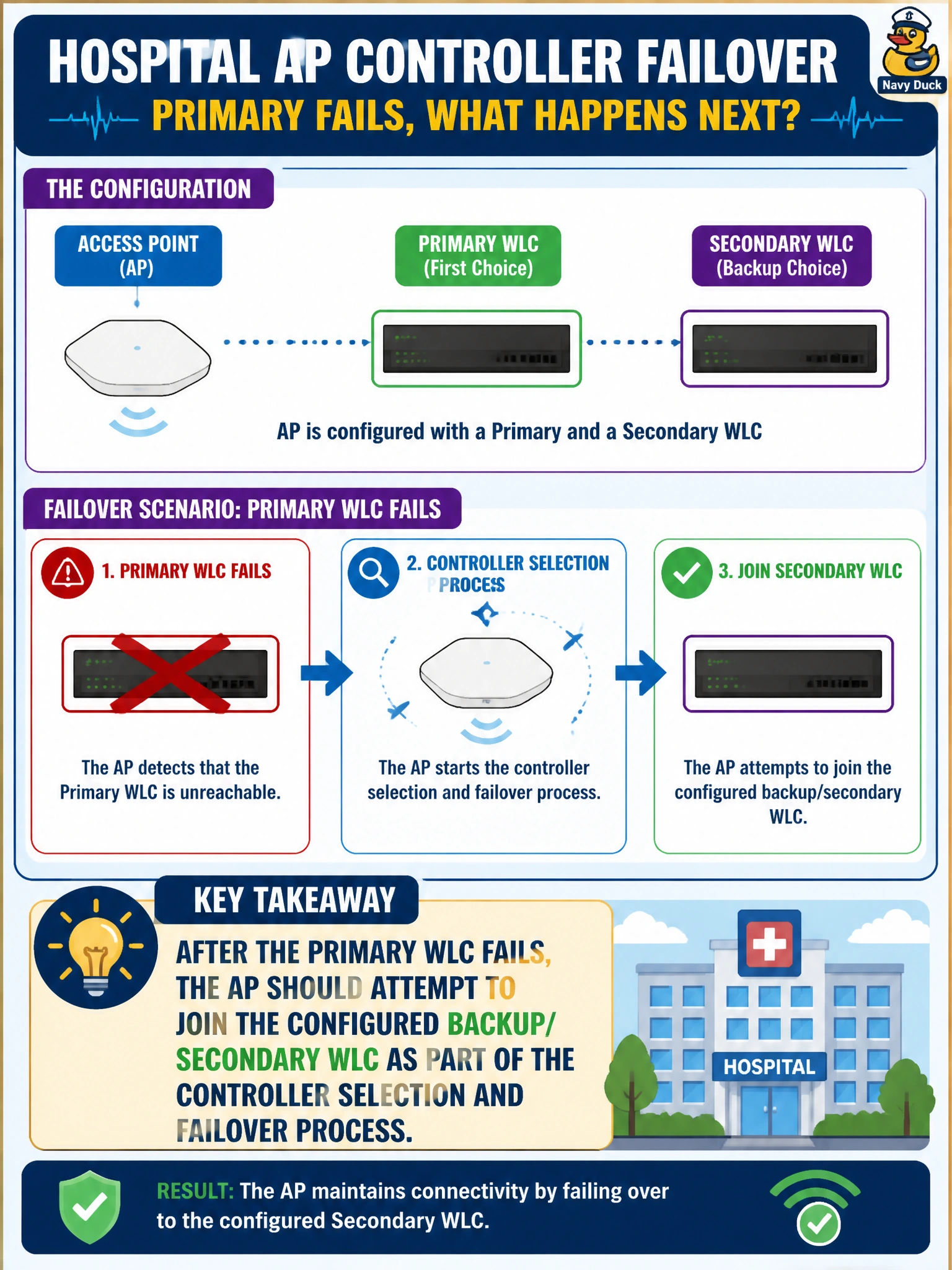
A hospital AP is configured with primary and secondary WLC entries. After the primary fails, which join behavior should operations expect?
Select an answer to reveal the explanation.
Short Explanation
APs keep a short list of controllers — when the primary drops, they try the backup, like a medic switching to the spare radio net. Clients do not re-point their default gateway at the WLC.
Full Explanation
A hospital AP configured with primary and secondary WLC entries should, after primary failure, attempt to join the backup/secondary controller as part of normal controller selection and high-availability failover behavior. Lightweight APs maintain a candidate list; when heartbeats/join to the primary fail, they progress through discovery/selection toward the configured secondary so clinical WLAN service can recover without rewriting client gateways.
Abandoning CAPWAP forever to become a Layer-2-only dumb bridge fails by concept for controller-based APs that are designed to rejoin a WLC. Continuing to advertise only the failed WLC management IP with no failover fails the purpose of configuring secondary entries. Requiring manual rewrite of every client default gateway to the secondary WLC fails because clients keep their VLAN gateway; the AP—not the client—rejoins the backup controller.
Exam caveat: Failover timing, AP SSO vs N+1 designs, and whether SSIDs briefly drop depend on the HA model; knowing “AP joins secondary” is necessary but not sufficient—validate the specific WLC HA mode in use.
Operational check: Confirm primary/secondary (or high-availability) controller config on the AP/WLC; fail the primary in a maintenance window; verify APs rejoin the secondary and clients recover; restore primary and validate failback policy.