
Ferry terminal Wi-Fi suffers intermittent interference resembling strong non-Wi-Fi noise on a crowded band. Which RF planning response is most appropriate?
Select an answer to reveal the explanation.
Short Explanation
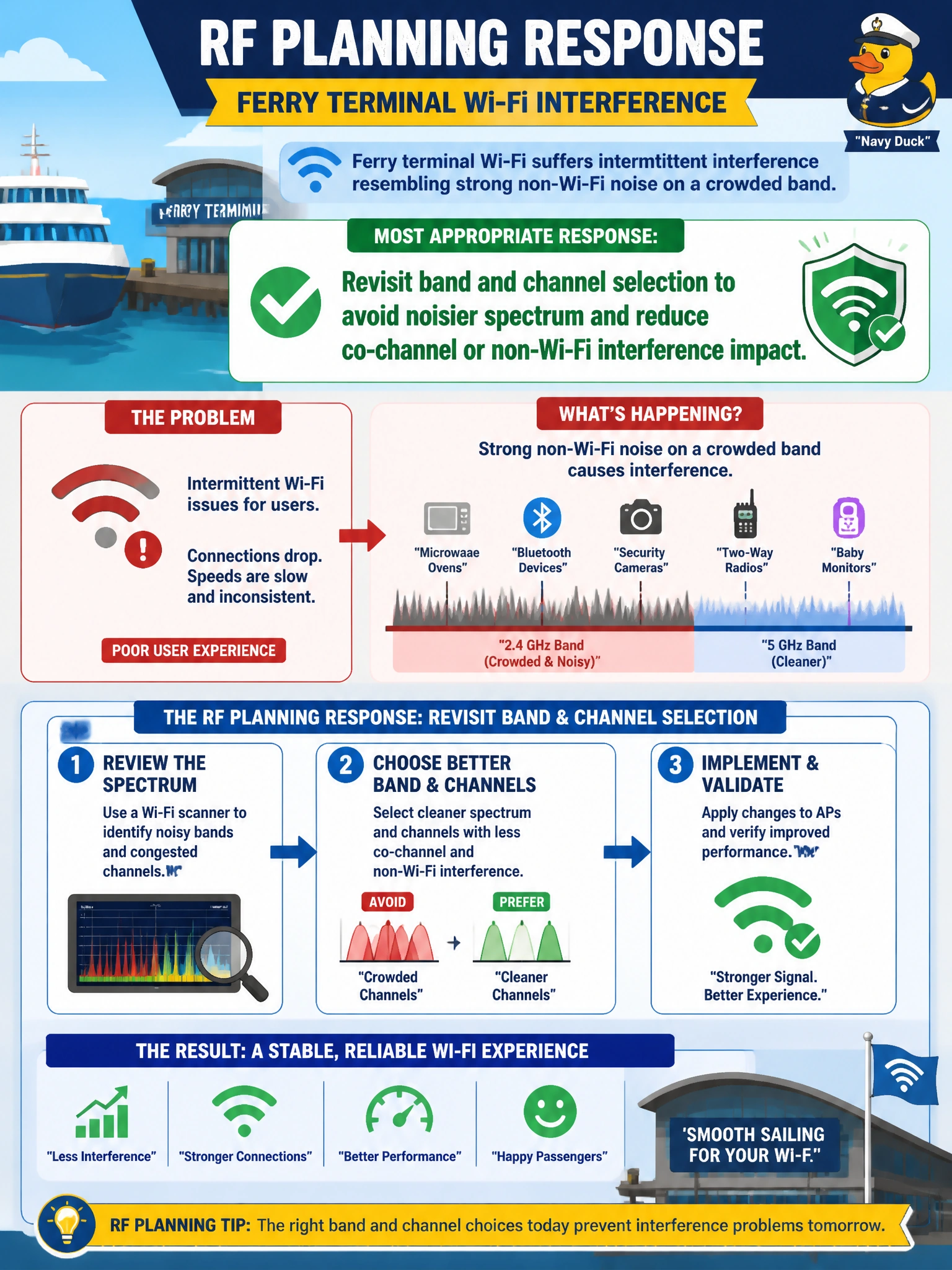
When the air is noisy, you can change the radio neighborhood by choosing a different band or cleaner channels—like moving your conversation away from the engine room. Overlapping 2.4 GHz channels add contention and collisions, so you’ll get better results by planning around the interference.
Full Explanation
At a ferry terminal, intermittent non-Wi-Fi noise on a crowded band calls for revisiting band and channel selection. Moving clients to cleaner 5/6 GHz channels or a non-overlapping plan can reduce co-channel contention and the impact of non-Wi-Fi interferers, such as engines, radar-like sources, and dense 2.4 GHz clutter, restoring usable airtime more effectively than ignoring the RF neighborhood. Ignoring band and channel choice because interference supposedly affects only copper CDP neighbors fails because interference is an RF-medium problem, not a CDP-adjacency issue. Deliberately reusing overlapping 2.4 GHz channels increases contention, collisions, and retries rather than mitigating noise. Converting every AP permanently to SE-Connect also fails because spectrum-analysis mode stops passenger client service. Exam caveat: Spectrum analysis may be needed to identify a non-Wi-Fi source; changing channels can help avoid it but may not eliminate a strong in-band interferer, so know when to relocate APs or shield or otherwise mitigate the emitter. Practical check: Survey noise by channel at the terminal, favor cleaner bands and channels, then validate reduced retries and higher MCS after the change. Use SE-Connect or a spectrum tool briefly to characterize stubborn sources, without leaving APs in that mode permanently.