
A convention center must keep exhibit-floor guest WLANs policy-separated from staff WLANs on the same AP hardware. Which wireless construct set addresses that segmentation?
Select an answer to reveal the explanation.
Short Explanation
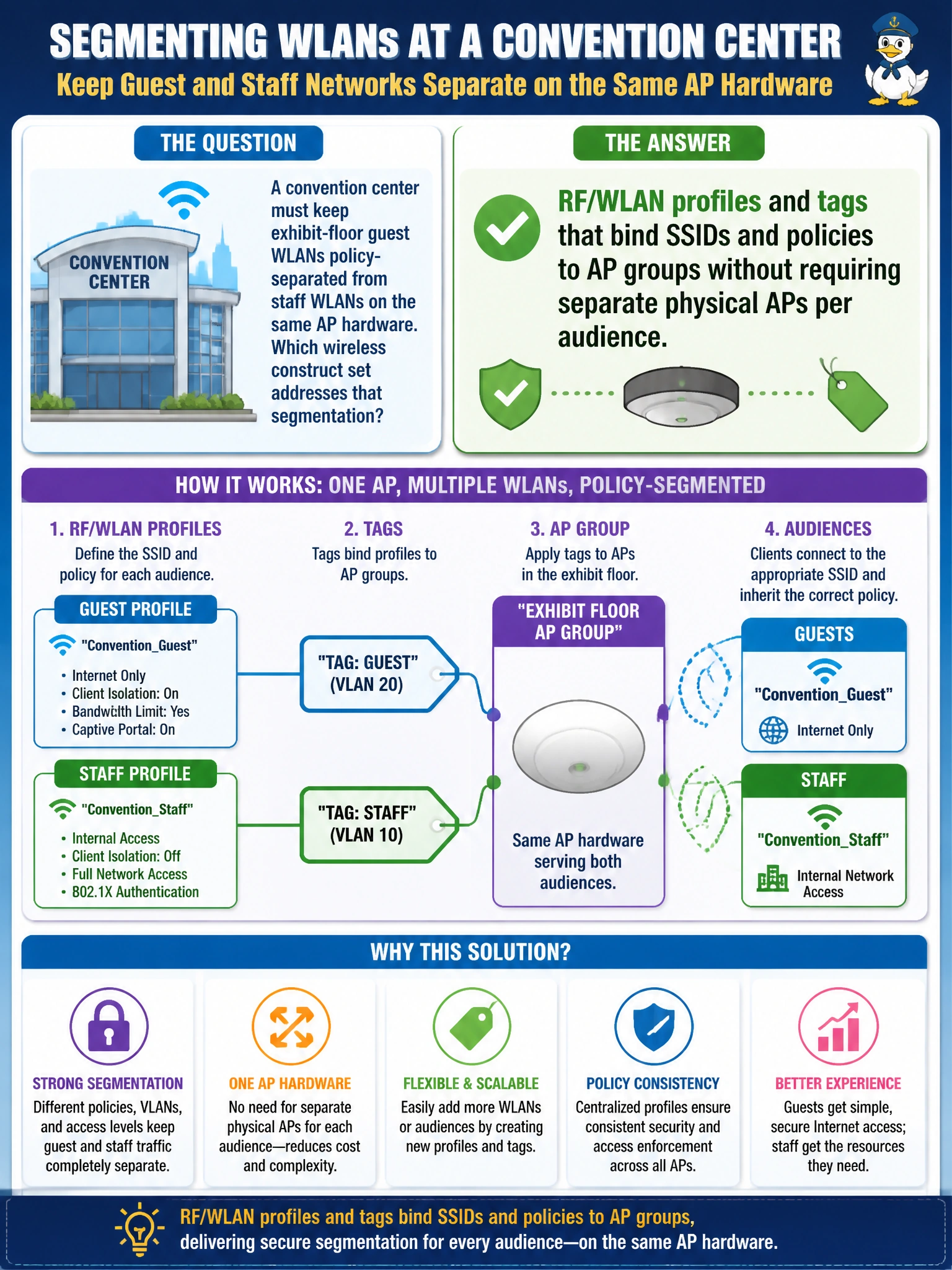
Profiles and tags are the sticky notes that say which SSID and policy live on which AP group — same AP can host guest and staff without becoming two routers. OSPF process IDs are not WLAN segmentation.
Full Explanation
A convention center that must keep exhibit-floor guest WLANs policy-separated from staff WLANs on the same AP hardware uses RF/WLAN profiles and tags (AP groups / tag bindings) so SSIDs and their policies attach to the right AP sets without dedicating separate physical APs per audience. Profiles define WLAN and RF behavior; tags bind those definitions to APs serving the exhibit floor versus staff areas, enabling segmentation on shared radios.
Per-AP unique OSPF process IDs per SSID fail by concept because OSPF process IDs are routing-protocol constructs, not WLAN policy separators. Static NAT overload entries per SSID on the WLC management interface fail because management-interface PAT is not how guest/staff SSID policy is applied. Disabling CAPWAP so each SSID becomes an autonomous IOS router fails the lightweight architecture and is not the ENCOR segmentation model for controller-based WLANs.
Exam caveat: Profiles/tags segment policy and RF; they do not by themselves replace firewalling between guest and staff VLANs—pair WLAN policy with correct dynamic interfaces/VLANs and upstream ACLs.
Operational check: Assign guest and staff WLANs distinct profiles/policies, bind tags to the exhibit AP group, verify both SSIDs appear on the shared APs with different VLAN/security attributes, and test that guest clients cannot inherit staff WLAN policy.