
A school district AP fails to join its WLC. Engineers review CAPWAP discovery paths including DHCP and DNS. Which statement best describes the join principle?
Select an answer to reveal the explanation.
Short Explanation
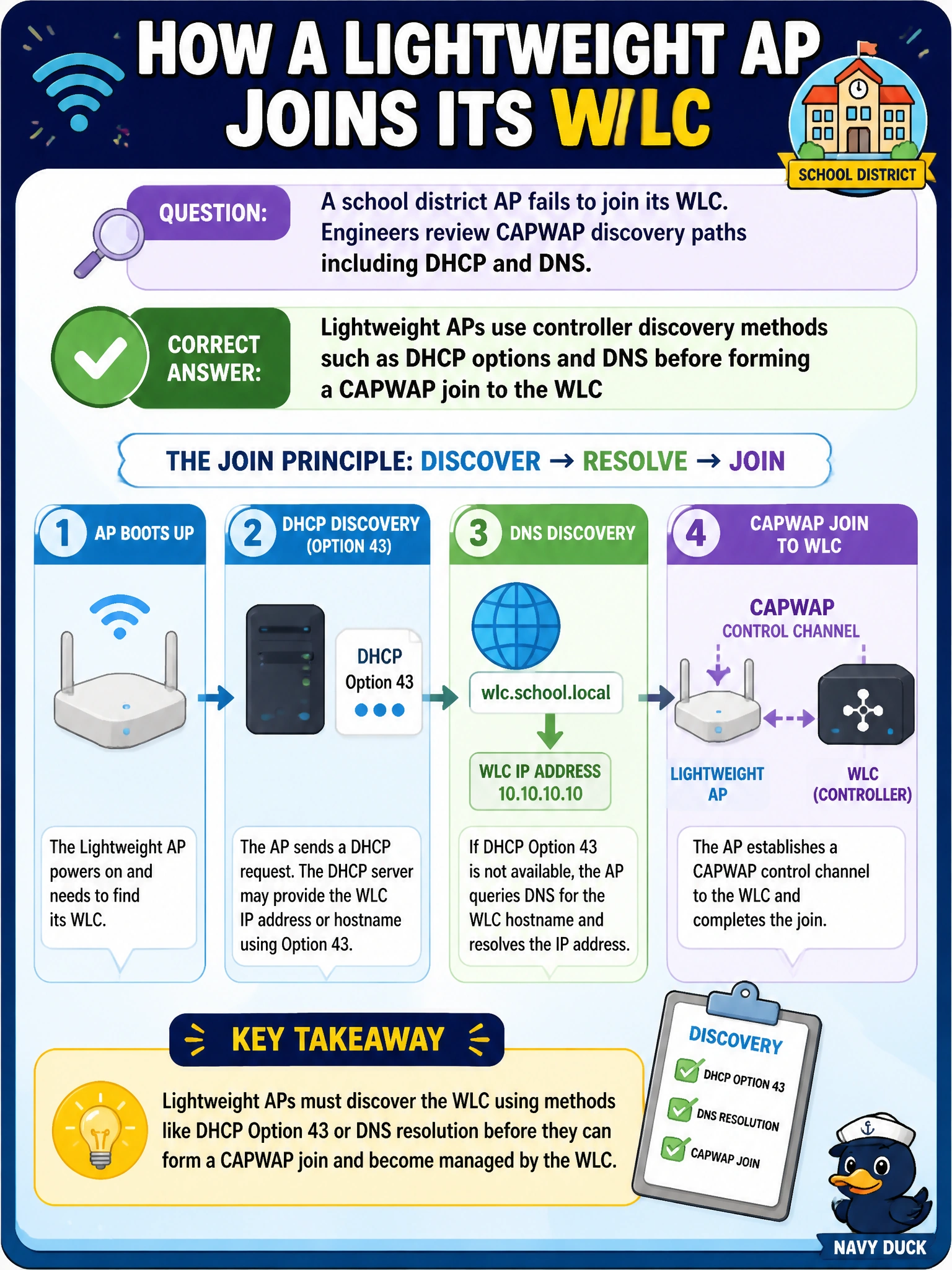
The AP has to find its boss before it can join — DHCP options and DNS are common name-tags on the hunt. STP BPDUs and PIM RPs are the wrong phone books for CAPWAP.
Full Explanation
When a school-district lightweight AP fails to join its WLC, the governing principle is CAPWAP discovery then join: the AP uses discovery methods such as DHCP options (commonly option 43), DNS (CISCO-CAPWAP-CONTROLLER), layer-2/3 broadcasts, and primed/static controller lists to learn candidate WLCs before forming a CAPWAP tunnel and completing join. Engineers should verify those discovery paths when an AP never progresses beyond discovery.
Claiming APs join only through manual serial console on every reboot fails by concept because production APs discover and join over the network after initial bootstrap. Discovering controllers exclusively via STP BPDU extensions fails because spanning-tree BPDUs are not a CAPWAP discovery mechanism. Ignoring DHCP/DNS and joining only via multicast PIM RP announcements fails because PIM RPs serve multicast trees, not WLC address discovery for CAPWAP.
Exam caveat: Multiple discovery methods can coexist; fixing DHCP alone may be insufficient if DNS, priming, or reachability to the WLC management address is broken. ENCOR emphasizes the discovery-then-join flow, not inventing STP/PIM as wireless join protocols.
Operational check: Confirm the AP gets a DHCP lease with the correct option pointing at the WLC, resolve the CAPWAP DNS name if used, verify IP reachability and ACL allowance to the controller, and watch join state advance from discovery to joined on the WLC.