
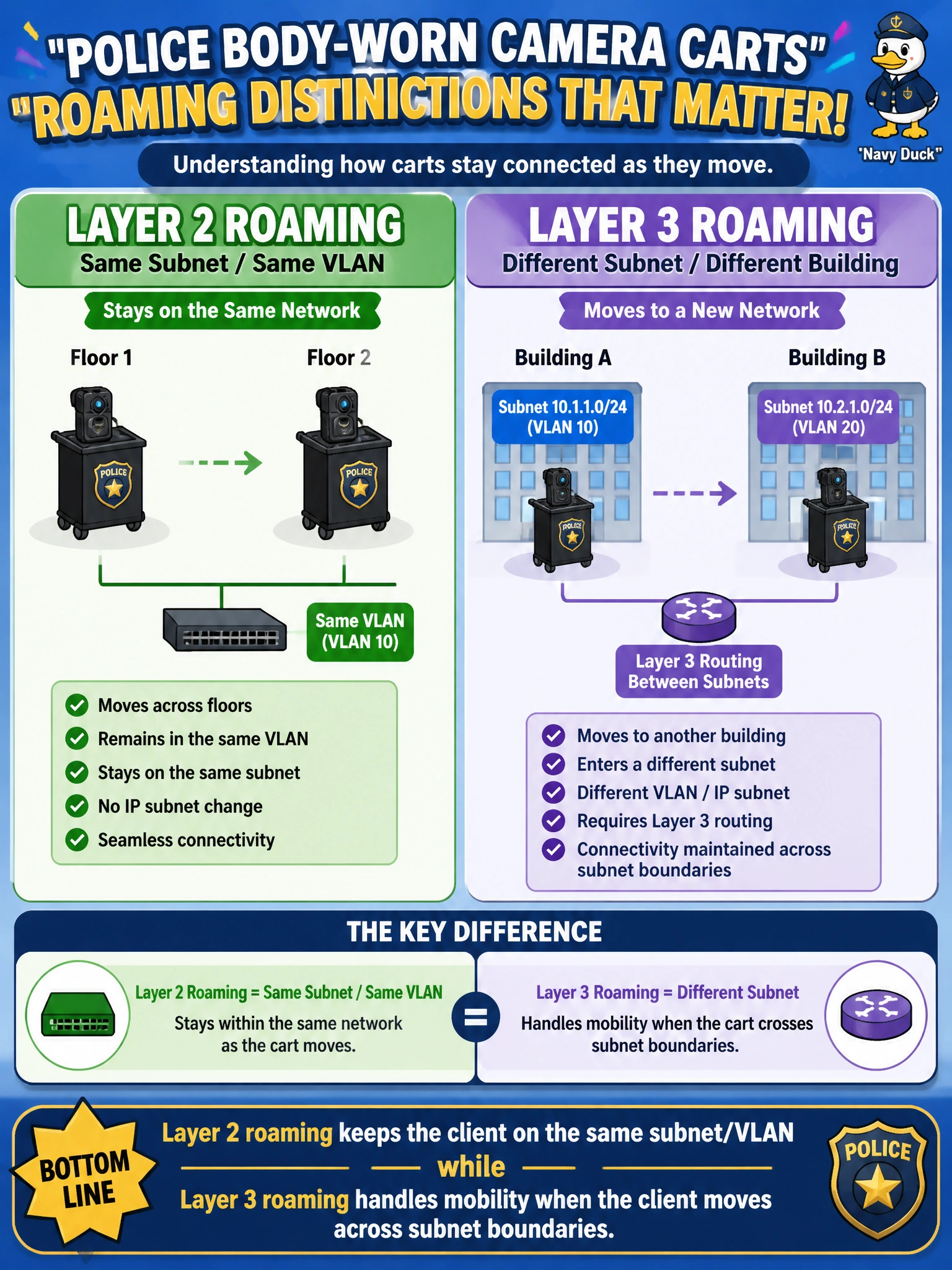
Police body-worn camera carts roam across floors that remain in the same VLAN versus carts that move onto a different subnet in another building. Which roaming distinction matters?
Select an answer to reveal the explanation.
Short Explanation
Same VLAN roam is like walking rooms in one house without changing your address. Cross-subnet roam is moving to another house — mobility has to keep the session alive across that address change.
Full Explanation
Police body-worn camera carts that roam across floors in the same VLAN keep their IP subnet; that is Layer 2 roaming—the client changes AP/radio while remaining on the same broadcast domain. Carts that move into another building on a different subnet require Layer 3 roaming (mobility/anchoring or equivalent inter-controller mobility) so the session can continue across subnet boundaries. The distinction that matters is therefore same-subnet L2 roam versus inter-subnet L3 mobility.
Asserting that Layer 2 roaming always requires a new DHCP lease on every AP hop inside one VLAN fails by concept: staying in the same subnet is precisely why L2 roam avoids mandatory readdressing. Saying Layer 3 roaming is identical to FlexConnect local auth with no mobility considerations fails because inter-subnet roam is a mobility problem, not merely a local-auth checkbox. Claiming roaming exists only on wired EtherChannel member links fails because wireless client roaming is an 802.11/controller mobility topic, not LAG member failover.
Exam caveat: Even L2 roams can trigger reauth or key management events depending on fast-roaming design; “same VLAN” simplifies addressing but does not erase security/roam optimizations. ENCOR wants the L2 vs L3 boundary clear.
Operational check: Trace cart IP and VLAN as it moves floor-to-floor versus building-to-building; confirm L2 roam retains the address inside one subnet and that inter-building moves use configured mobility/L3 roam so sessions survive subnet change.