
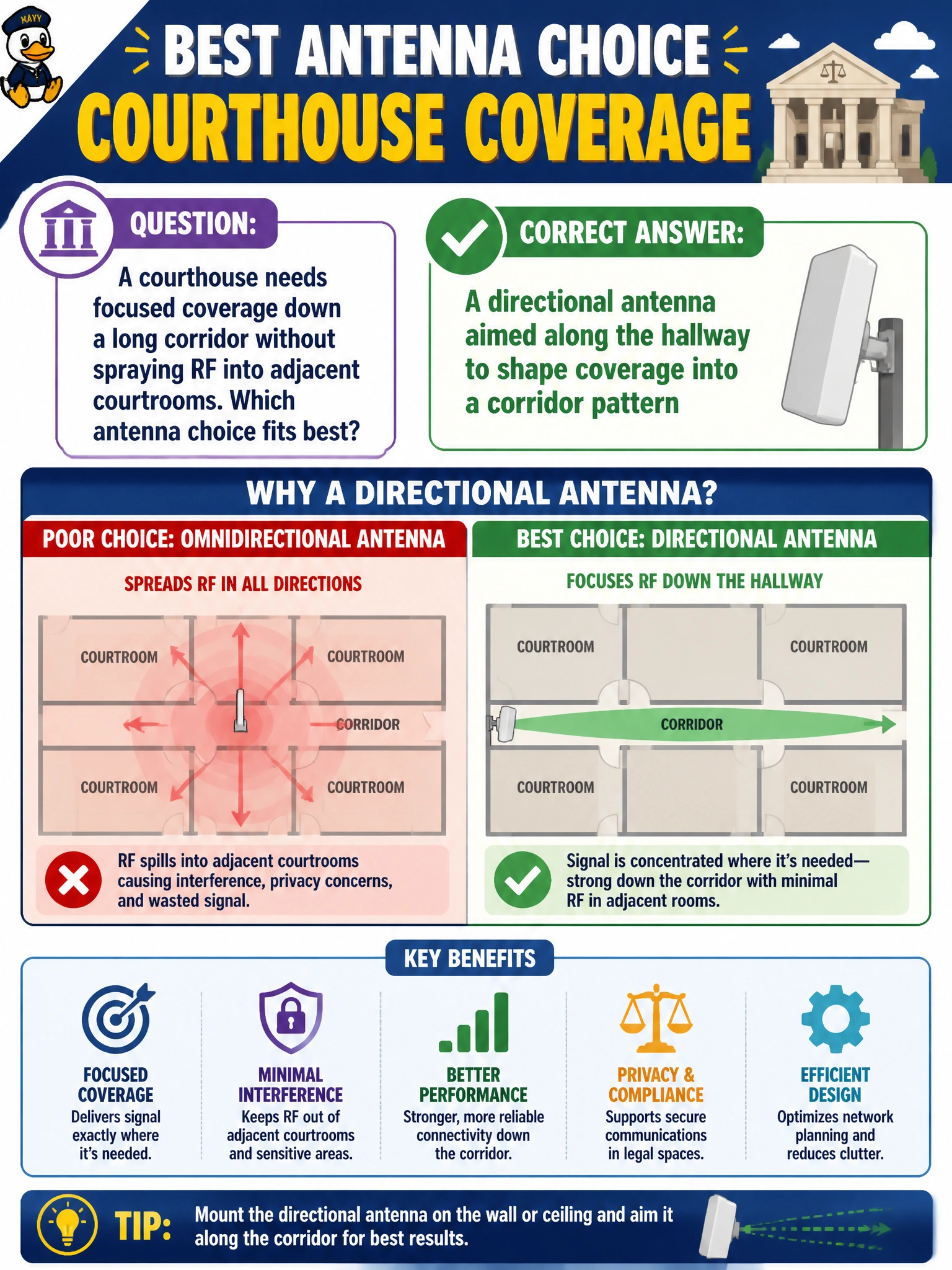
A courthouse needs focused coverage down a long corridor without spraying RF into adjacent courtrooms. Which antenna choice fits best?
Select an answer to reveal the explanation.
Short Explanation
Omni is a lightbulb; directional is a flashlight down the hall. Point the beam along the corridor so courtrooms next door do not soak up the RF. Antennas do not become OSPF next hops.
Full Explanation
A courthouse corridor that needs coverage down a long hallway without spraying RF into adjacent courtrooms calls for a directional antenna aimed along the corridor. Directional patterns concentrate energy in the intended azimuth/elevation so judges’ chambers and courtrooms beside the hall receive less unintended RF, improving both coverage where needed and interference/security posture next door.
An omnidirectional antenna fails by concept for this geometry because it radiates roughly equally in the horizontal plane and will illuminate adjacent rooms as readily as the corridor. Treating a Yagi as a Layer-3 OSPF next-hop fails because antennas shape RF patterns; they are not routing adjacencies or next-hop interfaces. Relying on copper trunking with no antenna fails because 802.11 client access requires radiated RF—wired trunks do not carry Wi-Fi frames to handhelds in the hall.
Exam caveat: Directional coverage still needs correct mounting height, downtilt, and channel planning; a mis-aimed panel can starve the far end of the corridor or leak into unintended spaces. ENCOR tests antenna purpose, not exotic routing metaphors.
Operational check: Aim the corridor panel along the hallway centerline; verify RSSI/SNR along the walk path and measure leakage into adjacent courtrooms; adjust tilt/azimuth until corridor targets are met with acceptable courtroom RF footprint.