
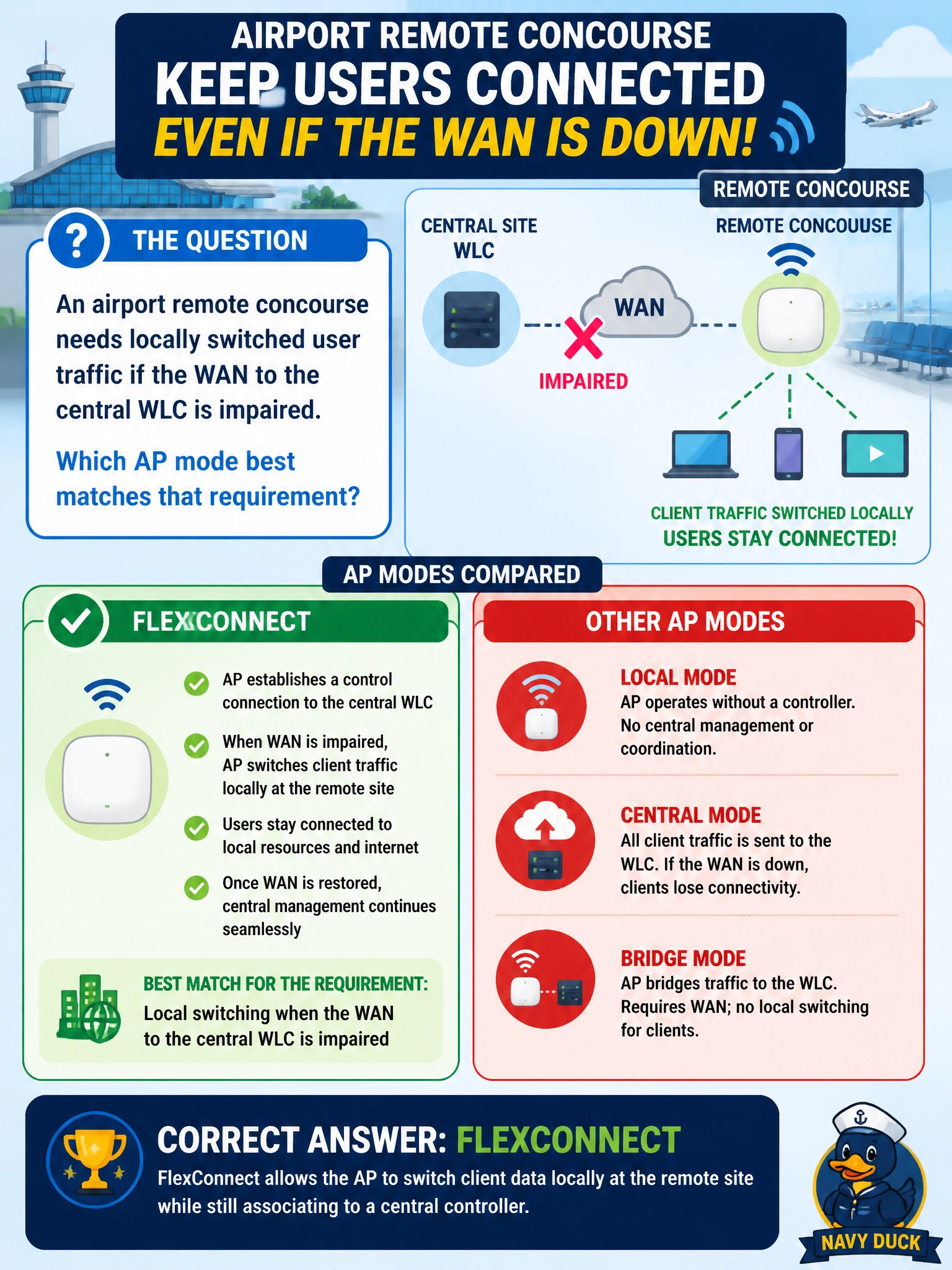
An airport remote concourse needs locally switched user traffic if the WAN to the central WLC is impaired. Which AP mode best matches that requirement?
Select an answer to reveal the explanation.
Short Explanation
Think of FlexConnect as a branch AP that still phones home to the WLC for control, but can keep client data switching local when the WAN wobbles. Monitor and sniffer modes are eavesdroppers, not passenger Wi-Fi.
Full Explanation
An airport remote concourse that must keep user traffic switching locally when the WAN to the central WLC is impaired needs FlexConnect (H-REAP) behavior: the AP still associates to the central controller for management and WLAN definition, but client data can be locally switched at the remote site when the CAPWAP data path or WAN is degraded. That matches branch/remote operational requirements where passenger and staff traffic should not black-hole solely because the WAN wobbles.
Monitor mode fails by concept because those APs serve no clients and only listen for security/spectrum visibility. Sniffer mode fails because it streams frames to a remote capture server and provides no local WLAN service for concourse users. SE-Connect mode fails because it is a short-lived spectrum-analysis role, not a production client-serving access mode for the remote site.
Exam caveat: FlexConnect still needs correct local switching VLAN mappings and WAN failure behavior tested; “joined to a WLC” alone does not imply local data path during WAN loss unless FlexConnect local switching is designed for that SSID.
Operational check: Place a FlexConnect AP at the concourse, map WLANs to local VLANs, simulate WAN loss to the WLC, and verify clients remain associated with locally switched traffic while control-plane recovery rejoins the primary/backup controller when the WAN returns.