
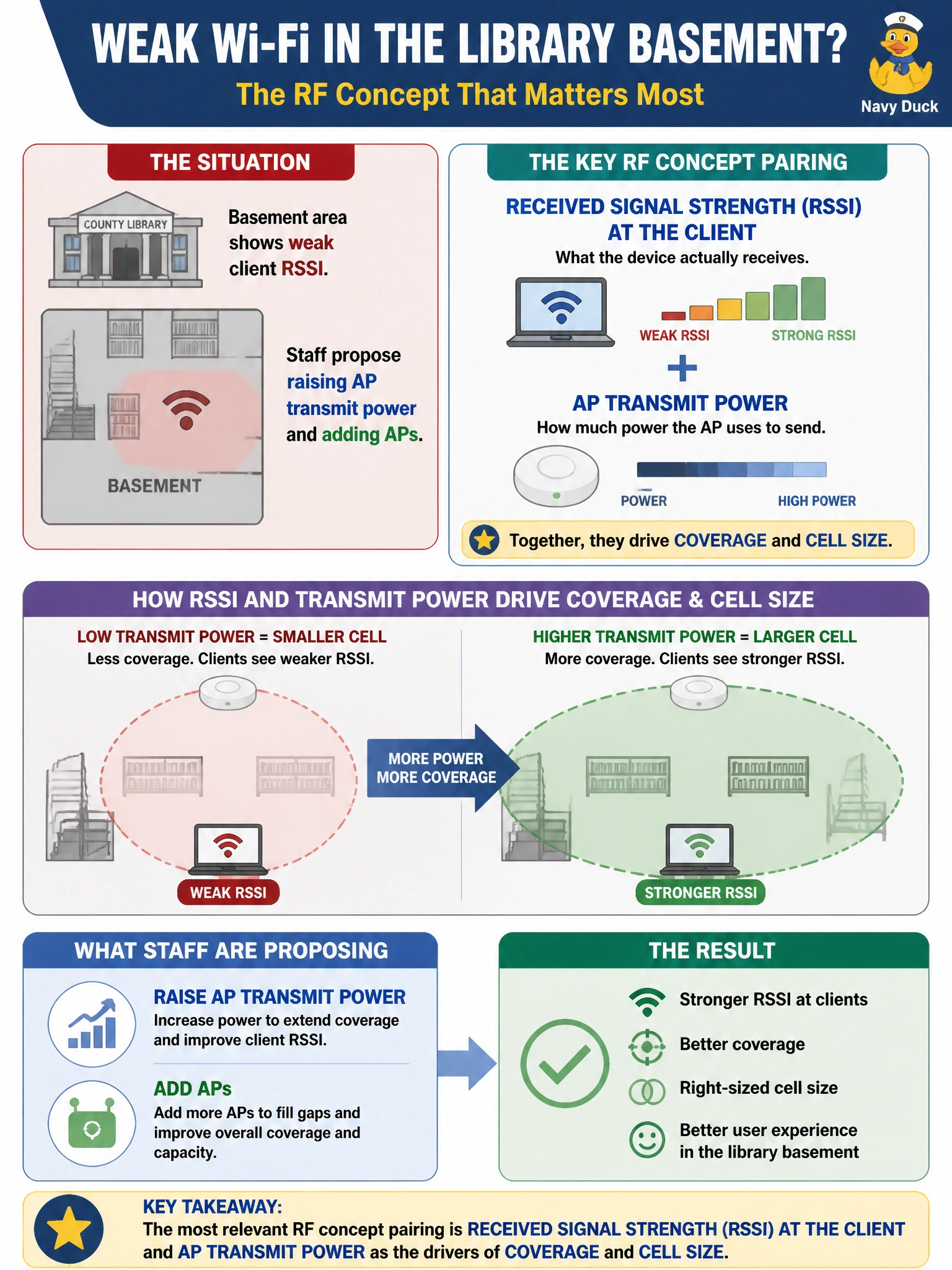
A county library basement shows weak client RSSI. Staff propose raising AP transmit power and adding APs. Which RF concept pairing is most relevant?
Select an answer to reveal the explanation.
Short Explanation
Weak basement RSSI means the client barely hears the AP — like a whisper through concrete. Bumping Tx power and adding APs changes how loud and how dense the cells are. Routing protocols will not fix radio physics.
Full Explanation
In the county library basement, weak client RSSI means the station is not receiving enough AP energy for reliable rates through dense construction. Raising AP transmit power increases the radiated energy that can improve downlink RSSI and enlarge the cell, while adding APs shortens path distance and densifies coverage. The RF concept pairing that matters is therefore received signal strength at the client together with AP transmit power (and resulting cell size/coverage design)—the levers that actually change how well basement clients hear the WLAN.
STP root priority and EtherChannel hashing fail by concept because they govern Layer-2 loop prevention and link aggregation on wired trunks, not basement RF attenuation. BGP AS-path length and eBGP multihop TTL fail because they select inter-AS paths and control TTL for BGP sessions, not 802.11 coverage. VXLAN VNI mapping and LISP map-server registration fail because overlay/locator control planes do not raise client RSSI through concrete and earth.
Exam caveat: Tx power and densification help coverage, but excessive power can worsen co-channel interference upstairs; ENCOR wants the RF pairing identified correctly without treating wired routing features as Wi-Fi amplifiers.
Operational check: Measure client RSSI and SNR at basement seats before and after a controlled Tx-power increase; validate whether additional APs are still required; confirm uplink capacity and channel plan so new cells do not create CCI; document cell-edge RSSI targets for the library floor.