
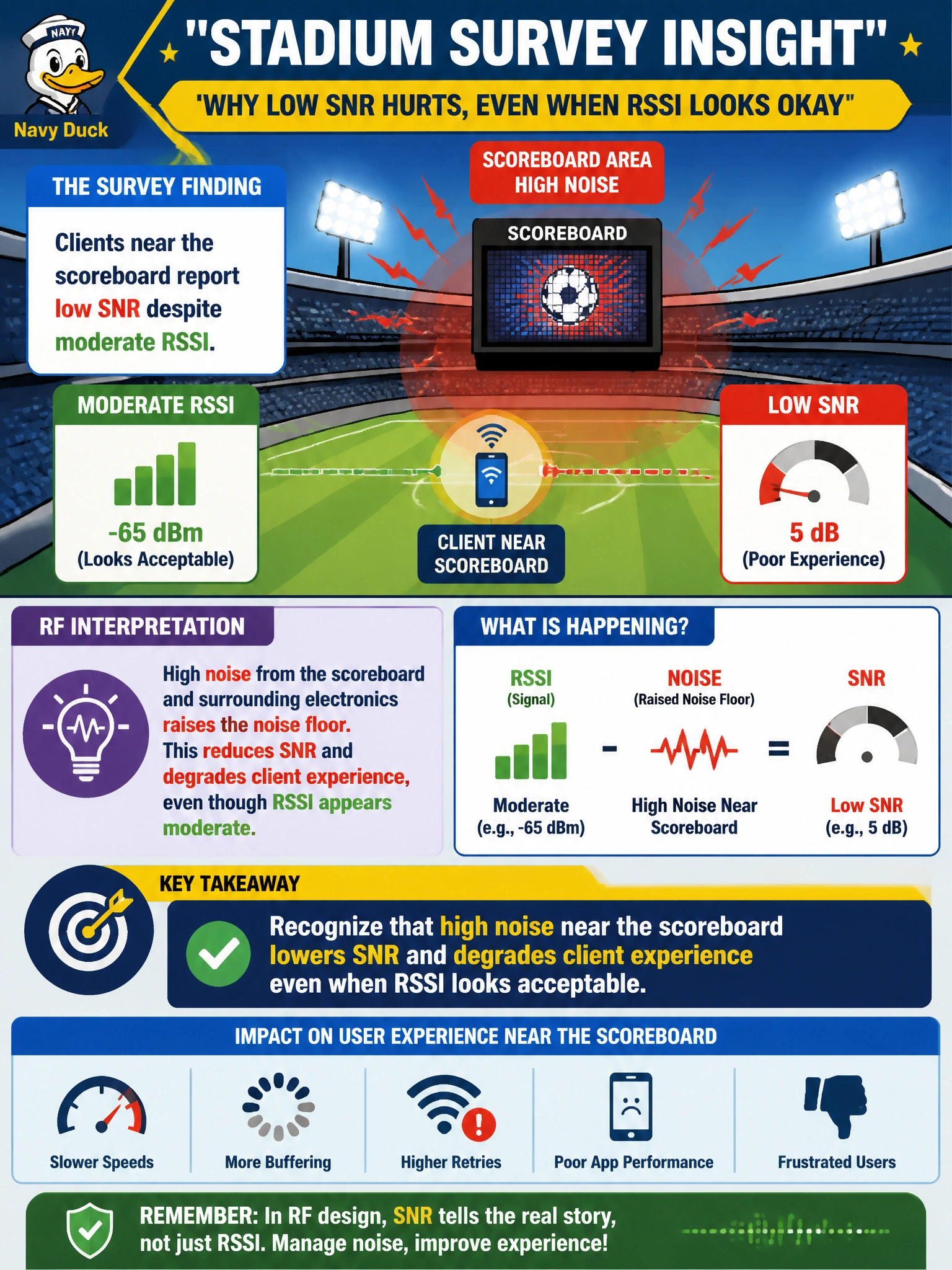
A city stadium survey finds clients near the scoreboard report low SNR despite moderate RSSI. Which RF interpretation should the wireless engineer apply?
Select an answer to reveal the explanation.
Short Explanation
SNR is the gap between the wanted signal and the noise floor — like trying to hear a coach over a roaring PA. Near that scoreboard, noise climbs and the gap shrinks even if RSSI still looks okay. Fix the noise or placement, not DHCP.
Full Explanation
At the city stadium, moderate RSSI only reports how strong the AP’s signal looks at the client; SNR measures the usable gap between that wanted signal and the local noise floor. Scoreboard electronics, LED boards, and crowd devices raise the noise floor, so the same RSSI can still yield a poor SNR and sluggish throughput, retries, and roaming complaints. The correct interpretation is therefore RF-noise-aware: treat low SNR near the scoreboard as a radio-environment problem that degrades experience even when RSSI looks “acceptable,” then survey noise, channels, and physical placement rather than chasing unrelated Layer-3 symptoms.
Treating low SNR as a DHCP lease problem fails by concept because address assignment does not create the signal-to-noise relationship measured in the RF survey. Assuming RSSI alone guarantees usable airtime fails because RSSI ignores noise; high noise collapses MCS rates and airtime efficiency despite a strong received-signal reading. Disabling all 5 GHz radios because “SNR only applies to wired spanning tree” confuses RF quality metrics with STP and removes the band that often has cleaner spectrum for stadium density.
Exam caveat: ENCOR expects you to separate RSSI from SNR and to recognize that noise-floor elevation—not merely weak RSSI—explains “bars look fine, performance does not.” Do not equate every client complaint with DHCP or STP.
Operational check: At the scoreboard survey points, capture RSSI, noise floor, and derived SNR on both bands; compare clean vs noisy channels; verify channel plan and AP placement reduce scoreboard-adjacent noise impact; retest client MCS and retry rates after remediation.