
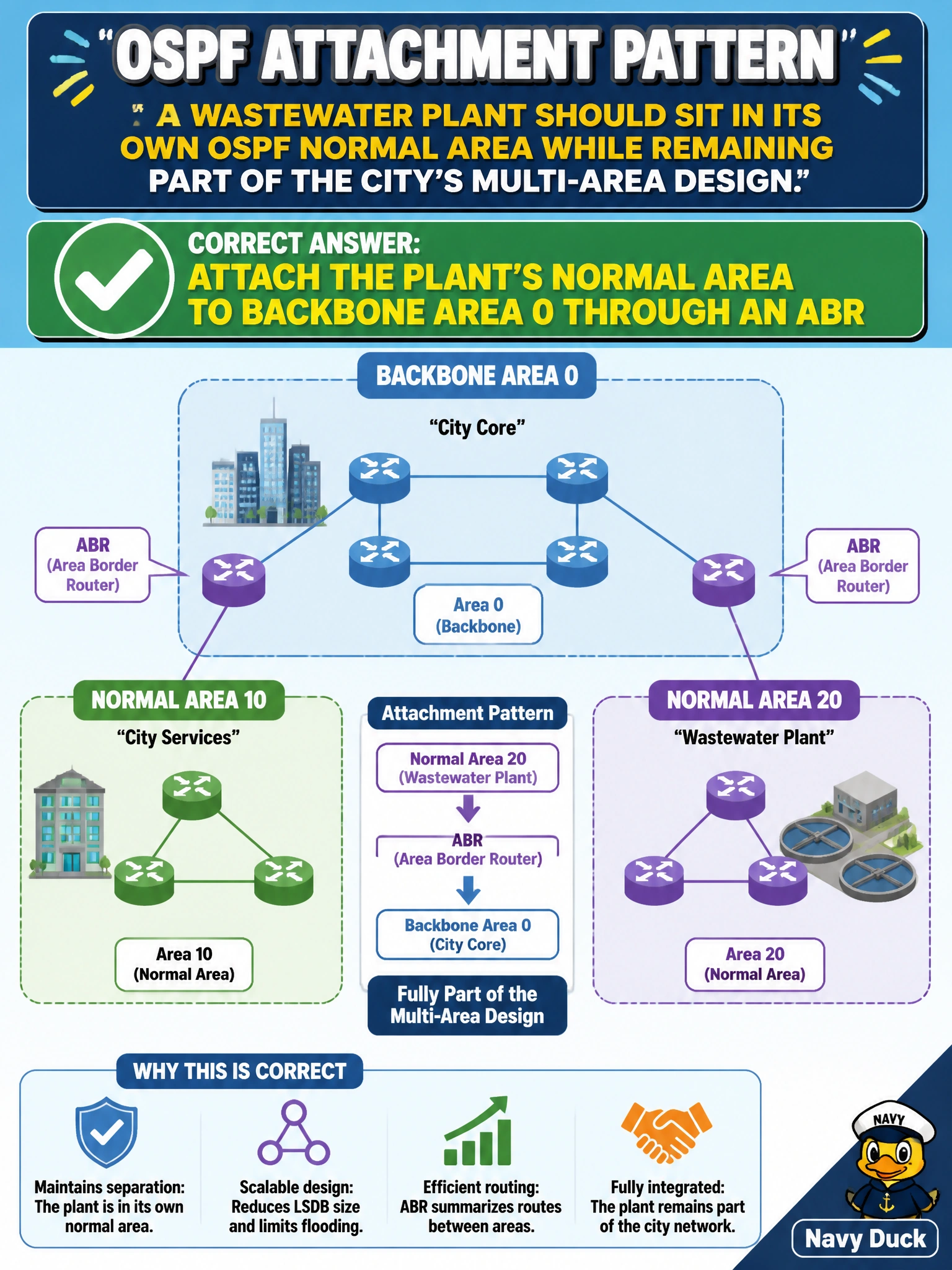
A wastewater plant should sit in its own OSPF normal area while remaining part of the city's multi-area design. Which attachment pattern is correct?
Select an answer to reveal the explanation.
Short Explanation
Your plant area needs a doorway into the city’s OSPF backbone, area 0, through an ABR. Backbone attachment keeps the plant in its own normal area while connecting it to the city’s multi-area design.
Full Explanation
The wastewater plant should remain in its own OSPF normal area and connect to backbone area 0 through an ABR. The ABR provides the doorway for Type-3 inter-area exchange, allowing plant prefixes and city prefixes to reach each other within the standard OSPF hierarchy without making the plant an island. Keeping the plant as a normal, non-backbone area also preserves failure-domain separation while respecting backbone attachment rules. An area with no ABR path and no connectivity toward area 0 is a discontinuous, isolated area that breaks classic multi-area expectations. Numbering the plant area as area 0 and deleting the civic backbone reverses the intended hierarchy and collapses the city’s backbone design into the plant. Running only RIP inside the plant and blocking all OSPF at the fence line abandons OSPF integration rather than connecting a normal area through an ABR. Exam caveat: every normal area needs a path to area 0, directly through an ABR or, when forced, through a remedial construct such as a virtual link. Stub or NSSA configurations may still be used at the plant, but they do not remove the need for proper backbone linkage. Practical check: configure the plant area on an ABR that also participates in area 0, verify the ABR status, and confirm Type-3 routes between plant and city. Fail an internal plant link and check that city-wide LSDB churn remains limited compared with a single flat area; reject isolation from area 0 or demoting the civic backbone to accommodate one facility.