
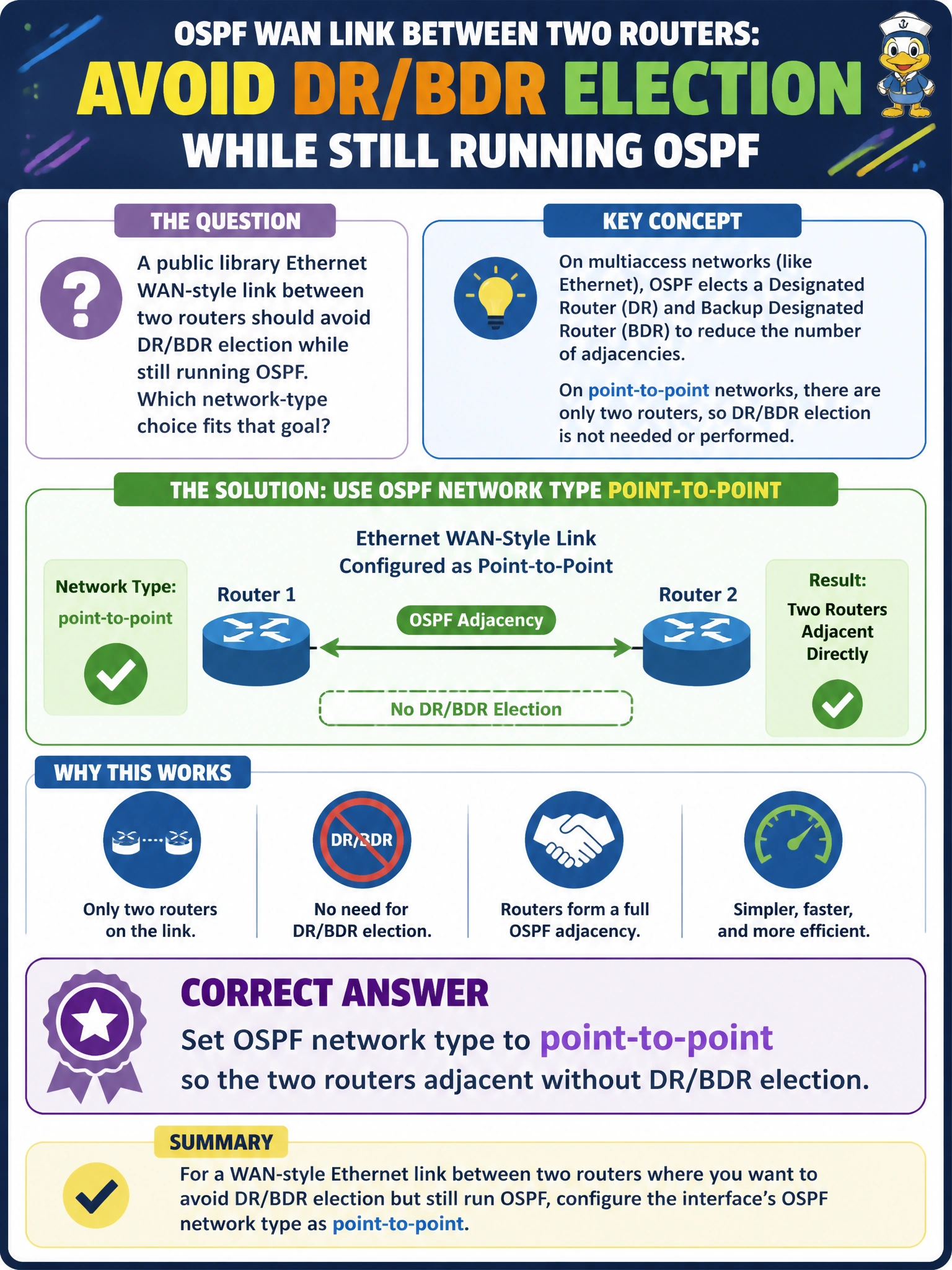
A public library Ethernet WAN-style link between two routers should avoid DR/BDR election while still running OSPF. Which network-type choice fits that goal?
Select an answer to reveal the explanation.
Short Explanation
Two library routers on one Ethernet hop are really a point-to-point conversation — tell OSPF that and you skip the DR/BDR ceremony. Broadcast mode would still elect a DR on that segment. Killing IP or bridging away OSPF doesn't help adjacency design.
Full Explanation
A public library Ethernet link between two routers that should avoid DR/BDR election while still running OSPF should use OSPF network type point-to-point so the two routers adjacent without DR/BDR election. Point-to-point tells OSPF the segment is a simple adjacency between two peers, suppressing multi-access DR/BDR behavior even though the media is Ethernet. That yields a direct FULL adjacency appropriate for a two-router WAN-style Ethernet hop.
Keeping broadcast network type so a DR is always required leaves DR/BDR election in place on the two-router link, which the stem wants to avoid. Using a non-OSPF bridge group so hellos never flow stops OSPF rather than running it correctly without DR/BDR. Configuring the link as an access port in VLAN 1 only and disabling IP removes routed OSPF capability entirely.
Exam caveat: both sides should use matching OSPF network types; mismatched types can break adjacency. Point-to-point also affects how the link is described in the LSDB versus a transit LAN with a network LSA from a DR. ENCOR expects network-type selection as the lever for DR/BDR behavior on Ethernet.
Operational check: set ip ospf network point-to-point on both library routers' interconnect, verify neighbor FULL with neither DR nor BDR role, and confirm routes exchange. Compare with broadcast mode in lab to see DR election appear. Standardize this on civic two-router Ethernet handoffs where DR election adds no value.