
Museum campus engineers compare how EIGRP and OSPF react when a successor path disappears. Which operational contrast is accurate?
Select an answer to reveal the explanation.
Short Explanation
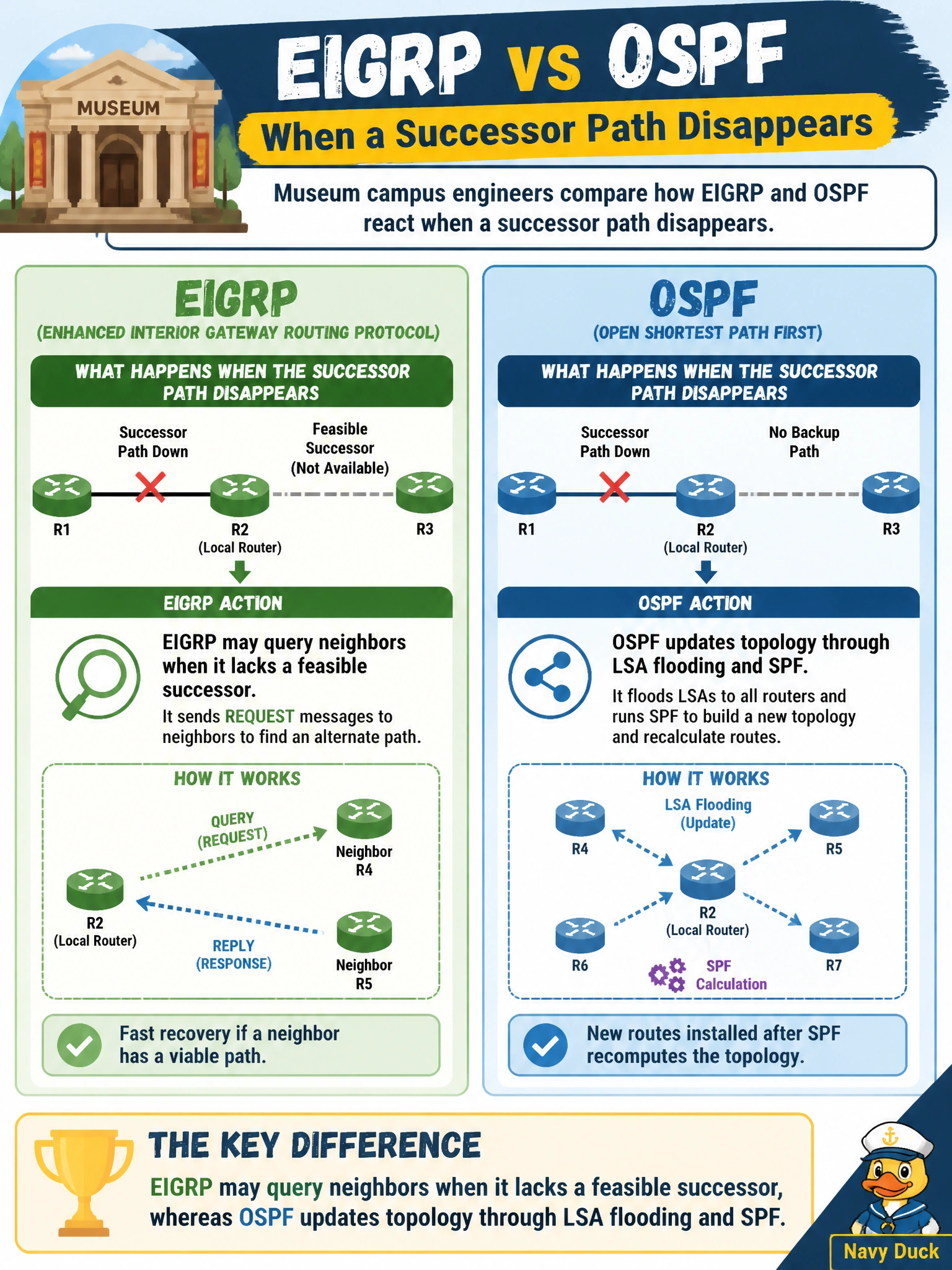
When EIGRP loses its best path and has no ready spare, it asks around with queries; OSPF updates the shared map with LSAs and reruns SPF. Different gossip styles, same goal of a new path. CAM moves and RSSI aren't the routing control plane here.
Full Explanation
Museum campus engineers comparing reactions when a successor path disappears should note: EIGRP may query neighbors when it lacks a feasible successor, whereas OSPF updates topology through LSA flooding and SPF. If EIGRP loses its successor and no feasible successor is waiting, DUAL actively queries to discover a new loop-free path; with an FS present, cutover can be local without queries. OSPF has no query/FS mechanism—it floods updated LSAs and recomputes SPF on the LSDB to install new next hops.
Saying OSPF sends EIGRP-style queries for feasible successors before using an LSDB incorrectly attributes EIGRP DUAL behavior to OSPF. Claiming both protocols use only CAM moves and never exchange routing information denies their control planes entirely. Answering OSPF 'queries' via wireless RSSI thresholds invents a radio metric that OSPF SPF does not use in this campus wired routing contrast.
Exam caveat: query storms can extend EIGRP convergence scope; stub routers and summarization help contain queries—OSPF containment is about areas/LSA domains instead. Keep vocabulary clean: successor/FS/query for EIGRP; LSA/LSDB/SPF for OSPF. ENCOR loves this operational contrast after a link loss.
Operational check: clear or shut a museum successor uplink on EIGRP without an FS and observe queries; repeat with an FS present and observe silent local switchover. On OSPF, shut the link and confirm LSA updates plus SPF without EIGRP query packets. Use show/debug appropriately in a maintenance window so gallery exhibit traffic impact is measured, not assumed.