
Voter registration SVIs are configured as OSPF passive interfaces. What behavior should the team expect?
Select an answer to reveal the explanation.
Short Explanation
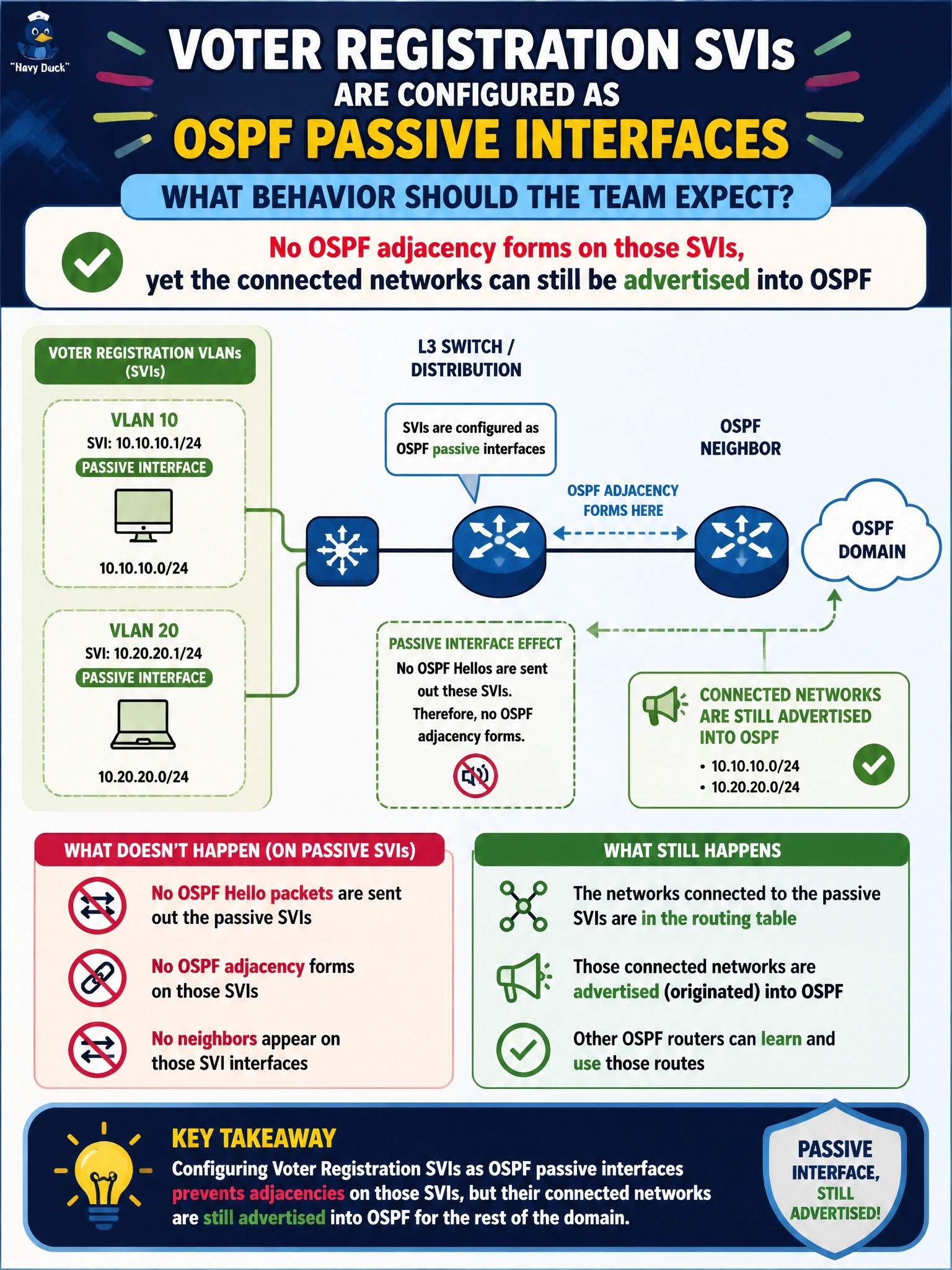
Passive means "list the polling-place subnet in the map, but don't hold neighbor town halls on the user VLAN." Adjacency stays off; advertisement of the connected network can still happen. It doesn't invite laptop neighbors or delete the subnet from existence.
Full Explanation
When voter registration SVIs are OSPF passive interfaces, the team should expect no OSPF adjacency on those SVIs while the connected networks can still be advertised into OSPF. Passive suppresses hello transmission and neighbor formation on the user-facing SVI—important so laptops do not become accidental adjacency targets—yet the prefix can remain in the OSPF domain for reachability advertising toward the rest of the county. That is the standard campus passive-SVI behavior.
OSPF deleting connected subnets from the RIB immediately is not what passive does; connected routes remain, and OSPF can still advertise them. Forcing full adjacency with every end-user laptop is the opposite of passive-interface intent. Hellos increasing until BPDU Guard shuts the SVI mixes OSPF hello behavior with STP BPDU Guard; passive reduces/stops hellos rather than accelerating them into an STP err-disable.
Exam caveat: if an interface is passive and also not included in OSPF, the subnet will not be advertised—passive alone is not a substitute for enabling the network in the OSPF process. Uplinks that must form neighbors must remain non-passive. ENCOR repeatedly tests 'advertise without adjacent' via passive-interface.
Operational check: mark voter SVIs passive, confirm show ip ospf neighbor lists no peers on those SVIs, and verify the voter prefixes still appear in OSPF advertisements to distribution. Place a test router on a voter VLAN and confirm adjacency does not form. Keep the registration closet uplinks active in OSPF so the rest of the county still learns those subnets.