
Fire/EMS dual-homes to two ISPs with eBGP for civic Internet. Within ENCOR scope, which neighbor pattern is the expected model?
Select an answer to reveal the explanation.
Short Explanation
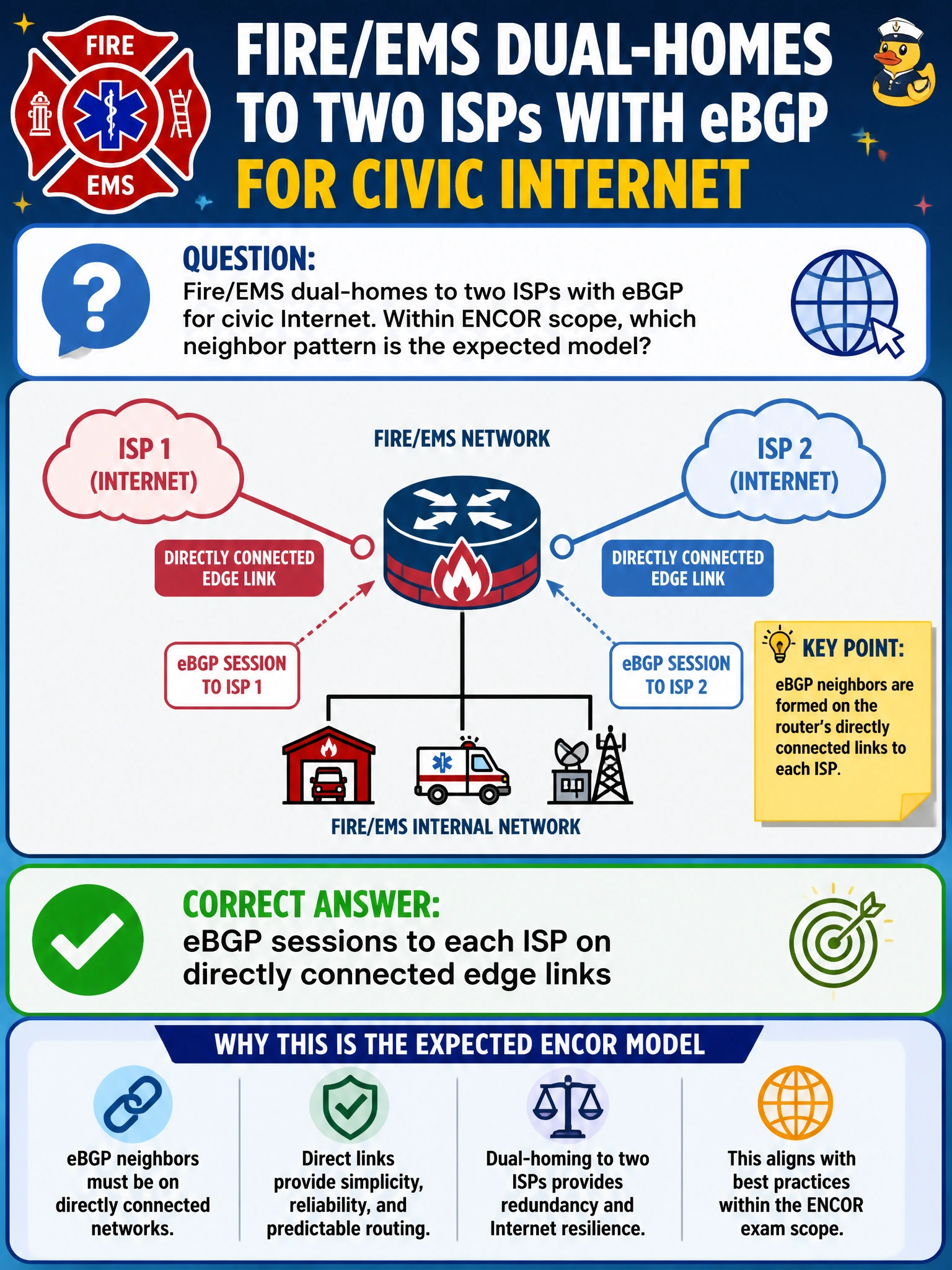
Each ISP gets a front-door Ethernet — eBGP on those directly connected edge links is the ENCOR-sized pattern. You don't hand Fire/EMS's ASN to the ISP as IBGP, and MST isn't an Internet routing protocol.
Full Explanation
Fire/EMS dual-homing to two ISPs for civic Internet within ENCOR scope expects eBGP sessions to each ISP on directly connected edge links. Each provider handoff is an external neighbor relationship using the shared interconnect addressing and standard eBGP behavior, giving Fire/EMS dual exits without pretending the ISPs share the agency ASN. That neighbor pattern is the ENCOR-sized model for enterprise multihoming fundamentals.
Running eBGP only through unmanaged Layer-2 loops without IP next hops removes the routed foundation BGP needs and invites bridging loops rather than clean ISP peering. Using iBGP to the ISPs because external peers must share the Fire/EMS ASN is wrong: ISPs are external; eBGP between different ASNs is correct, and agencies do not hand their ASN to the ISP as iBGP. Disabling BGP in favor of MST load sharing across ISP handoffs confuses Spanning Tree with Internet routing and cannot replace BGP policy/path selection.
Exam caveat: dual eBGP ISP links still need outbound/inbound policy (local preference, AS-path filters, prefix advertisements) to avoid becoming an accidental transit AS. ENCOR focuses on directly connected eBGP relationships rather than full ISP-grade multihoming curricula. Distinguish eBGP to ISPs from iBGP inside the Fire/EMS AS.
Operational check: bring up eBGP Established to both ISPs on their respective edge links, verify default or needed Internet prefixes, and set local preference for primary/secondary exit. Confirm Fire/EMS does not advertise customer-of-ISP routes as transit. Failover-test by shutting the primary ISP link and validating civic Internet shifts to the secondary eBGP neighbor.