
City planning needs a temporary construction-trailer subnet steered to a specific inspection firewall without redesigning the entire destination-based routing policy. Which description of PBR fits?
Select an answer to reveal the explanation.
Short Explanation
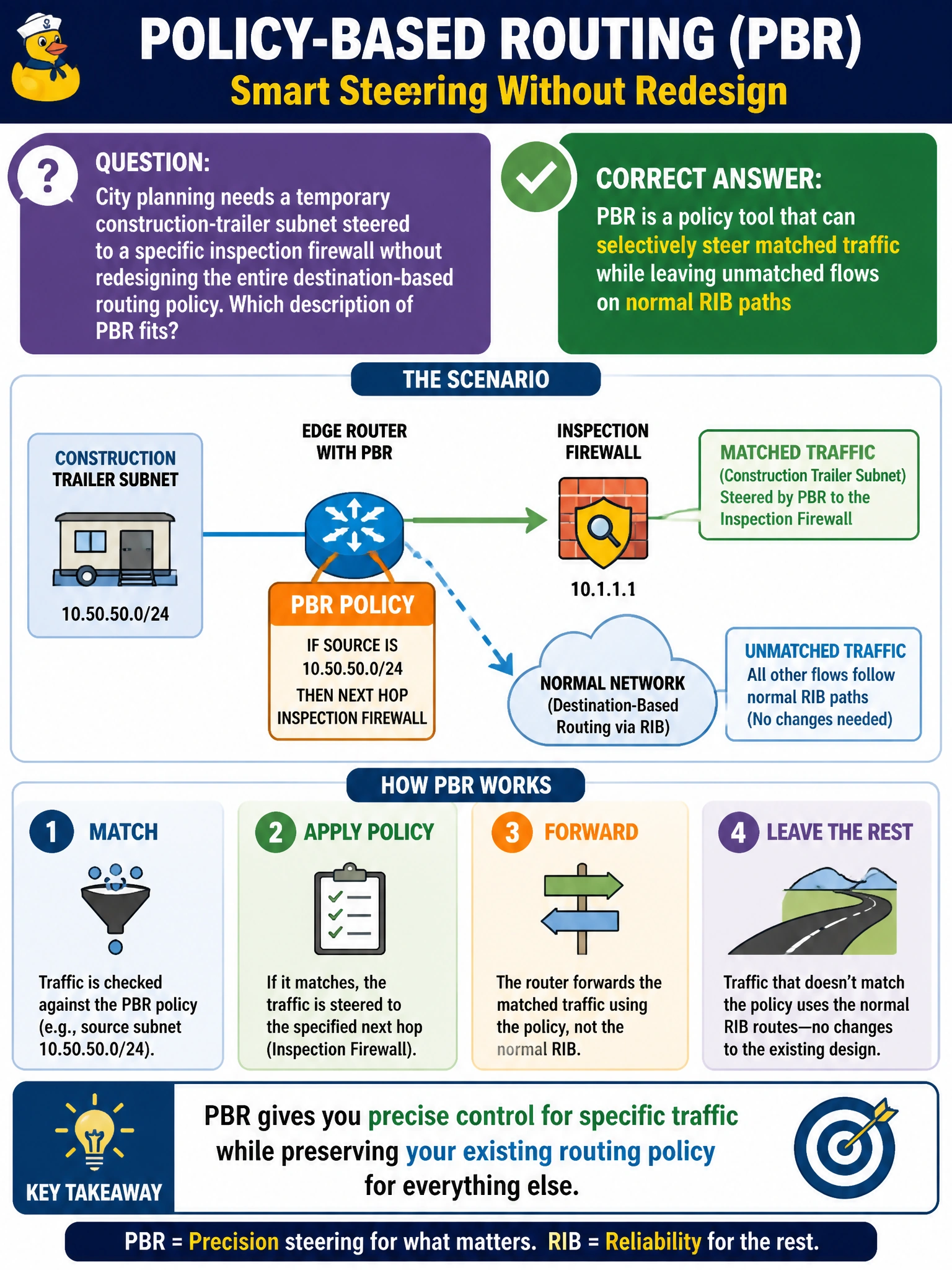
The trailer is a short-term detour cone — PBR points just that subnet at the inspection firewall and leaves everyone else on the normal map. It isn't a wholesale replacement for OSPF/BGP or an STP toy on laptops.
Full Explanation
City planning's temporary construction-trailer subnet should be steered to an inspection firewall without redesigning all destination-based routing. PBR fits as a policy tool that selectively steers matched traffic while leaving unmatched flows on normal RIB paths—ideal for a short-term trailer exception. Matched trailer packets take the firewall next hop; the rest of city planning traffic continues to follow OSPF/BGP destinations.
Saying PBR permanently replaces BGP and OSPF for all city prefixes overstates PBR; it is an exception mechanism, not a wholesale IGP/EGP replacement. Claiming PBR only changes Spanning Tree port roles confuses PBR with STP and is conceptually wrong. Requiring PBR exclusively on end-user laptops places policy in the wrong place—enterprise PBR is applied on routers/L3 switches in the forwarding path.
Exam caveat: temporary policies still need correct ACLs, reachable next hops, and a removal plan when the trailer leaves. Unmatched traffic fall-through to the RIB is expected and desirable here. ENCOR describes PBR as selective steering beside destination routing, not as STP or PC-only configuration.
Operational check: match only the trailer subnet in the PBR ACL, set the inspection firewall next hop on the planning distribution router, and verify trailer flows hit the firewall while other departments do not. When the trailer is decommissioned, remove the PBR clause and confirm reversion to pure RIB forwarding. Log hit counts during the project so auditors see inspection steering was actually applied.