
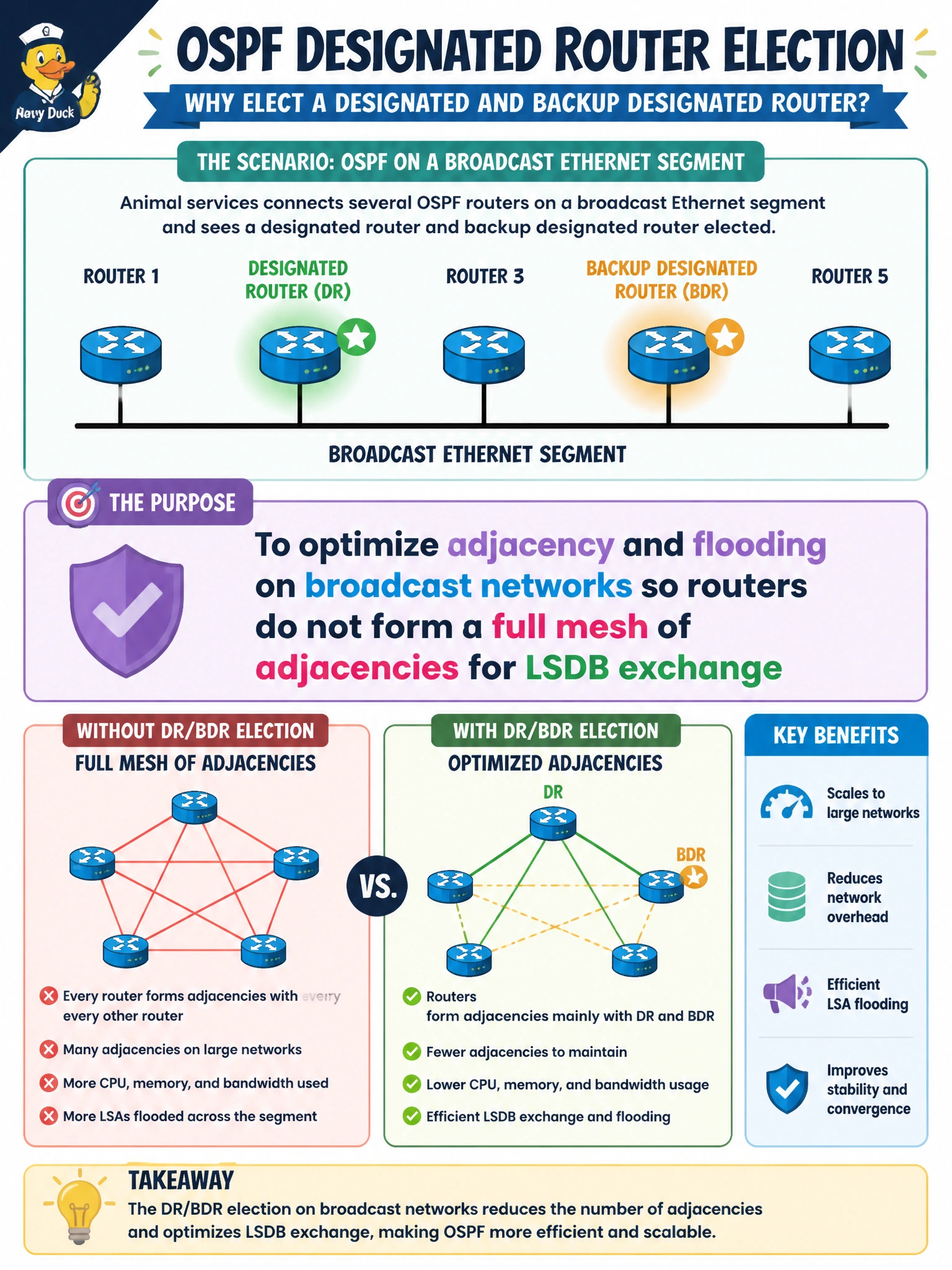
Animal services connects several OSPF routers on a broadcast Ethernet segment and sees a designated router and backup designated router elected. What is the purpose of that election?
Select an answer to reveal the explanation.
Short Explanation
On a busy Ethernet meeting table, DR/BDR are the note-taker and understudy so everyone doesn't pairwise swap full notebooks. That keeps broadcast-segment OSPF adjacencies and flooding efficient. They're not STP roots or AP-only switches.
Full Explanation
On the animal-services broadcast Ethernet segment with multiple OSPF routers, DR and BDR election optimizes adjacency and flooding so routers do not form a full mesh of adjacencies solely for LSDB exchange. DROTHERs adjacent primarily with the DR/BDR; the DR originates network LSAs and plays the central role in reliable flooding on that multi-access segment. The BDR stands ready if the DR fails, limiting adjacency scale compared with n*(n-1)/2 full meshes.
Replacing all IP addressing with MAC-only forwarding is not the purpose of DR/BDR election and would break IP OSPF. Electing the Spanning Tree root using OSPF hellos confuses STP root election with OSPF DR election—different protocols and PDUs. Disabling OSPF on every router except wireless APs contradicts the segment's OSPF design and is unrelated to DR/BDR purpose.
Exam caveat: DR/BDR election matters on broadcast/multi-access network types; point-to-point network types skip DR/BDR. Priority and router-ID influence who wins; priority 0 prevents DR/BDR candidacy. ENCOR expects the adjacency-optimization rationale, not STP root myths.
Operational check: show ip ospf neighbor on the animal-services LAN and identify DR/BDR/DROTHER roles; confirm DROTHERs show FULL to DR/BDR as expected. If adjacency scale is unnecessary on a two-router Ethernet, consider point-to-point network type instead. Set DR priority intentionally on stable civic routers rather than leaving election to accidental highest RID on a flaky workstation-turned-router.