
A community college edge uses eBGP to two providers and wants outbound traffic to prefer one ISP using a well-known BGP best-path attribute. Which attribute awareness matches ENCOR depth for that goal?
Select an answer to reveal the explanation.
Short Explanation
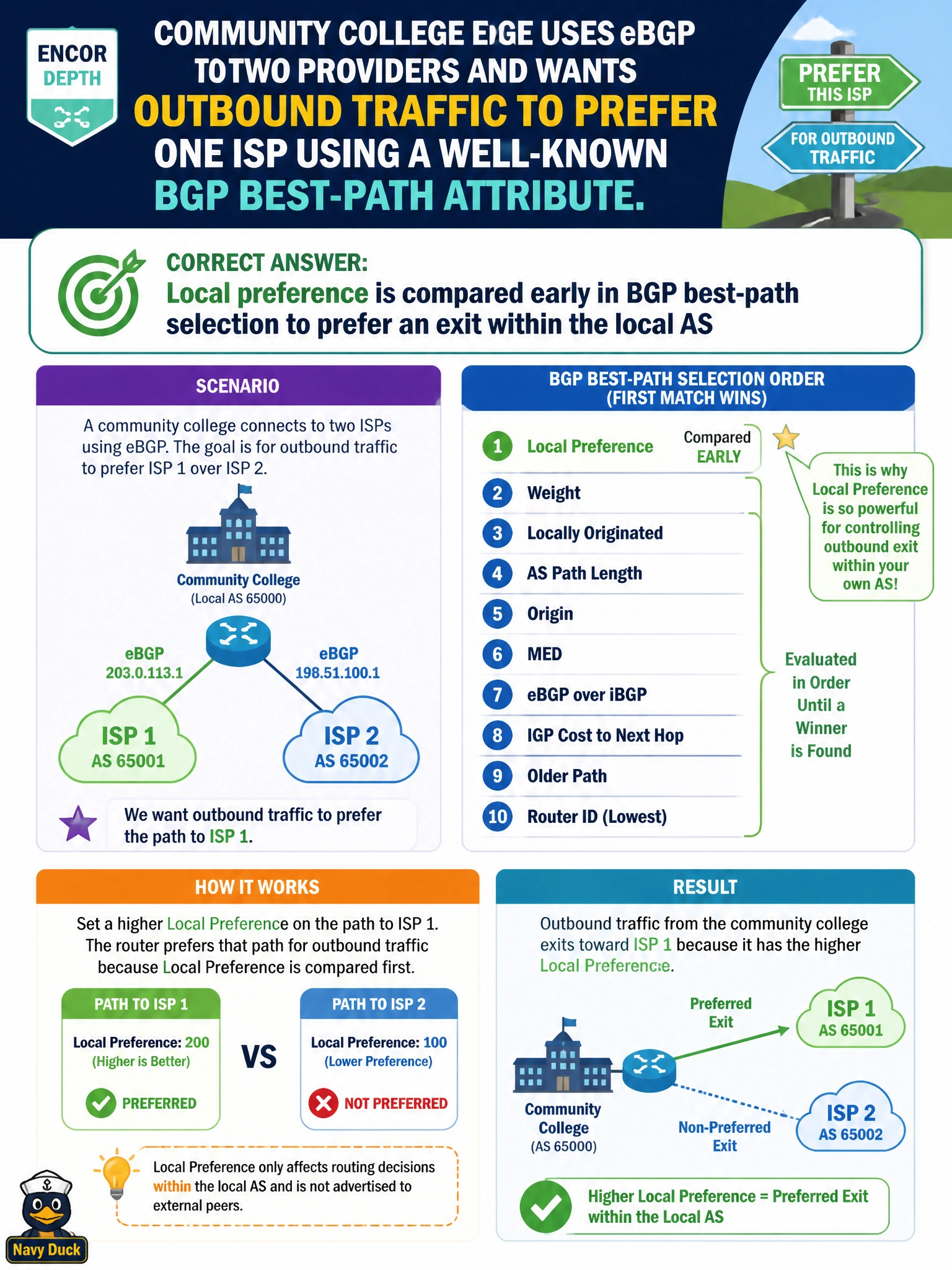
Local preference is the college's internal sticky note saying "prefer this exit" before other BGP debates get loud. It influences outbound path choice inside the AS. VLAN IDs, OSPF area numbers, and CAM aging aren't BGP best-path attributes.
Full Explanation
At the community college edge with eBGP to two providers, outbound traffic preference for one ISP is commonly driven by local preference, which is compared early in BGP best-path selection to prefer an exit within the local AS. Raising local preference on paths learned from (or advertised internally for) the preferred ISP makes that exit win for outbound civic traffic without relying on Layer-2 or IGP myths. That attribute awareness matches ENCOR depth for enterprise exit selection.
Using native VLAN ID on trunks as the first BGP best-path tiebreaker confuses 802.1Q trunk semantics with BGP attribute order. Claiming OSPF area ID always overrides every BGP attribute for Internet exits is false—OSPF areas do not trump BGP best-path for eBGP-learned Internet routes. CAM aging timers affect MAC table longevity, not which ISP path BGP installs.
Exam caveat: local preference is local-AS scoped (not sent to eBGP peers as a transitive Internet signal the way AS-path manipulations or communities might be used externally). Weight is Cisco-local and even earlier, but local preference is the classic multi-router AS exit tool. Know that early attributes dominate later ones such as MED or router-ID tie-breakers.
Operational check: set local preference favoring ISP-A on college border routers, confirm BGP best path and outbound traceroutes prefer ISP-A, then review BGP table reason codes/attributes. Ensure iBGP advertises the preferred path consistently across edges so students and campus servers share the same exit policy. Document the intended local-preference values so weekend ISP maintenance does not surprise the help desk.