
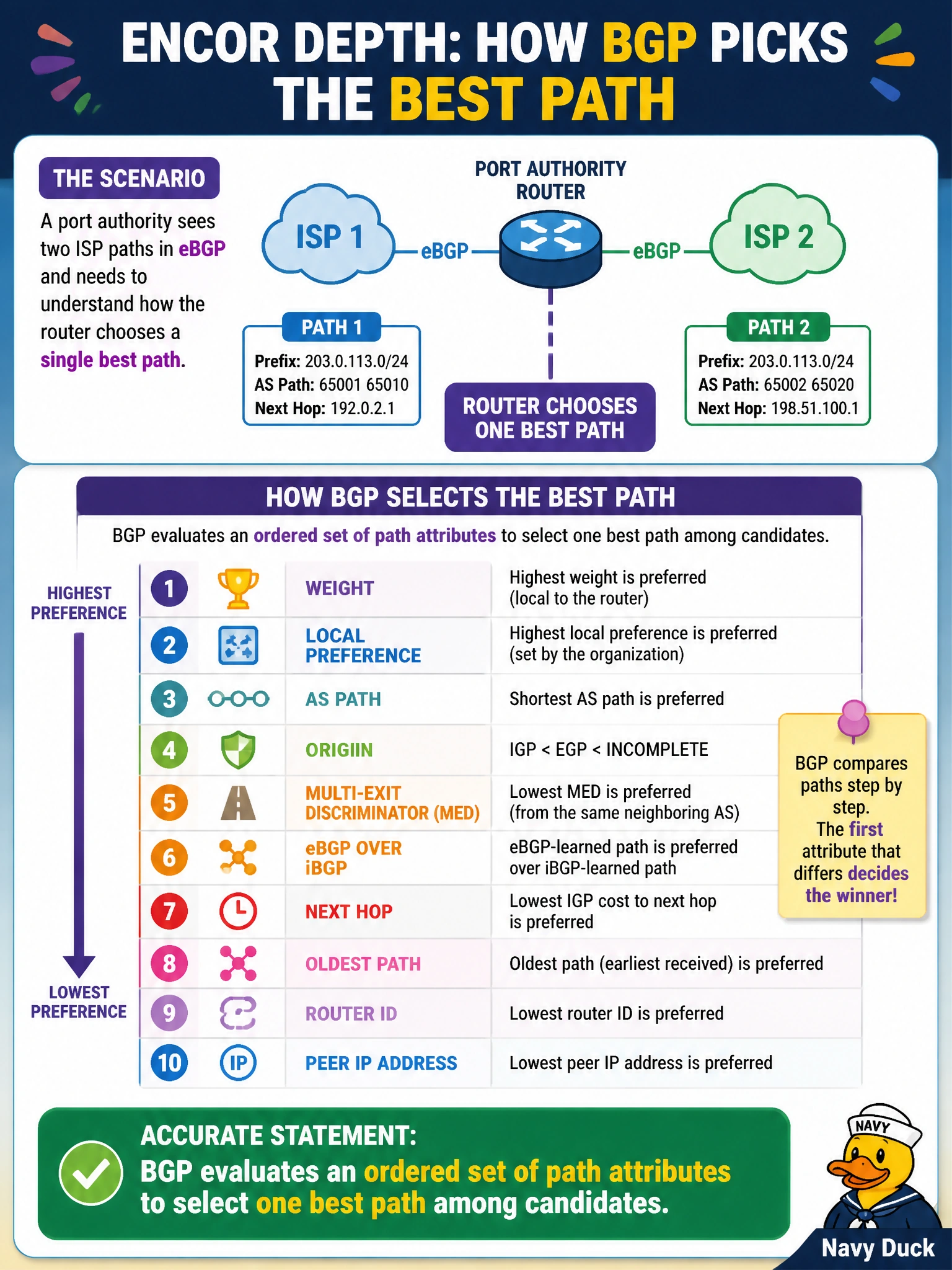
A port authority sees two ISP paths in eBGP and needs to understand how the router chooses a single best path at ENCOR depth. Which statement is accurate?
Select an answer to reveal the explanation.
Short Explanation
BGP path picking is like a harbor master checking a checklist — weight, draft, then berth — in order until one ship wins. Attributes are compared in sequence to pick the best path. OSPF cost, CAM, and STP don't replace that BGP decision process.
Full Explanation
When the port authority learns two ISP paths via eBGP, the router selects a single best path by evaluating an ordered set of BGP path attributes among candidate routes. ENCOR-level understanding is that BGP does not collapse to a single IGP cost; it walks a deterministic attribute sequence (for example weight/local preference, AS-path length, origin, MED where applicable, eBGP vs iBGP, IGP metric to next hop, and further tie-breakers) until one path wins and is installed in the RIB for that prefix. That ordered comparison is how one ISP exit is chosen over the other for a given destination.
Claiming BGP ignores attributes and always prefers the highest OSPF cost path fails conceptually: OSPF cost is not the BGP best-path algorithm, even if IGP metric to the BGP next hop appears late as a tie-breaker. The switch CAM table decides Layer-2 MAC forwarding inside a VLAN; it does not run BGP best-path selection for ISP routes. Spanning Tree root priority influences L2 topology, not eBGP path selection among ISP advertisements.
Exam caveat: know that best-path is ordered and that early attributes (such as local preference for outbound exit preference inside the AS) often matter more in enterprise edge design than obscure late tie-breakers. Do not mix STP, CAM, or raw OSPF cost into the primary BGP decision story. Also note multiple paths may exist in the BGP table while only the best (unless multipath configured) is typically used for forwarding.
Operational check: on the port-authority edge, show both ISP candidates in the BGP table, identify which attribute step caused the winner, and confirm the RIB/FIB install matches that best path. Change a controlled attribute (for example local preference) in a maintenance window and verify outbound traffic shifts as expected. Document the intended exit preference so civic Internet policy stays intentional rather than accidental from AS-path length alone.