
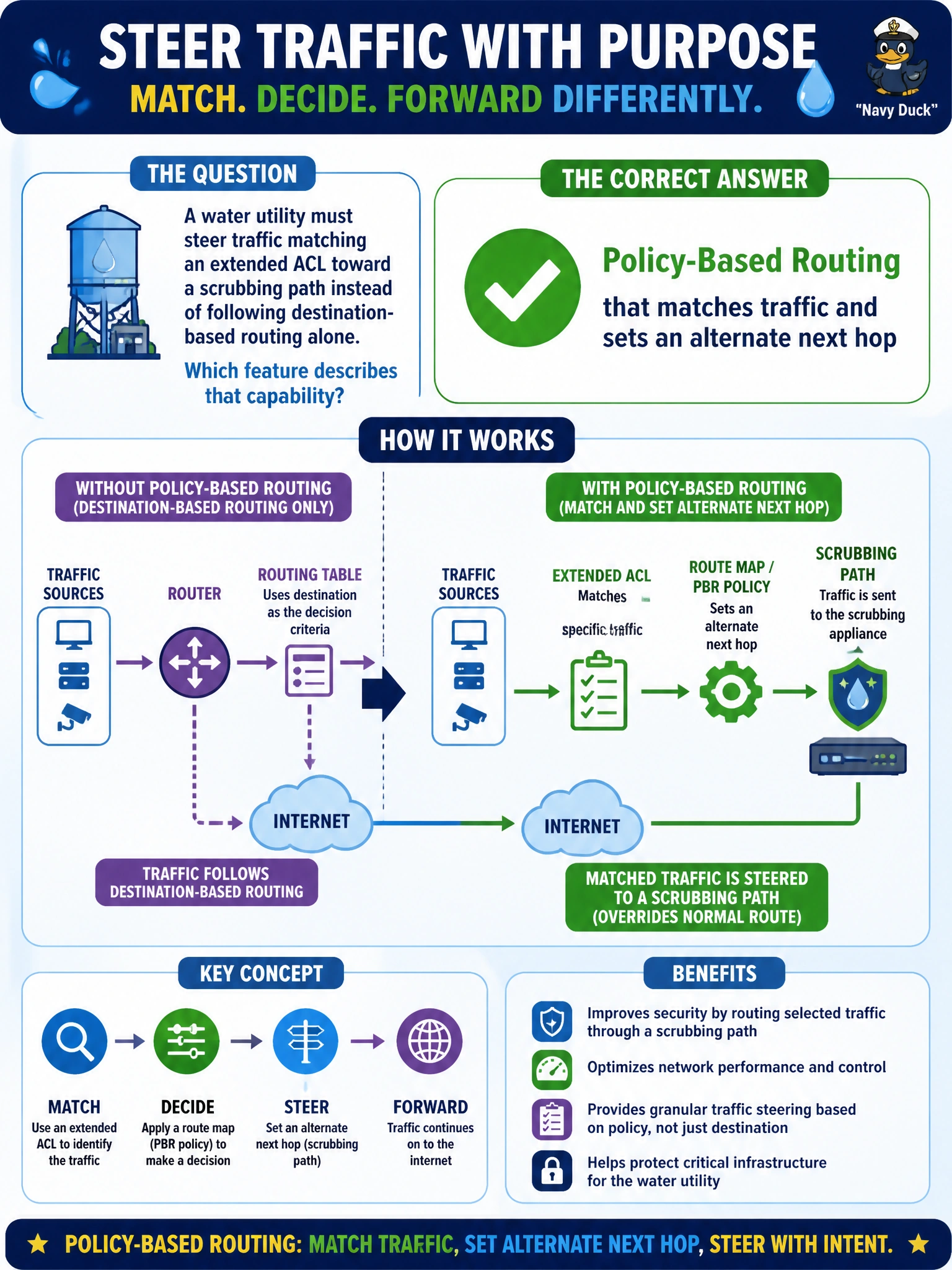
A water utility must steer traffic matching an extended ACL toward a scrubbing path instead of following destination-based routing alone. Which feature describes that capability?
Select an answer to reveal the explanation.
Short Explanation
Destination routing is the GPS that always follows the map; PBR is the utility truck that gets special directions based on what's in the load. Match with an ACL, set a next hop, and you steer off the pure destination path. Root Guard and EtherChannel hashing aren't that tool.
Full Explanation
The water utility needs traffic that matches an extended ACL steered toward a scrubbing path instead of following pure destination-based routing. Policy-Based Routing (PBR) provides that capability: a route-map matches interesting traffic (commonly via ACL) and sets an alternate next hop or interface so matched packets take the scrubbing path while other flows continue to use the normal RIB. That is selective steering based on policy, not a wholesale replacement of OSPF/BGP for every prefix.
Root Guard on distribution uplinks protects STP root placement; it does not match ACLs or redirect packets to a scrubbing next hop. OSPF stub area flags on printer VLANs change inter-area LSA admission in OSPF areas; they do not implement per-flow alternate next hops for scrubbing. EtherChannel load-balance hashing spreads flows across member links of a bundle; a single TCP flow still hashes to one member and hashing is not ACL-driven scrubbing redirection.
Exam caveat: PBR is evaluated for matched traffic (often on ingress) and unmatched traffic falls through to destination-based routing—do not assume PBR black-holes everything else. Verify CEF/PBR support and that the set next hop is reachable; an unreachable PBR next hop can drop or bypass depending on platform options. ENCOR frames PBR as a policy tool alongside normal routing, not as STP or EtherChannel behavior.
Operational check: build the extended ACL for the water-utility interesting traffic, attach it in a PBR route-map set to the scrubbing next hop, apply on the correct ingress interface, and test matched vs unmatched flows. Confirm matched packets arrive at the scrubbing path and unmatched civic traffic still follows the RIB. Monitor for ACL misses or next-hop failures so plant telemetry is not accidentally policy-routed into a dead path.