
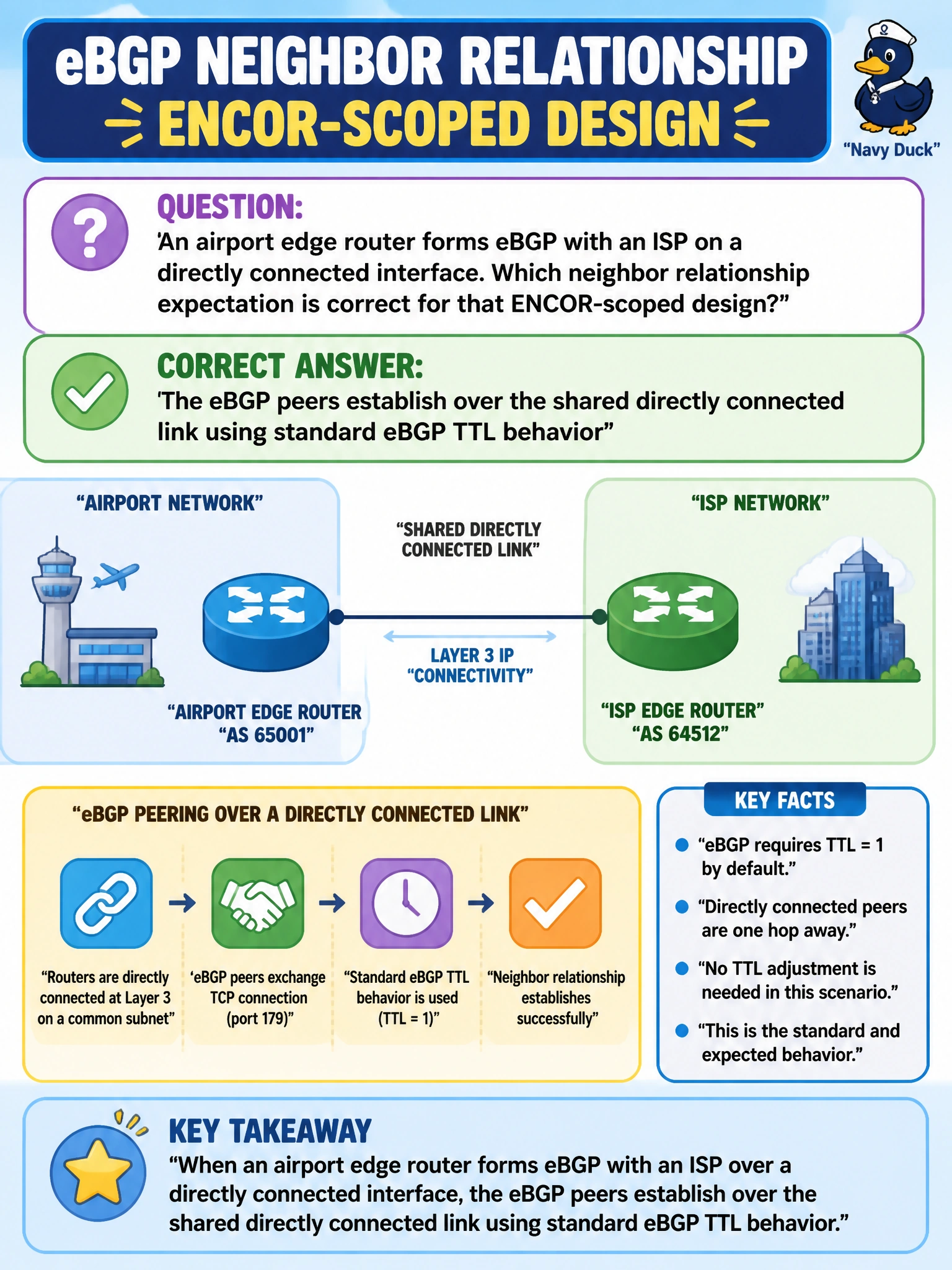
An airport edge router forms eBGP with an ISP on a directly connected interface. Which neighbor relationship expectation is correct for that ENCOR-scoped design?
Select an answer to reveal the explanation.
Short Explanation
Picture two airport desks facing each other across one counter — that's a directly connected eBGP peer. The session rides that shared link with normal eBGP TTL expectations. You don't invent ten-hop detours, kill IP, or wait on MST for BGP.
Full Explanation
At the airport edge, ENCOR-scoped eBGP with an ISP on a directly connected interface expects the peers to establish over that shared link using standard eBGP TTL behavior for adjacent neighbors. The BGP TCP session (port 179) rides the interconnect; each side uses the directly connected next hop, and ordinary eBGP TTL (typically 1) is appropriate because the peer is one IP hop away. No multihop gymnastics are required for this classic enterprise-to-ISP handoff pattern.
Requiring the ISP neighbor to sit ten hops away before any session can open invents a false prerequisite—directly connected eBGP is valid and common. Disabling IP on the interconnect would remove the very addressing BGP needs to form TCP to the peer. Matching MST regions before TCP 179 works confuses Spanning Tree region design with BGP session establishment; MST has no role in eBGP adjacency on a routed interconnect.
Exam caveat: distinguish directly connected eBGP (normal TTL) from eBGP multihop used when peers are not adjacent. Also remember eBGP vs iBGP: the ISP relationship is external, so ASNs differ and eBGP rules apply. ENCOR depth here is neighbor relationship expectation, not full Internet policy or route-reflector design.
Operational check: verify both airport and ISP interfaces share the interconnect subnet, confirm neighbor state reaches Established, and validate TTL/multihop settings match adjacency (no unnecessary ebgp-multihop). Check that the BGP next hop for learned prefixes is reachable via the connected route on that link. If the session flaps, inspect Layer-3 reachability and TCP 179 filters before chasing STP or ten-hop myths.