
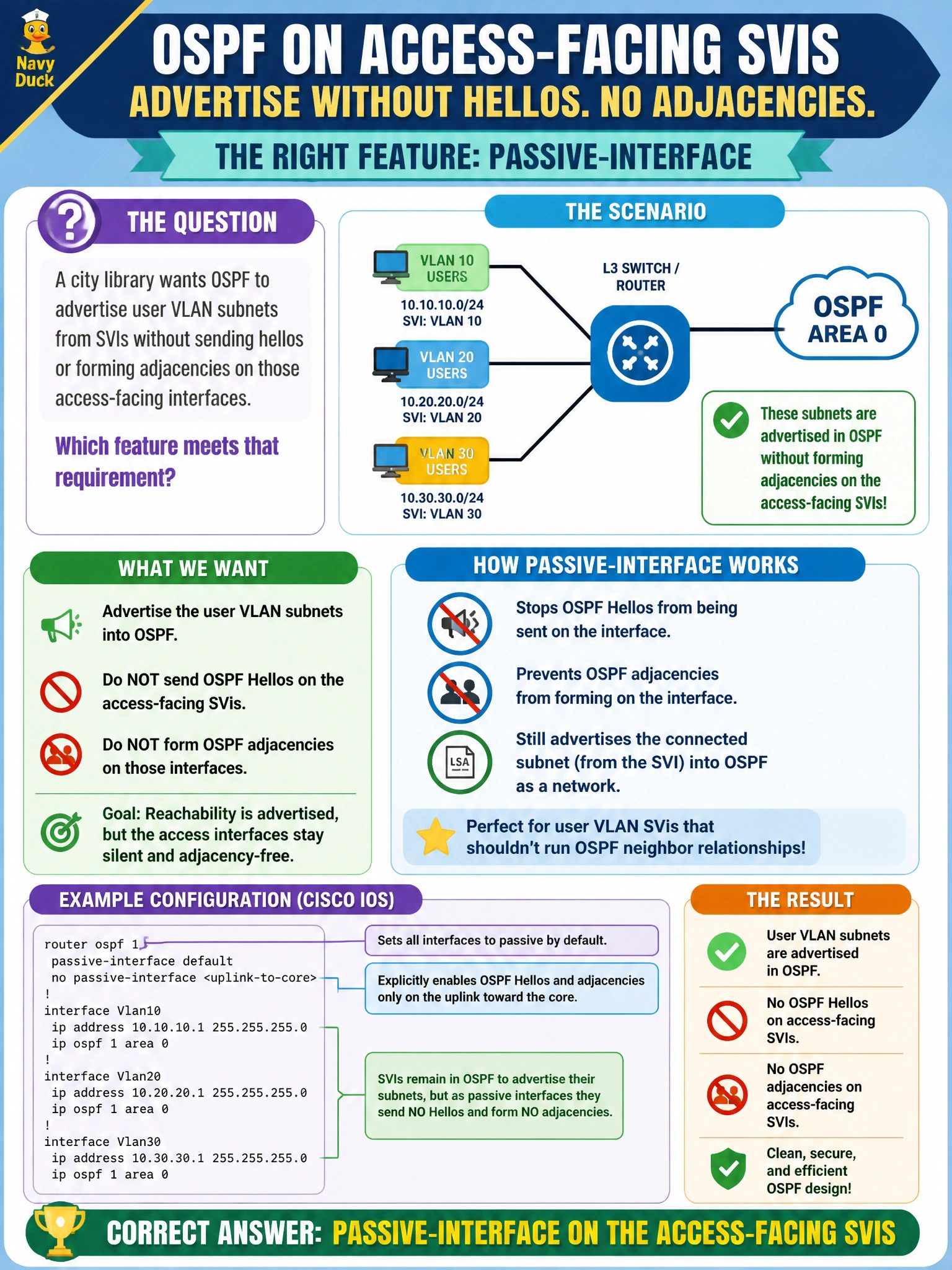
A city library wants OSPF to advertise user VLAN subnets from SVIs without sending hellos or forming adjacencies on those access-facing interfaces. Which feature meets that requirement?
Select an answer to reveal the explanation.
Short Explanation
You can use passive-interface on the access-facing SVIs to advertise their subnets without sending hellos or forming neighbors there. BPDU Guard on the OSPF WAN uplink, NAT overload on printers, and disabling CEF don’t meet that goal.
Full Explanation
Passive-interface on the access-facing SVIs meets the requirement: OSPF suppresses hellos on each interface, preventing neighbor relationships with hosts or accidental routers on the user VLAN, while the connected subnet can still be advertised into the OSPF domain. This is a common campus pattern: advertise the user subnet without forming an adjacency on it. BPDU Guard on the OSPF WAN uplink is an STP edge-protection feature; it does not control OSPF hello behavior on the library SVIs. NAT overload applied to every library printer changes translation for outbound sessions, but neither advertises SVI subnets into OSPF nor stops hellos on access SVIs. Disabling CEF forces process switching and harms forwarding performance; it is unrelated to adjacency suppression or connected-network advertisement. Exam caveat: passive-interface stops adjacency formation on that interface but does not by itself remove the prefix from OSPF; the network must still be included in the OSPF process through a network statement or interface enablement. Do not mistake passive for OSPF being off. Practical check: mark the user SVIs passive, confirm no OSPF neighbors appear on them with show ip ospf interface and show ip ospf neighbor, and verify the user VLAN prefixes remain in the OSPF LSDB or routing table. A test router on a user VLAN should fail to form an adjacency while the campus core can still reach the subnet; keep distribution uplinks non-passive so routers form the required adjacencies.