
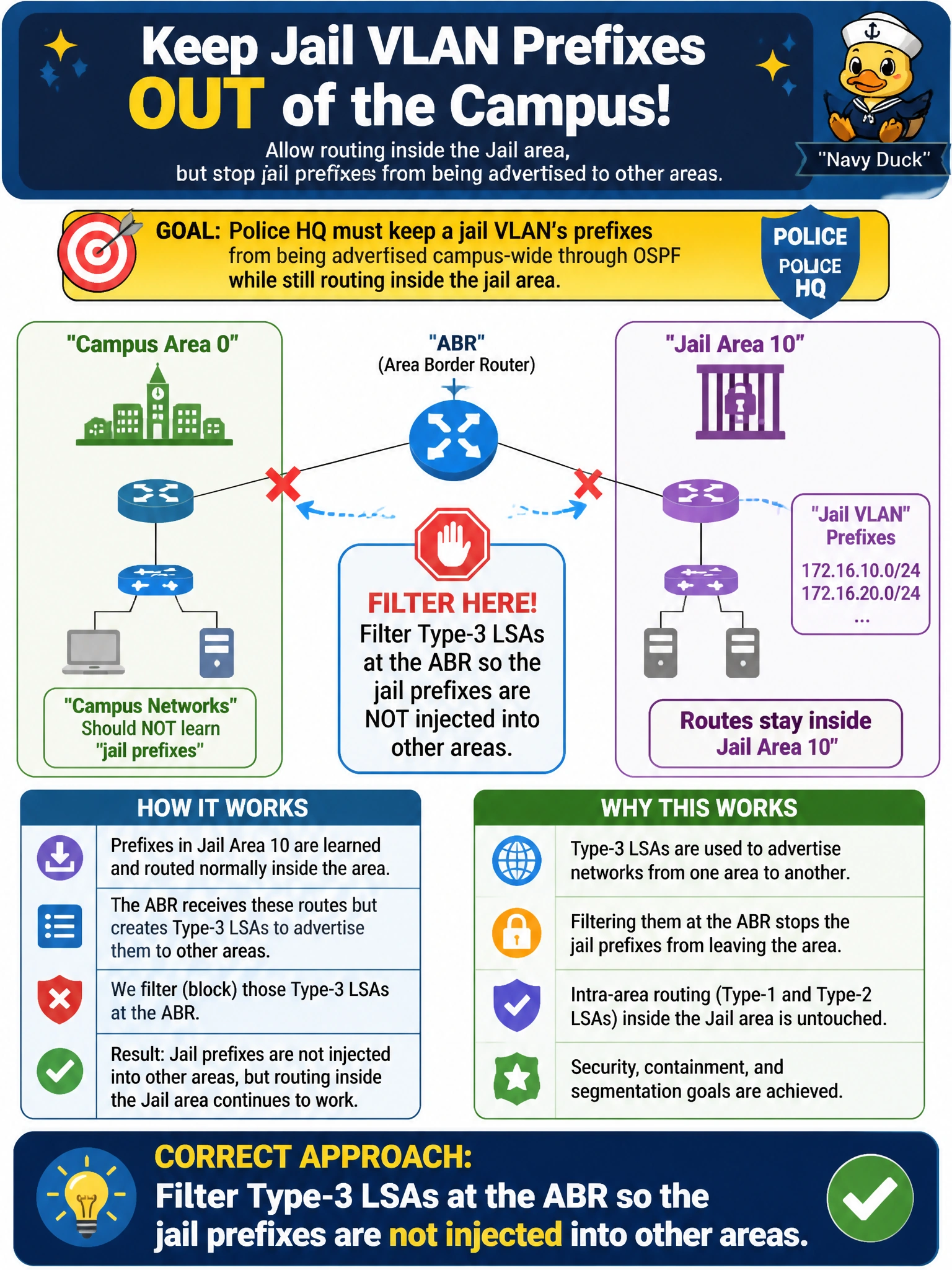
Police HQ must keep a jail VLAN's prefixes from being advertised campus-wide through OSPF while still routing inside the jail area. Which approach matches that inter-area filtering goal?
Select an answer to reveal the explanation.
Short Explanation
Think of the ABR as a records clerk deciding which folders leave the jail area. You keep jail prefixes local by filtering Type-3 LSAs at the ABR, while routing inside the jail area continues; disabling Spanning Tree, changing jail ports to access mode, or relying on static AP defaults does not filter inter-area OSPF advertisements.
Full Explanation
Police HQ needs jail VLAN prefixes to remain routable inside the jail OSPF area without being advertised campus-wide. Filtering Type-3 LSAs at the ABR meets that inter-area goal by preventing selected jail prefixes from being injected into other areas. Intra-area routing within the jail area continues through Type-1 and Type-2 LSAs; the ABR’s inter-area advertisements are constrained, preserving local jail reachability without leaking those prefixes into every civic area’s LSDB. Disabling Spanning Tree on trunks toward the jail closet fails by layer: STP loop control does not govern OSPF prefix advertisement between areas. Converting jail ports to access mode may change Layer-2 edge behavior, but it does not implement inter-area LSA filtering; the ABR can still advertise the jail subnets as Type-3 LSAs. Static default routes on wireless access points are orthogonal: they neither filter Type-3 LSAs nor control ABR advertisements for jail VLAN ranges. Exam caveat: inter-area filtering concerns Type-3 LSAs; do not confuse it with intra-area LSA flooding, which generally cannot be selectively filtered in the same way, or with stub-area defaults and ASBR Type-5 external filtering. Practical check: from a non-jail campus router, confirm the jail prefixes are absent as Type-3 LSAs while jail-area routers retain intra-area routes to them; test local jail routing and verify campus routers cannot resolve those prefixes through OSPF.