
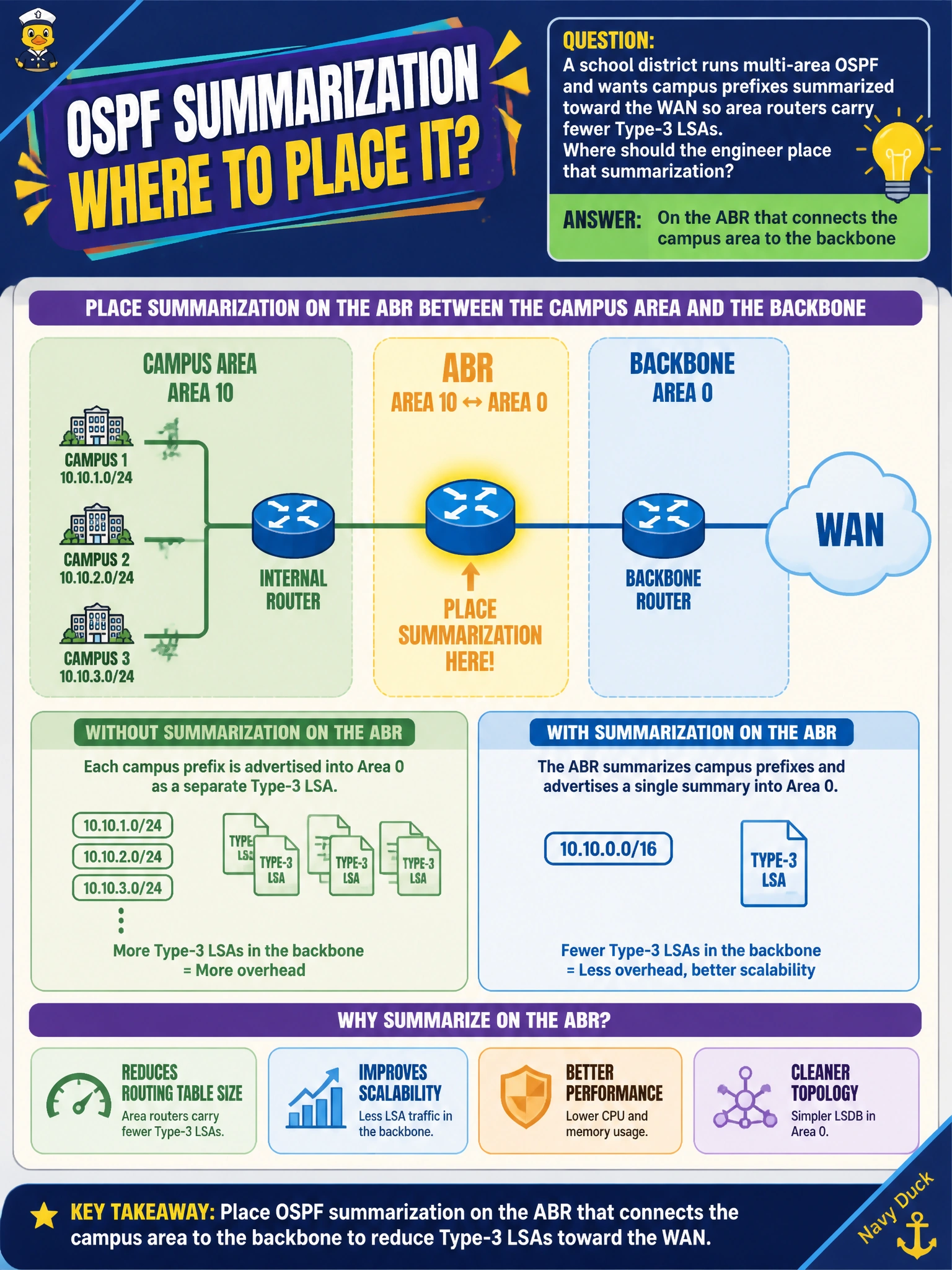
A school district runs multi-area OSPF and wants campus prefixes summarized toward the WAN so area routers carry fewer Type-3 LSAs. Where should the engineer place that summarization?
Select an answer to reveal the explanation.
Short Explanation
Think of the ABR as the district's hallway door between wings — that's where you hang one building-directory sign instead of listing every classroom. Summarizing campus prefixes toward the WAN belongs on the ABR facing area 0. Access switches and PCs aren't where OSPF area summaries get created.
Full Explanation
In the school district's multi-area OSPF design, campus prefixes should be summarized at the ABR that joins the campus area to backbone area 0. ABRs are the only routers that originate Type-3 summary LSAs into other areas, so configuring an area-range (or equivalent summary) on that ABR collapses many campus subnets into fewer advertisements toward the WAN and remote areas. Area-internal routers then carry a leaner Type-3 set instead of every classroom and lab prefix, which is exactly the scaling goal in the stem.
Summarizing on every access-layer switch that only has stub hosts fails by role: those switches typically are not ABRs and often are not even OSPF speakers for inter-area Type-3 generation. They cannot invent backbone-facing summaries the ABR is responsible for. Placing summarization only on end-user PCs fails because PCs are not OSPF area border devices and do not originate Type-3 LSAs for the district topology. A Layer-2 access port that never runs OSPF has no LSDB role at all, so it cannot reduce Type-3 flood scope toward the WAN.
Exam caveat: summarization is configured on the ABR for the area being summarized, and remote routers see the summary rather than every more-specific. Do not confuse ABR Type-3 summarization with ASBR Type-5 external summarization, and remember a poorly chosen summary can black-hole if the ABR loses reachability to covered prefixes while still advertising the aggregate. ENCOR expects you to know where the control plane for inter-area summaries lives—at the ABR—not at access edges or hosts.
Operational check: on the campus ABR, confirm the area range is configured for the campus area, verify the summary appears as a Type-3 toward area 0/WAN, and that interior campus routers no longer need to flood every leaf subnet inter-area. Compare pre/post Type-3 counts on a remote area router and validate that district WAN destinations still resolve through the summary next hop. If a summarized campus link fails, confirm local repair inside the campus area while remote sites correctly retain only the aggregate until the ABR withdraws or replaces advertisements.