
City fleet garage trunks flap with CDP and spanning-tree oddities after one side tags the native VLAN and the other still expects classic untagged native behavior. Which troubleshooting family does this fall into?
Select an answer to reveal the explanation.
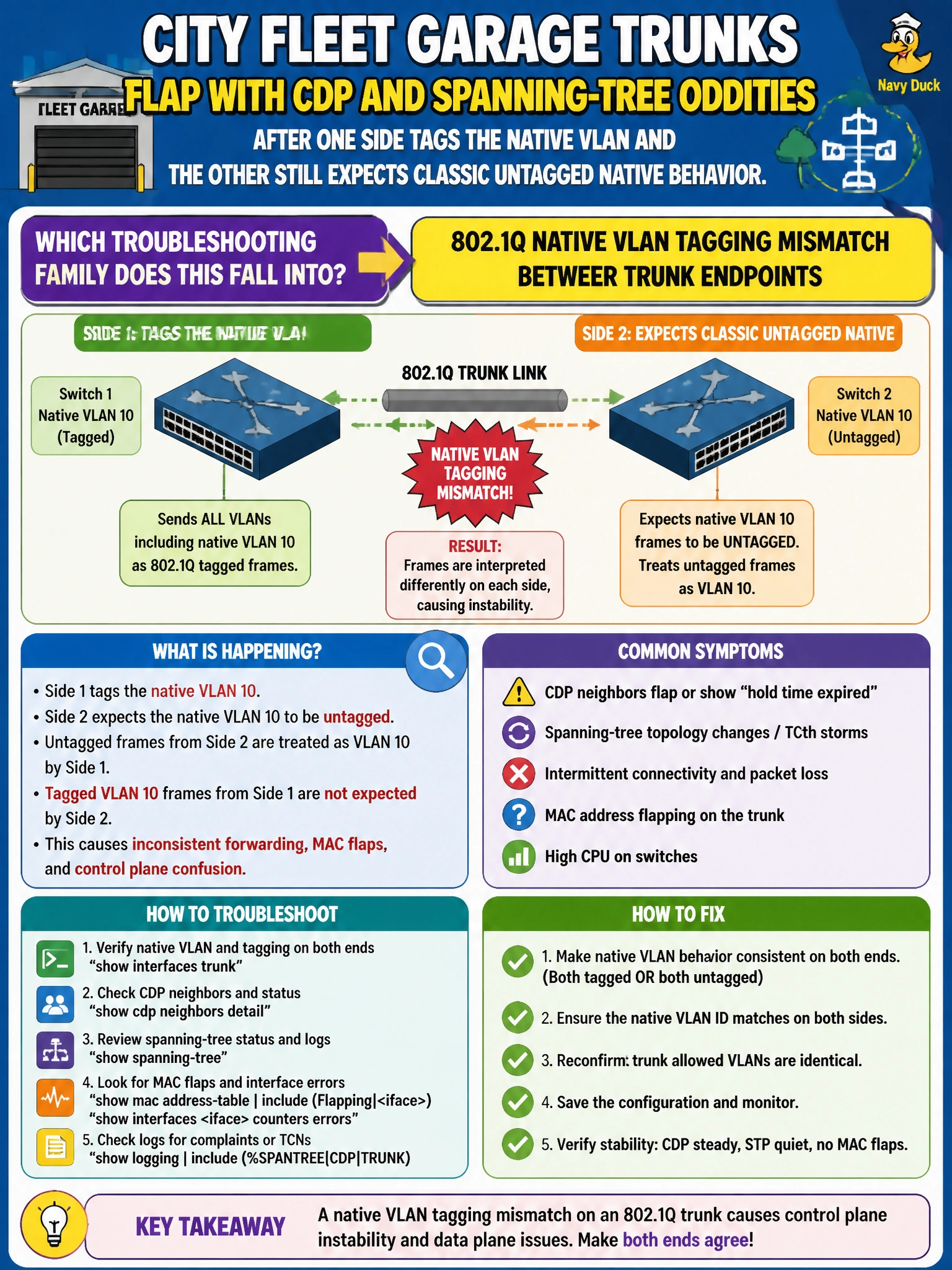
Short Explanation
One side wraps the native VLAN in a tag; the other still expects plainclothes frames. That dress-code fight shows up as flaky CDP and STP—classic trunk tagging mismatch drama.
Full Explanation
When one side of a city fleet garage trunk tags the native VLAN and the other still expects classic untagged native behavior, control protocols and spanning-tree observations become inconsistent. Untagged versus tagged treatment of the same native VLAN is an 802.1Q native VLAN tagging mismatch between trunk endpoints. That Layer-2 tagging disagreement explains CDP and STP oddities with flapping or unreliable control visibility after the change.
OSPF network-type mismatch on a broadcast multi-access segment is a Layer-3 adjacency problem and does not describe native VLAN tagging on a trunk. EIGRP unequal-cost load balancing with variance of 1 is a routing-metric topic unrelated to trunk tagging. HSRP version mismatch that only affects IPv6 RA messages likewise misses the Layer-2 trunk tagging family entirely.
Exam caveat: native VLAN number mismatch and native VLAN tagging mismatch are related but distinct—align both the VLAN ID and whether vlan dot1q tag native (or equivalent) is enabled on both garage peers. CDP remaining partially up can mask how badly tagged data VLANs are affected; dig into trunk counters and native settings explicitly.
Operational check: compare native VLAN IDs and native-tagging configuration on both trunk ends, standardize on the municipal design (prefer a dedicated unused native VLAN and consistent tagging policy), clear flaps, and recheck CDP/STP stability on the fleet garage uplink.