
County WAN engineers compare EIGRP’s composite metric and DUAL behavior with OSPF’s cost-based SPF on civic WAN routers. Which comparison is most accurate at ENCOR depth?
Select an answer to reveal the explanation.
Short Explanation
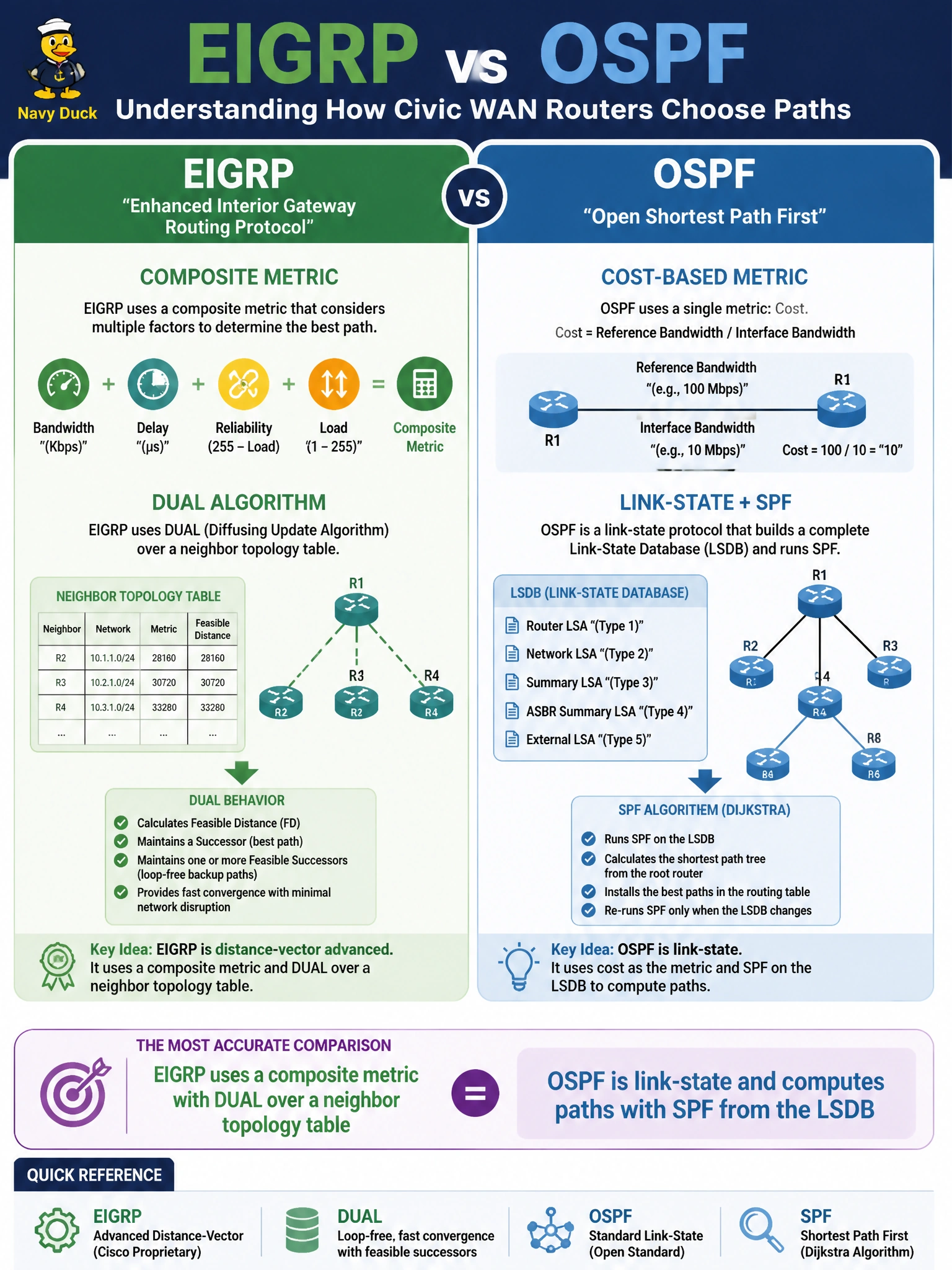
EIGRP is the chatty road-trip planner with a blended scorecard (bandwidth, delay, and friends) and DUAL keeping loop-free backups. OSPF is the map-room crew building a full link-state picture and running SPF. Different brains, both get you across the county WAN.
Full Explanation
At ENCOR depth, EIGRP and OSPF differ in how they compute and maintain paths on civic WAN routers. EIGRP is an advanced distance-vector protocol: it forms neighbors, builds a topology table of learned destinations, and uses DUAL with a composite metric (classically bandwidth and delay, optionally load and reliability) to select successors and feasible successors. OSPF is link-state: routers flood LSAs into a link-state database and run SPF to compute a shortest-path tree from interface costs. That contrast—composite metric plus DUAL versus LSDB plus SPF—is the accurate comparison.
Both protocols exclusively using hop count and never computing a topology database is wrong: neither is hop-count-only RIP, and both maintain rich databases (EIGRP topology table; OSPF LSDB). Claiming OSPF is distance-vector only while EIGRP is pure link-state with a full SPF tree and no neighbors reverses the models and invents “no neighbors” for EIGRP. Saying neither protocol supports multi-access Ethernet segments is false; both routinely run on Ethernet with appropriate network-type or neighbor behavior.
Exam caveat: EIGRP’s “advanced distance vector” label and OSPF’s link-state label matter on the exam; do not swap them. Also remember OSPF cost is typically derived from bandwidth, while EIGRP’s composite metric blends multiple K-values—do not treat their numeric metrics as interchangeable.
Operational check: on paired civic WAN routers, show EIGRP topology and successors versus OSPF LSDB and SPF routes for the same prefixes, verify neighbor types, and document which protocol’s multipath and metric rules apply on each circuit before changing path-selection knobs.