
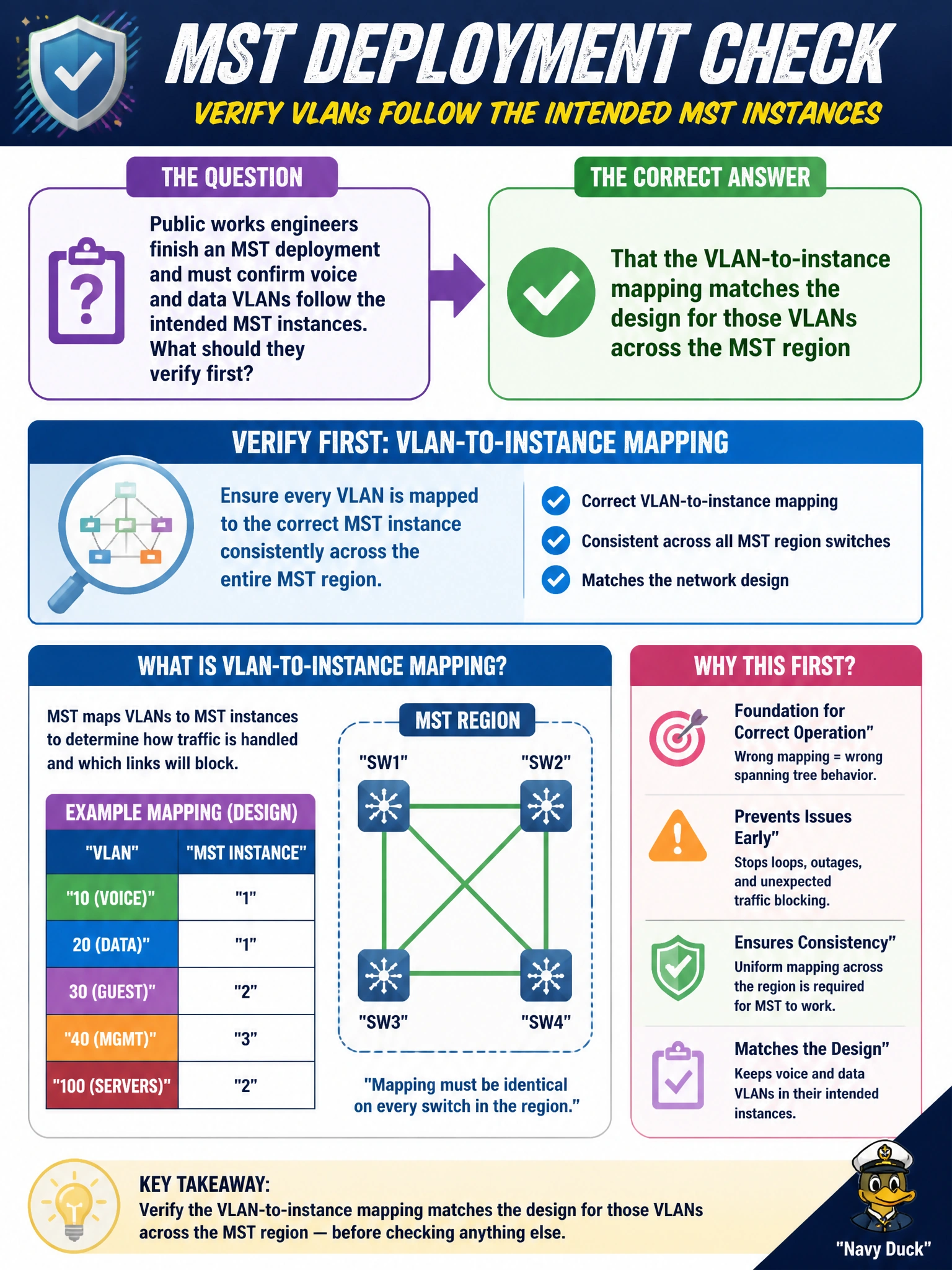
Public works engineers finish an MST deployment and must confirm voice and data VLANs follow the intended MST instances. What should they verify first?
Select an answer to reveal the explanation.
Short Explanation
MST only helps if VLANs sit in the instance seats you planned. Check the seating chart—voice and data mapping—before you chase random forwarding mysteries.
Full Explanation
MST only delivers the intended forwarding topology when VLANs sit in the instances the design assigned. After public works finishes an MST deployment, the first verification for voice and data is that the VLAN-to-instance mapping matches the plan across every switch in the MST region. If voice lands in a different instance than designed, or data drifts after a template push, traffic can follow an unexpected spanning-tree topology even though trunks are up and MST appears “enabled.”
Assigning every VLAN a unique OSPF area ID equal to the VLAN number does not validate MST mapping; OSPF areas are Layer-3 constructs. Confirming BPDU Guard only on distribution uplinks is usually the wrong place for BPDU Guard and does not prove VLAN-to-instance assignments. Setting EtherChannel mode ON on every access port facing printers is unrelated endpoint aggregation and does not verify MST instance membership for voice and data.
Exam caveat: matching region name and revision without matching the VLAN-to-instance map is still a failed region digest. Verify the map on all public-works switches, not only the seed switch. Instance 0/CIST behavior at region boundaries can surprise operators if some closets accidentally fall outside the region.
Operational check: display MST configuration on each switch, diff VLAN-to-instance lines for voice and data against the design spreadsheet, correct mismatches, and only then validate call and data path failover under the intended instances.