
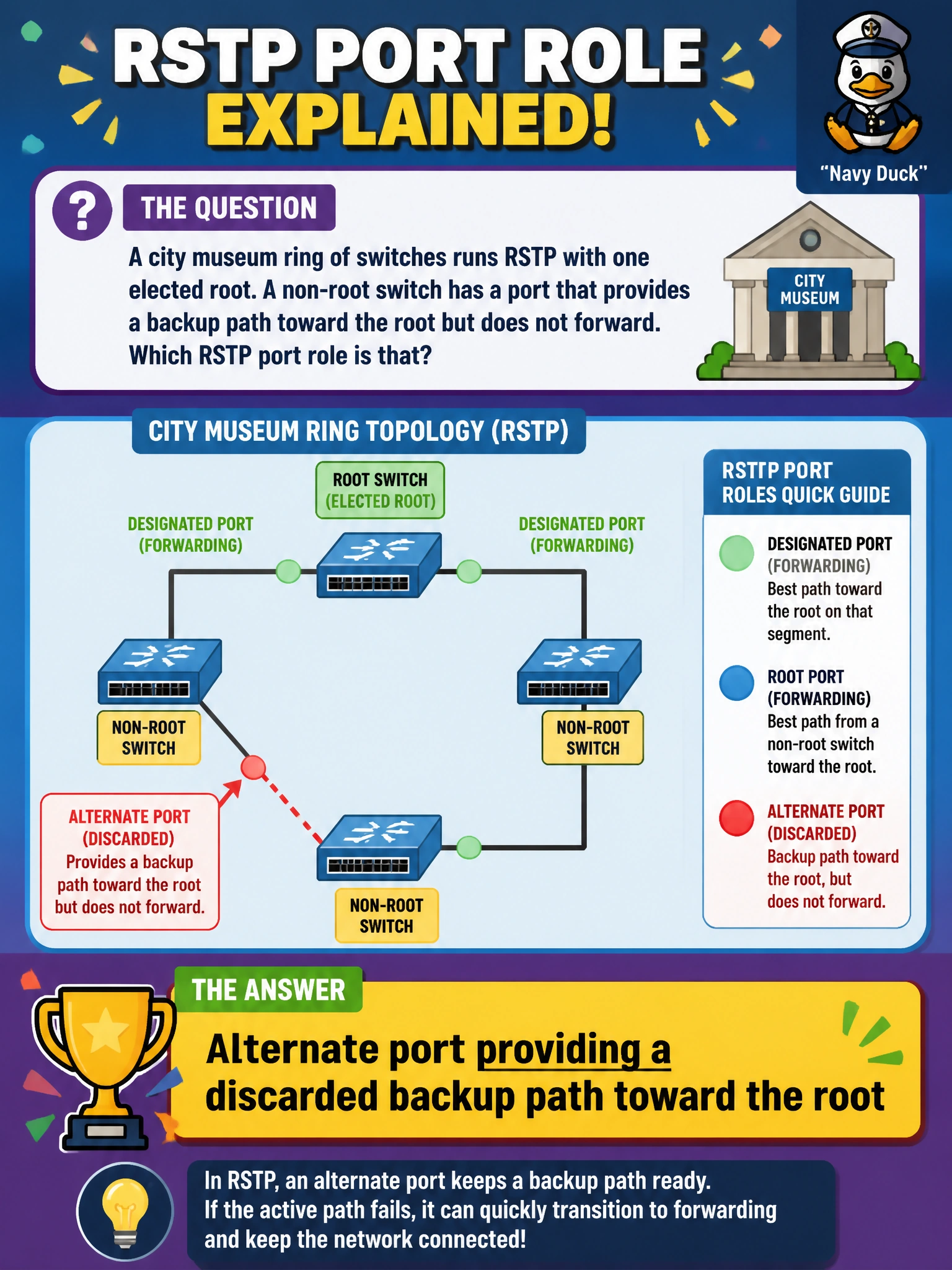
A city museum ring of switches runs RSTP with one elected root. A non-root switch has a port that provides a backup path toward the root but does not forward. Which RSTP port role is that?
Select an answer to reveal the explanation.
Short Explanation
Your alternate port is the spare route toward the root: it stays discarding while the root port works, then can take over if that path fails. Think of it as a spare key under the mat—ready, but not forwarding yet.
Full Explanation
In RSTP, each non-root switch selects one root port—the best path toward the elected root—and may have alternate ports that provide backup paths toward the root without forwarding. An alternate port remains in the discarding state while the root port is healthy and can take over quickly if that port fails. Thus, a non-root switch port that provides a backup path toward the root but does not forward is an alternate port. A designated port toward a downstream LAN forwards and advertises the best BPDU onto that segment; it is not the discarded backup path toward the root. The claim that every alternate path is a root port is incorrect: a switch has only one root port per spanning-tree instance, while a backup path is an alternate port. An edge port designated for end devices faces hosts and is already forwarding, rather than providing a redundant switch path toward the root. Exam caveat: RSTP’s backup role is distinct from the alternate role and applies when two links connect to the same shared segment collision domain; modern point-to-point campus links generally use the alternate role. RSTP can rapidly transition an alternate port to a root port, unlike classic STP. Practical check: on the non-root switch, use show spanning-tree to identify the root and alternate ports; during a maintenance window, fail the root-port link, confirm the alternate becomes the root port and forwards, then restore the link and verify the roles again.