
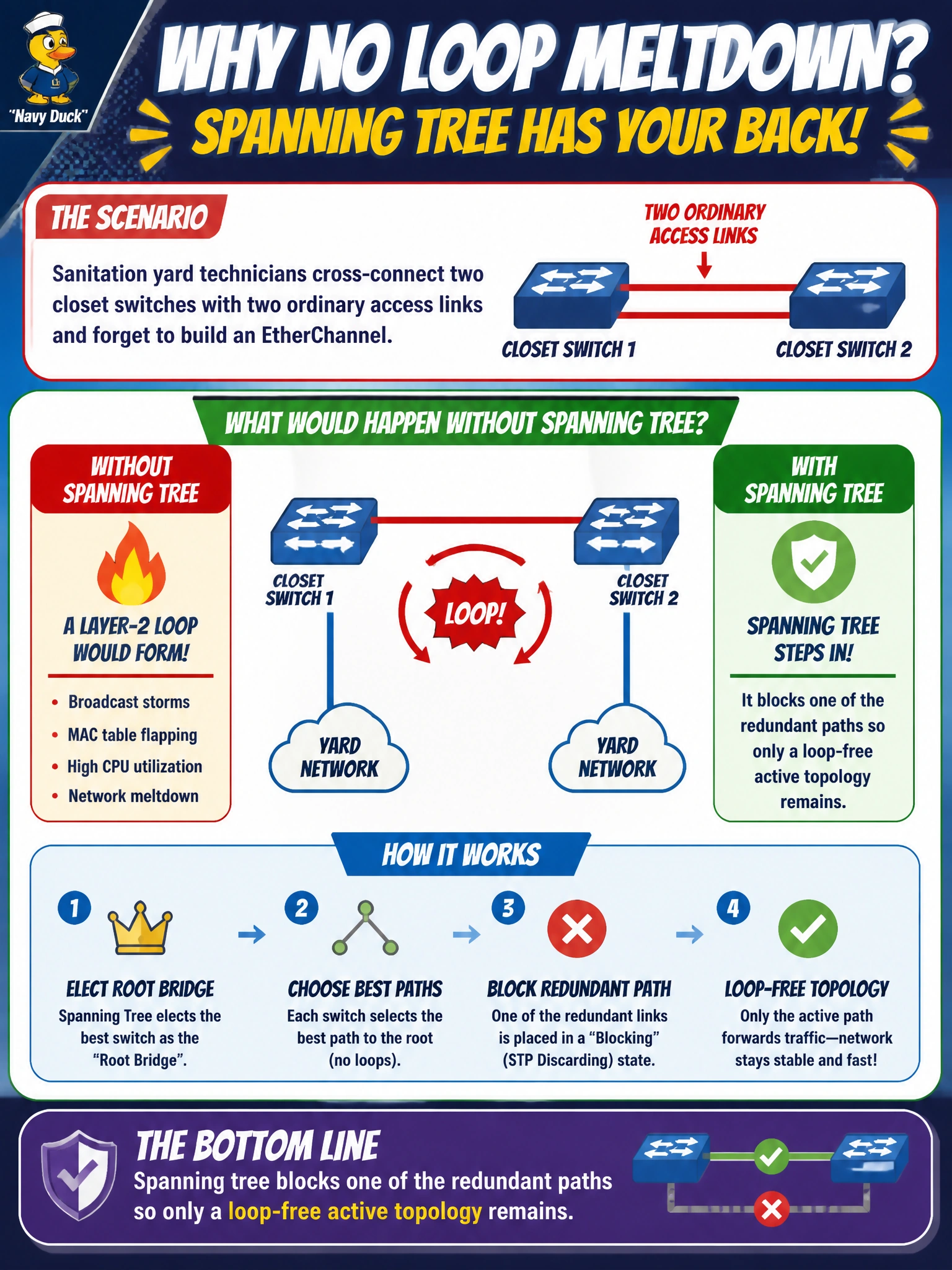
Sanitation yard technicians cross-connect two closet switches with two ordinary access links and forget to build an EtherChannel. What prevents a Layer-2 loop from melting the yard network?
Select an answer to reveal the explanation.
Short Explanation
Two plain cables between switches without a Port-Channel are a loop waiting to happen. Spanning tree is the adult in the room that puts one link in timeout so broadcasts do not spin forever.
Full Explanation
Two ordinary access links between sanitation yard closet switches create parallel Layer-2 paths in the same VLAN(s). Without an EtherChannel to collapse them into one logical link, spanning tree must block at least one path so frames do not loop endlessly. That blocked or discarding port is intentional loop prevention and is what keeps the yard network from melting when technicians cross-connect switches and forget to build a channel.
CEF adjacency tables automatically converting the links into routed ports is false—CEF is a Layer-3 forwarding optimization and does not reinterpret switched access links as routed interfaces because a loop appears. HSRP preempt blocking one physical cable at Layer 1 confuses first-hop gateway redundancy with physical/L2 loop control; HSRP does not shut a copper cross-connect at Layer 1. VRF-lite isolating each cable into its own routing table by default does not apply; VRF-lite is a Layer-3 virtualization feature and is not enabled merely because two access cables exist.
Exam caveat: if STP is disabled or filtered, the same cross-connect will loop. Building a proper EtherChannel would allow both cables to forward as one STP edge; leaving them independent means one stays blocked. Also ensure the links are not accidentally in different VLANs or trunking unexpectedly via DTP.
Operational check: locate the STP blocking port on the cross-connect, either remove the redundant cable or convert both links into a matched EtherChannel, then verify only the intended loop-free topology remains and yard VLANs stay stable.