
A 911 PSAP wants host-facing ports to come up quickly for workstations yet still shut down if a BPDU appears. Which combination best expresses that intent?
Select an answer to reveal the explanation.
Short Explanation
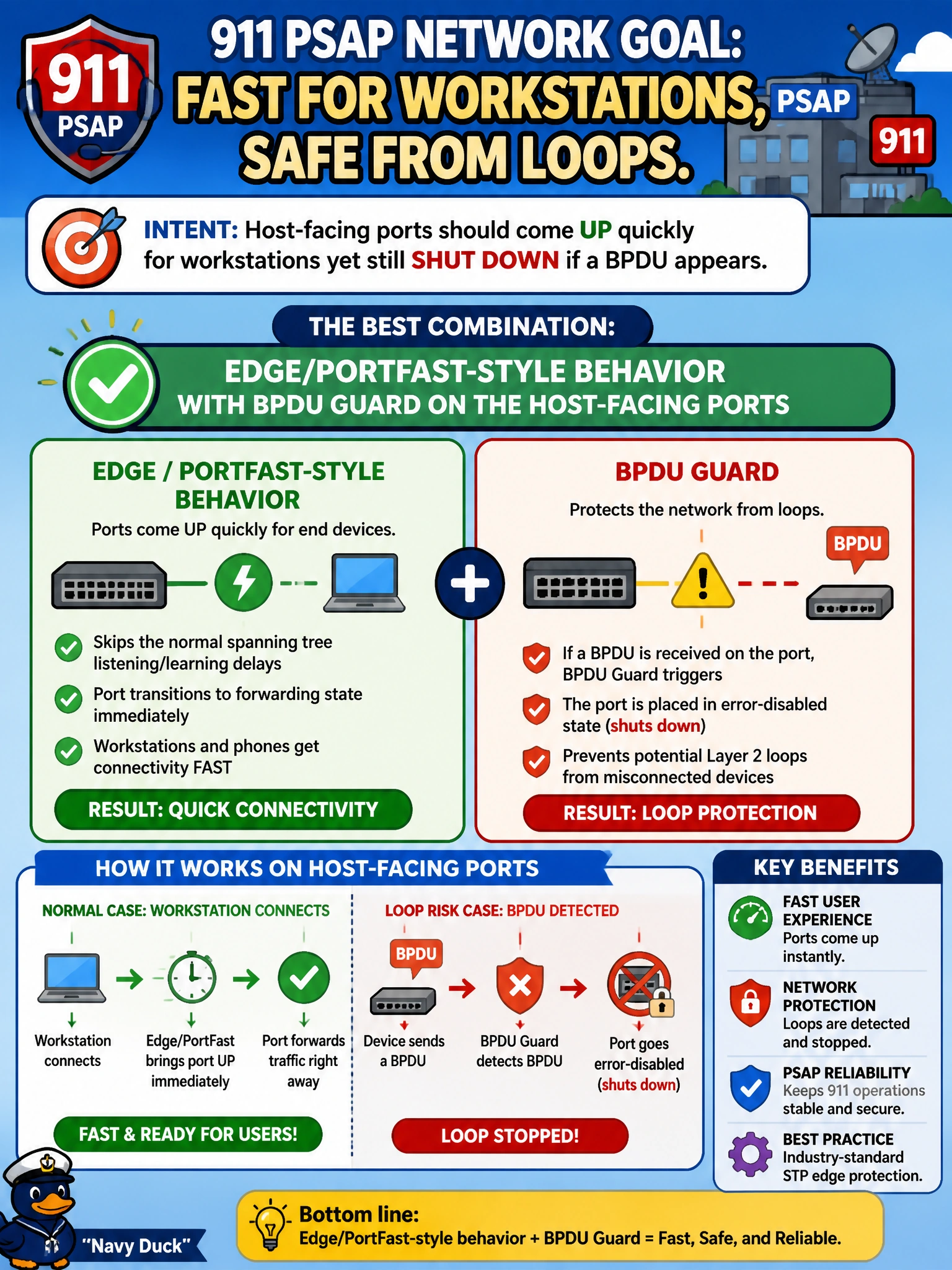
Edge/PortFast is the express lane for PCs; BPDU Guard is the trapdoor if something that speaks spanning tree shows up instead. Together they keep call-taker ports fast and safe.
Full Explanation
Host-facing ports in a 911 PSAP need two behaviors: rapid transition to forwarding for workstations (edge/PortFast-style) and immediate protection if a BPDU appears (BPDU Guard). Edge behavior skips long listening/learning delays so call-taking PCs come online quickly. BPDU Guard err-disables the port if someone attaches a switch that sends BPDUs, preventing that device from influencing the STP topology in a latency-sensitive public-safety environment. Together they express the stated intent.
Root Guard plus dynamic desirable trunking on every PC port is wrong on both counts: Root Guard is for designated ports protecting root placement, and desirable trunking on PC ports invites unintended trunks. MST region name mismatches to force rapid reconvergence are a failure mode, not a host-port design—they split regions and cause odd CIST behavior. Static ON EtherChannel with one member facing each workstation is nonsensical aggregation and does not provide edge-plus-BPDU-Guard semantics.
Exam caveat: never enable BPDU Guard on ports that must receive BPDUs (legitimate switch uplinks). PortFast/edge on a port connected to a switch without BPDU Guard can create temporary loops—pair them deliberately on true edge ports only. Know errdisable recovery policy for PSAP operational procedures.
Operational check: configure PortFast/edge and BPDU Guard on workstation ports, verify fast forwarding for a PC, inject BPDUs from a test switch and confirm err-disable, then document recovery steps for PSAP network staff.