
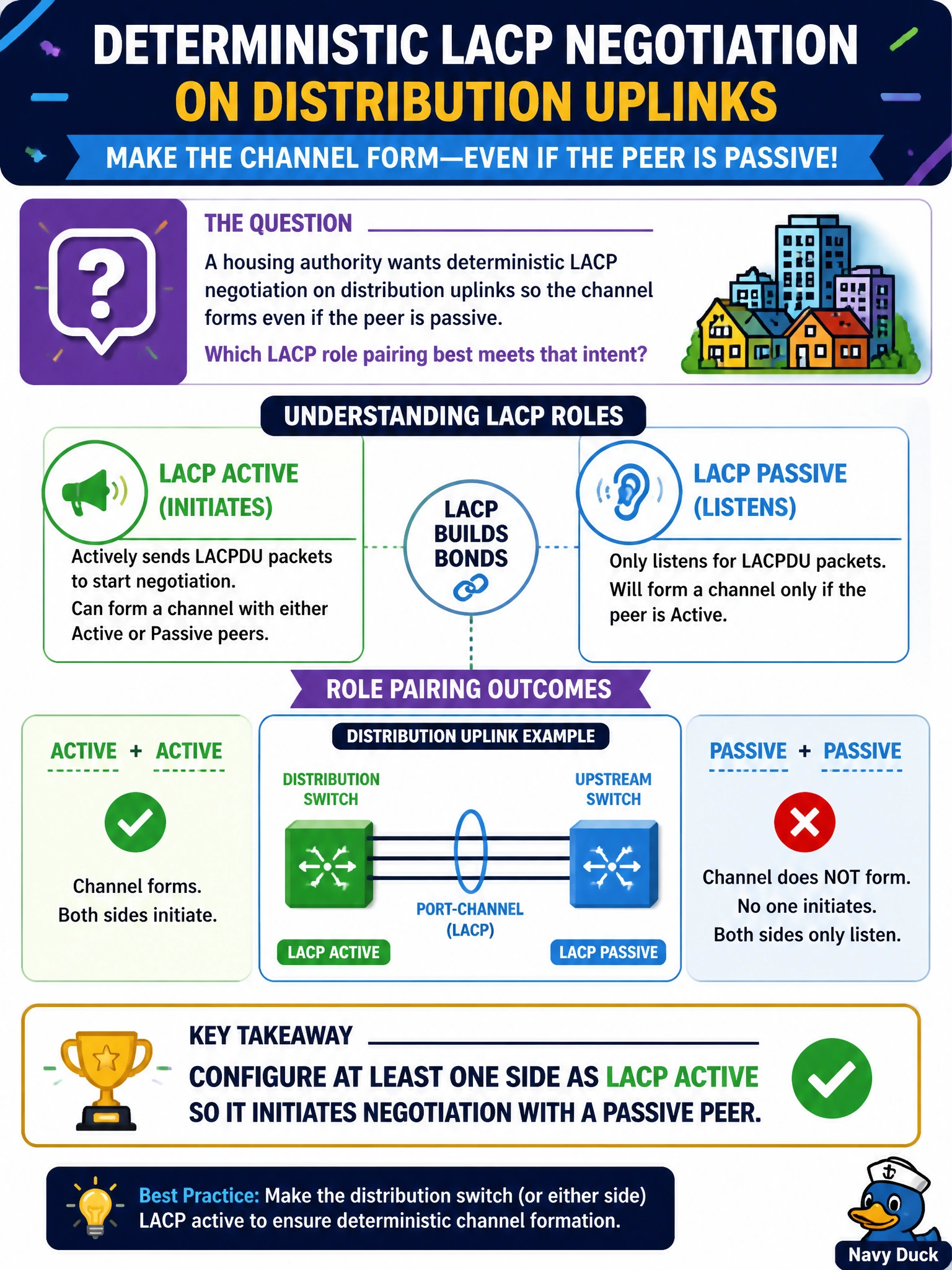
A housing authority wants deterministic LACP negotiation on distribution uplinks so the channel forms even if the peer is passive. Which LACP role pairing best meets that intent?
Select an answer to reveal the explanation.
Short Explanation
You can think of LACP active as the side that starts the conversation, while passive waits to respond. With active on at least one side, the channel can form even when the peer is passive.
Full Explanation
LACP forms an EtherChannel when at least one side initiates LACPDU exchange; both sides can also be active. Configure the housing authority’s distribution uplinks as LACP active, and they send LACPDUs so the channel can form even when the peer is passive. A passive peer responds but does not initiate, making active/passive a valid, deterministic pairing. Configuring both sides as LACP passive fails because neither starts negotiation; relying on ON mode timers also confuses LACP negotiation with a different channel method. Disabling LACP and using DTP desirable on member links does not build an EtherChannel: DTP negotiates trunking, not aggregation. Setting members to access mode so LACP can elect a root bridge confuses LACP with spanning tree; LACP does not elect an STP root, and access mode is unrelated to making LACP work. Exam caveat: active/active is often preferred for faster detection, but active/passive is valid. Match speeds, duplex, and allowed trunk lists across members, and do not pair LACP on one side with mode ON on the other, because that incompatibility prevents a correct bundle even if one side is active. Operational check: configure channel-group mode active on the authority side, verify LACP partner status, Port-Channel state, and bundled members, then confirm a passive-only peer forms a channel while the authority side remains active.