
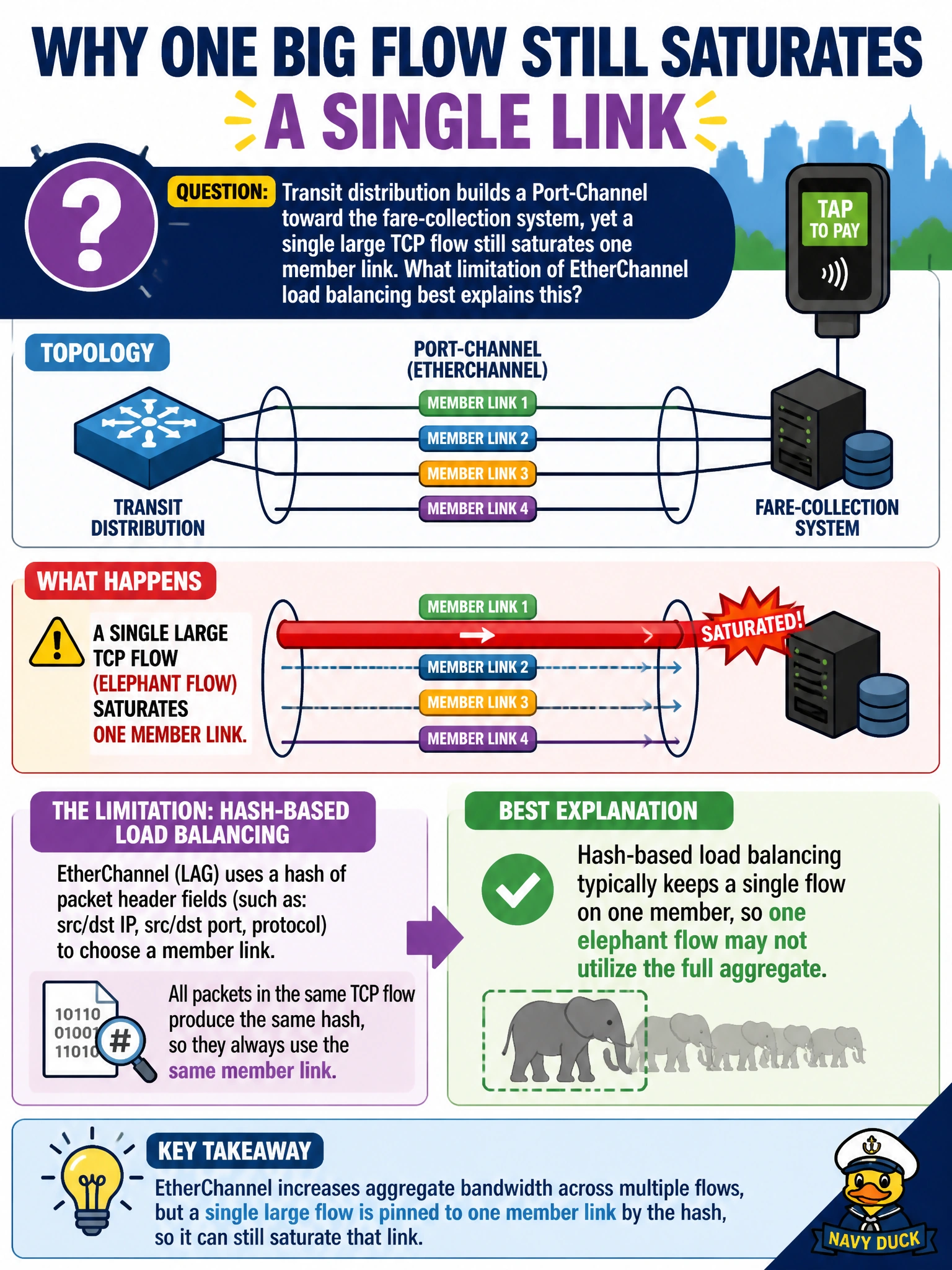
Transit distribution builds a Port-Channel toward the fare-collection system, yet a single large TCP flow still saturates one member link. What limitation of EtherChannel load balancing best explains this?
Select an answer to reveal the explanation.
Short Explanation
EtherChannel is more like multiple checkout lanes keyed off a hash of addresses/ports—not a blender that shreds one conversation across every lane. One big flow usually sticks to one member, so it can still fill that single pipe.
Full Explanation
EtherChannel load balancing selects a physical member by hashing fields such as source/destination MAC, IP, or Layer-4 ports—depending on platform and configured hash algorithm. Packets that produce the same hash index follow the same member for the life of that flow. Therefore a single large TCP session toward the fare-collection system typically saturates one member even when the Port-Channel aggregate has unused capacity on other links. That elephant-flow limitation is inherent to per-flow (or per-hash-bucket) distribution, not a sign that the channel is “broken.”
The claim that Port-Channels always pin every flow to the first member regardless of hash settings is too absolute; hashing does distribute different flows, but not by shredding one flow across members. Saying EtherChannel cannot carry TCP once more than one member is active is false—TCP is routinely carried; the issue is flow stickiness, not protocol exclusion. Increasing MTU on the Port-Channel does not automatically spray one flow across all members; MTU affects frame size, not the EtherChannel hash decision.
Exam caveat: some advanced fabrics or technologies offer more granular spraying, but classic ENCOR EtherChannel behavior is hash-based member selection. Changing the hash fields (for example including Layer-4 ports) can improve distribution across many flows, yet still will not split one identical 5-tuple across members on typical Catalyst-style hashing.
Operational check: identify the elephant flow’s endpoints, confirm which Port-Channel member carries it with platform counters or SPAN, evaluate whether adjusting load-balance method helps other flows, and if a single session must use more bandwidth, consider application-level parallelism, higher member speed, or designs beyond a single hash-bound Port-Channel.