
Library stacks try to bundle two uplinks into an EtherChannel: one switch is set to LACP active and the peer ports are set to static ON mode. The Port-Channel never comes up as expected. What is the primary reason?
Select an answer to reveal the explanation.
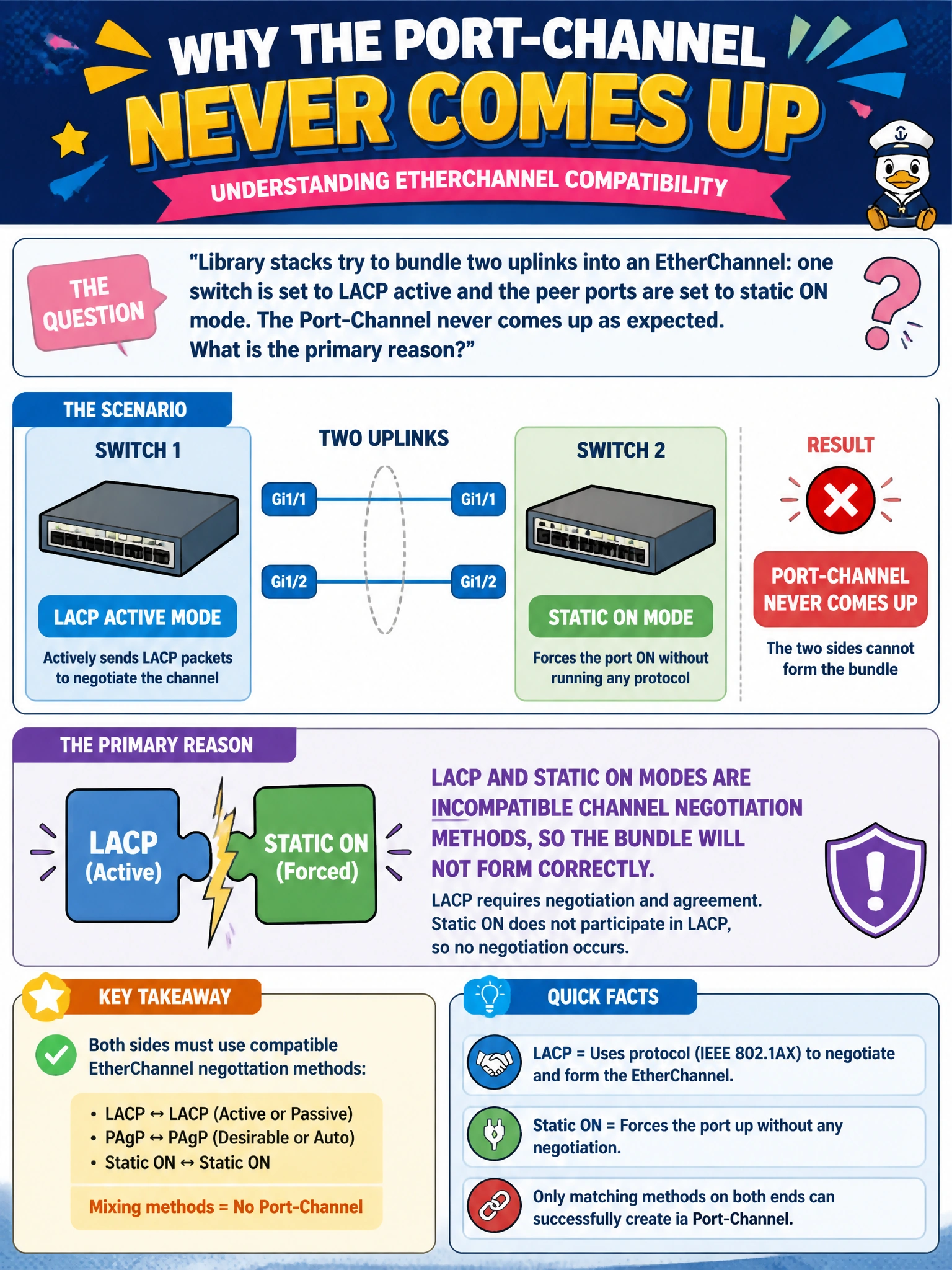
Short Explanation
LACP is a handshake; ON is a forced bundle with no handshake. Pairing them is like one side waiting for a high-five while the other never raises a hand—so the channel never forms the way you expect.
Full Explanation
EtherChannel formation requires both peers to use a compatible negotiation method on the member links. LACP active (or passive) exchanges LACPDUs to agree on bundling. Mode ON statically forces the port into a channel group without LACP messaging. When the library stacks set one switch to LACP active and the peer ports to static ON, the active side expects LACP partners while the ON side never speaks LACP; the Port-Channel therefore does not form correctly or remains incomplete. Matching LACP to LACP, or ON to ON (with careful consistency), is required for a healthy bundle.
Requiring both ends to be access mode before LACP can negotiate is incorrect: LACP commonly aggregates trunks or routed members; access mode is not a prerequisite for channel negotiation. Requiring exactly four physical members before any traffic can pass is also wrong—EtherChannel can operate with fewer members; member count affects capacity, not a hard four-link minimum. Enabling MST on both switches before EtherChannel can negotiate confuses technologies: MST is a spanning-tree instance model and is not a dependency for LACP or Port-Channel bring-up.
Exam caveat: even with matching LACP modes, mismatched speed/duplex, incompatible allowed VLANs on trunk members, or inconsistent port-channel load-balance settings can still prevent a clean bundle. ON-ON avoids LACP but loses negotiation safeguards and can black-hole if one side is mis-wired. Prefer LACP in municipal designs unless a platform constraint forces static ON.
Operational check: standardize both library peers on channel-group mode active (or active/passive), confirm LACP partner status for each member, verify member operational attributes match, and only then validate Port-Channel up/up with traffic hashing across members.