
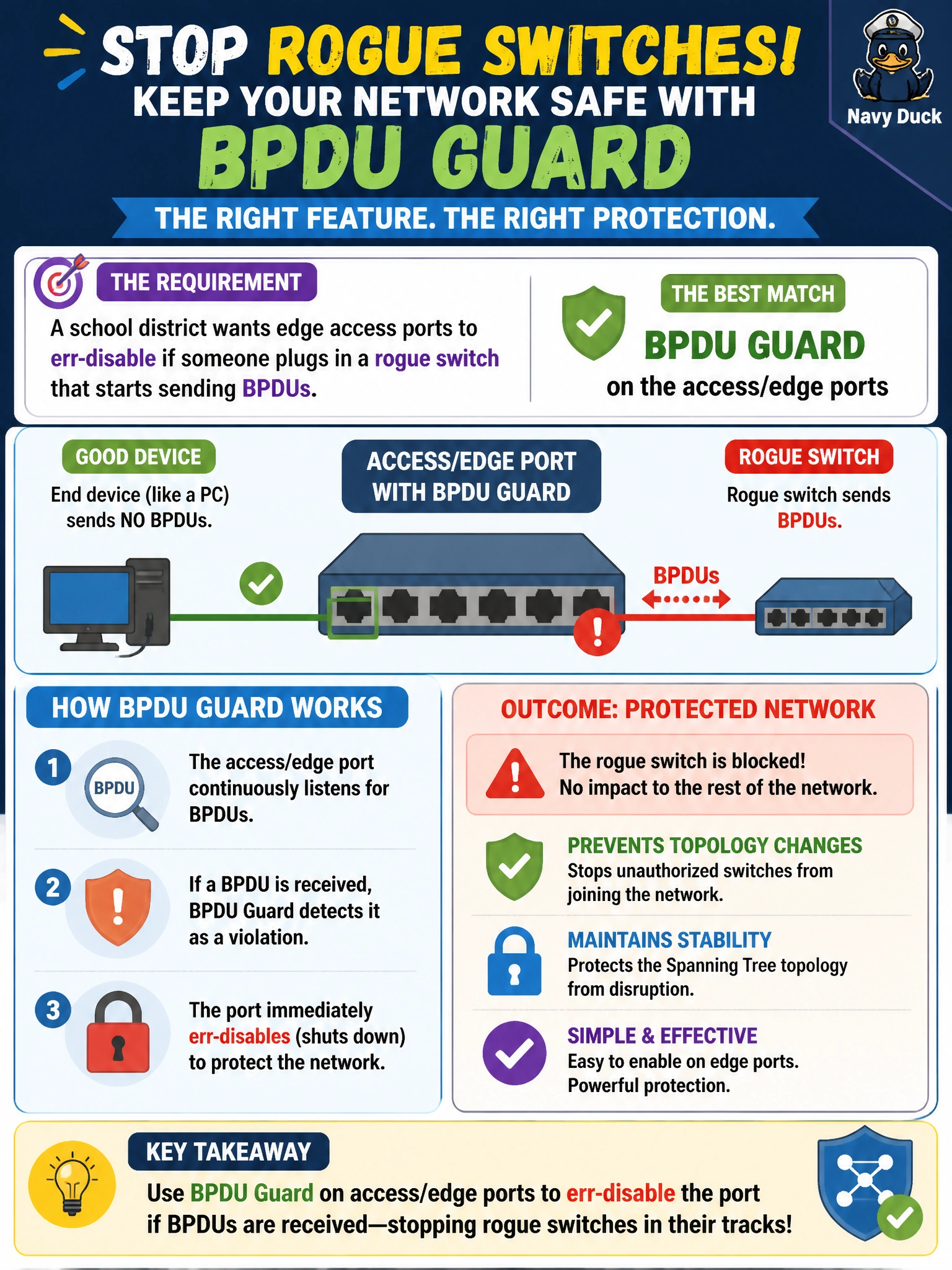
A school district wants edge access ports to err-disable if someone plugs in a rogue switch that starts sending BPDUs. Which feature best matches that requirement?
Select an answer to reveal the explanation.
Short Explanation
BPDU Guard is the classroom smoke alarm for rogue switches. If a BPDU shows up on an edge port, the port shuts itself down instead of letting that mystery box play spanning-tree politics.
Full Explanation
BPDU Guard on edge/access ports matches the school district’s goal: those ports should face end stations, not switches. If a rogue switch is plugged in and begins sending BPDUs, BPDU Guard err-disables the port instead of allowing the unauthorized bridge to participate in spanning-tree elections. That protective shutdown preserves the designed STP topology for classroom and office access layers and gives operators a clear fault signal (err-disabled) when someone introduces a switch where only a host should appear.
Root Guard only on core switches with no edge protection addresses a different threat—blocking superior BPDUs on guarded designated ports toward the root—so it does not meet the “err-disable when a rogue switch sends BPDUs on access ports” requirement by itself. Disabling spanning tree entirely on classroom closets removes loop protection and increases blast radius if redundant cables appear; it is the opposite of hardening. Enabling DTP desirable on every user port increases the chance of unintended trunks and does nothing to stop STP influence from a rogue bridge.
Exam caveat: BPDU Guard is typically paired with PortFast/edge configuration. Enabling BPDU Guard on a legitimate uplink that must receive BPDUs will take that uplink down—apply it to host-facing ports, not distribution uplinks. Also know how your platform recovers err-disabled ports (manual shutdown/no shutdown versus errdisable recovery).
Operational check: enable spanning-tree portfast and bpduguard on classroom access interfaces, connect a test switch that sends BPDUs in a maintenance window, confirm the port err-disables, review logging, and document the recovery procedure for campus staff.