
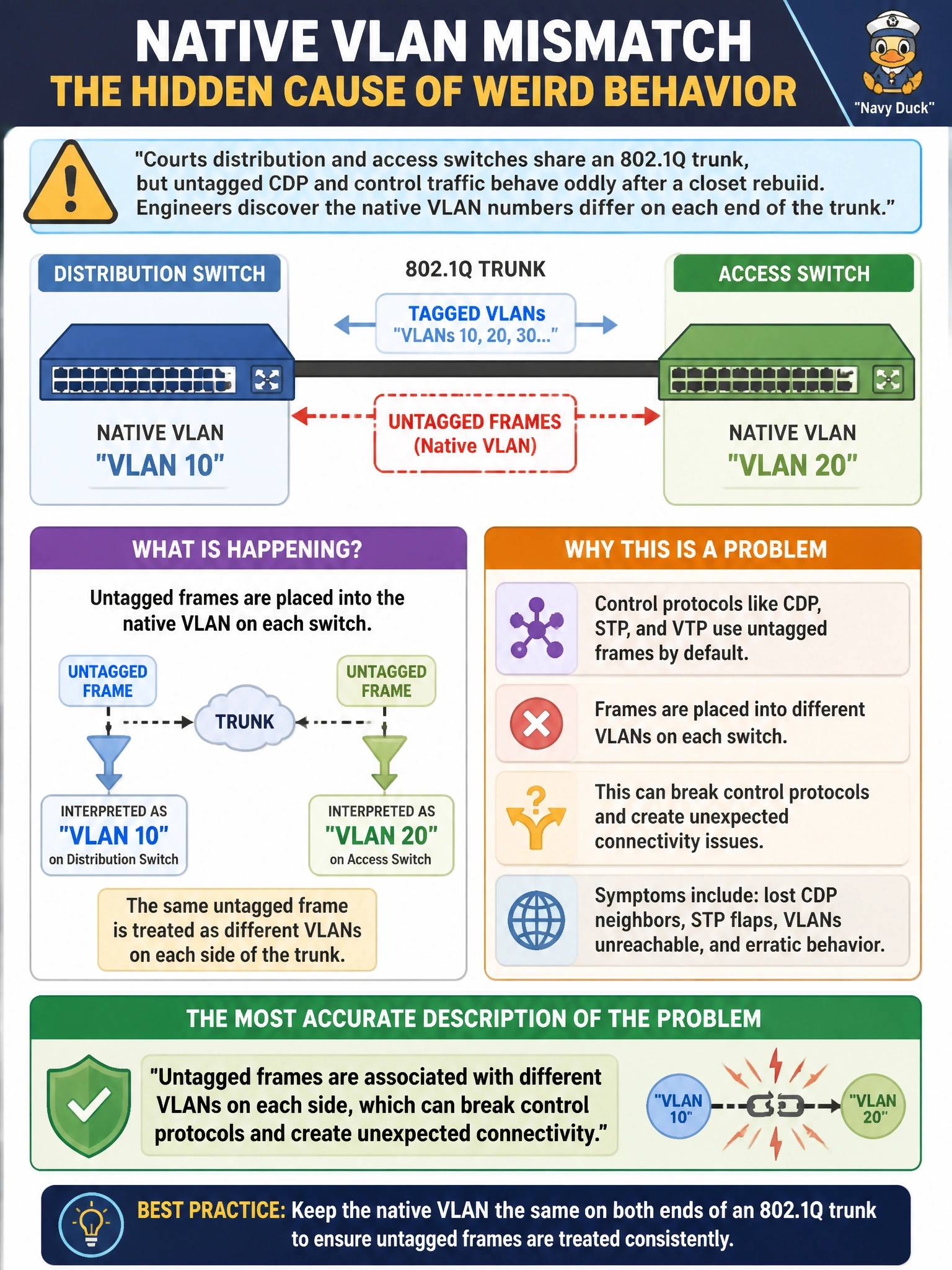
Courts distribution and access switches share an 802.1Q trunk, but untagged CDP and control traffic behave oddly after a closet rebuild. Engineers discover the native VLAN numbers differ on each end of the trunk. What is the most accurate description of that problem?
Select an answer to reveal the explanation.
Short Explanation
Picture two doorways labeled differently for the same unmarked packages—mail ends up in the wrong room. Untagged trunk traffic follows the native VLAN on each side, so mismatched native VLANs scramble CDP and friends.
Full Explanation
On an 802.1Q trunk between courts distribution and access switches, frames belonging to the native VLAN are transmitted untagged. Each switch associates those untagged frames with whichever VLAN it has configured as native. When the native VLAN numbers differ on the two ends, the same untagged frame is interpreted as belonging to different broadcast domains. That mismatch commonly breaks or confuses untagged control-plane traffic such as CDP and can produce one-way or odd spanning-tree and connectivity symptoms after a closet rebuild—even when tagged data VLANs appear partly healthy.
The claim that a native VLAN mismatch is harmless because all frames are always tagged is false: by definition the native VLAN uses untagged frames unless native VLAN tagging features are explicitly enabled and matched on both ends. Saying the mismatch only affects EtherChannel hashing and never impacts spanning-tree or CDP misstates the failure domain; hashing is unrelated, while CDP and STP are classic victims of native VLAN inconsistency. Claiming the mismatch forces both switches into RSTP alternate role on every port invents an STP reaction that native VLAN mismatch does not cause; port roles follow BPDUs and path cost, not a simple native-ID disagreement.
Exam caveat: some platforms can tag the native VLAN (for example vlan dot1q tag native). If one side tags and the other still expects classic untagged native behavior, you get a tagging mismatch that looks similar operationally. Always treat “native VLAN” as both a number and a tagging policy, not just an ID on a show command.
Operational check: compare show interfaces trunk (or equivalent) native VLAN on both peers, align them to the designed unused or dedicated native VLAN, confirm whether native tagging is enabled symmetrically, and verify CDP and STP behavior recover on the courts trunk after the change.