
Port authority engineers discuss which devices encapsulate and decapsulate VXLAN traffic. What is the VTEP's role?
Select an answer to reveal the explanation.
Short Explanation
The VTEP is the shipping dock at each VXLAN edge—wrap the cargo for the IP underlay on the way out, unwrap it on the way in. It is not just a Syslog chatterbox or a certificate authority cosplay.
Full Explanation
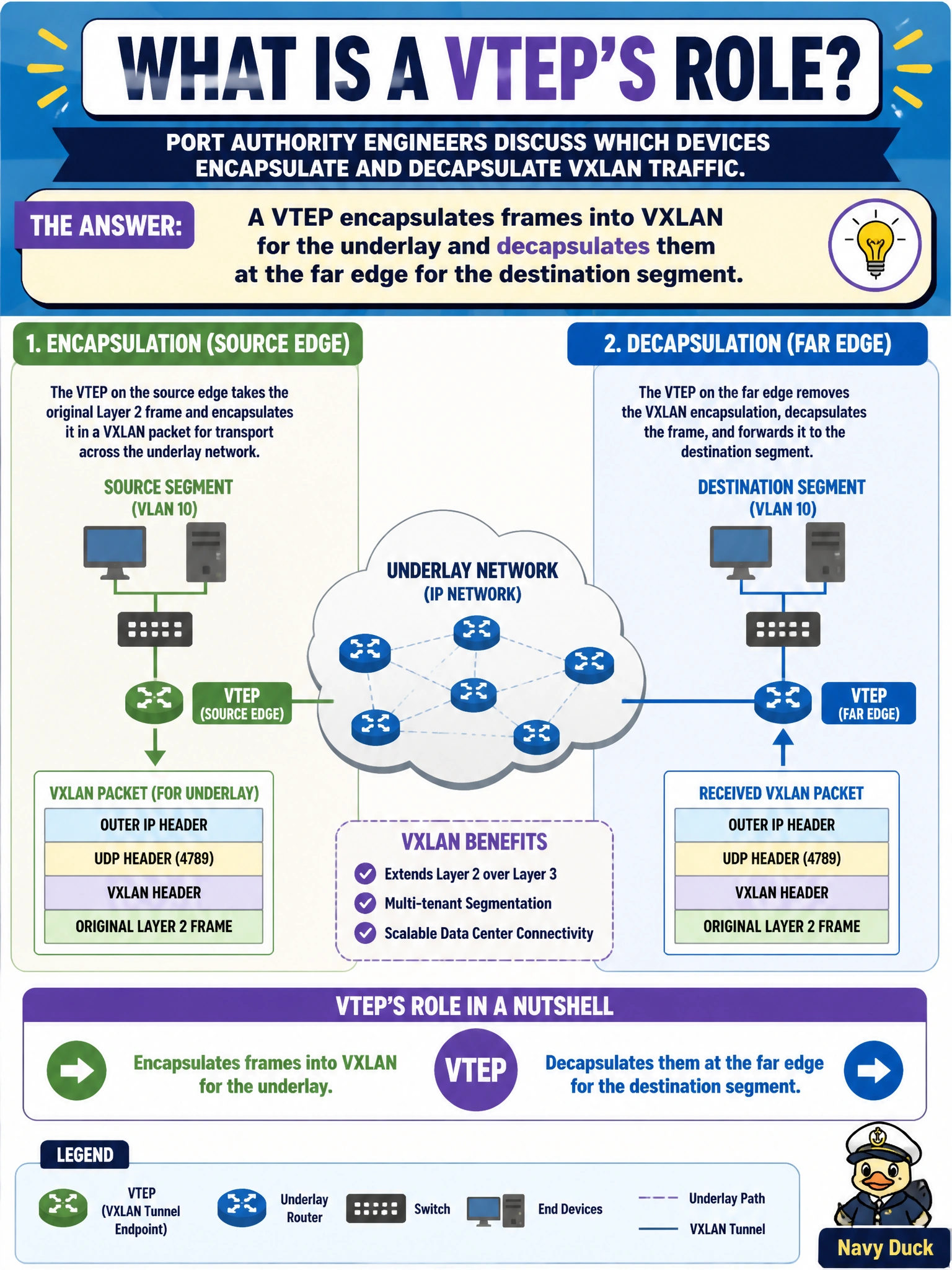
Port authority engineers discussing which devices encapsulate and decapsulate VXLAN traffic should identify the VTEP's role: a VXLAN Tunnel Endpoint encapsulates frames into VXLAN for the underlay and decapsulates them at the far edge for the destination segment. The VTEP is the edge shipping dock between overlay segments and the IP underlay—wrapping on egress toward the underlay and unwrapping on ingress into the local segment for port-authority workloads. A VTEP does not only generate Syslog messages and never forward encapsulated frames; forwarding and encapsulation are the primary role. A VTEP is not exclusively an IPsec CA that issues certificates for GRE tunnels; certificate authorities and GRE crypto are separate technologies. A VTEP does not replace underlay routers by running STP between all VNIs; underlay routing remains, and STP is not a VTEP substitute. Exam caveat: VTEP function can live on switches, routers, or hosts depending on design, but the role—encap/decap between overlay and underlay—stays constant. Operational check: identify VTEP IP addresses in the port-authority fabric, confirm they exchange encapsulated traffic over the underlay, and verify a host frame enters a VNI on one VTEP and exits correctly decapsulated on the remote VTEP.