
Emergency management is designing a fabric-style solution and asks how LISP and VXLAN typically complement each other at ENCOR concept depth?
Select an answer to reveal the explanation.
Short Explanation
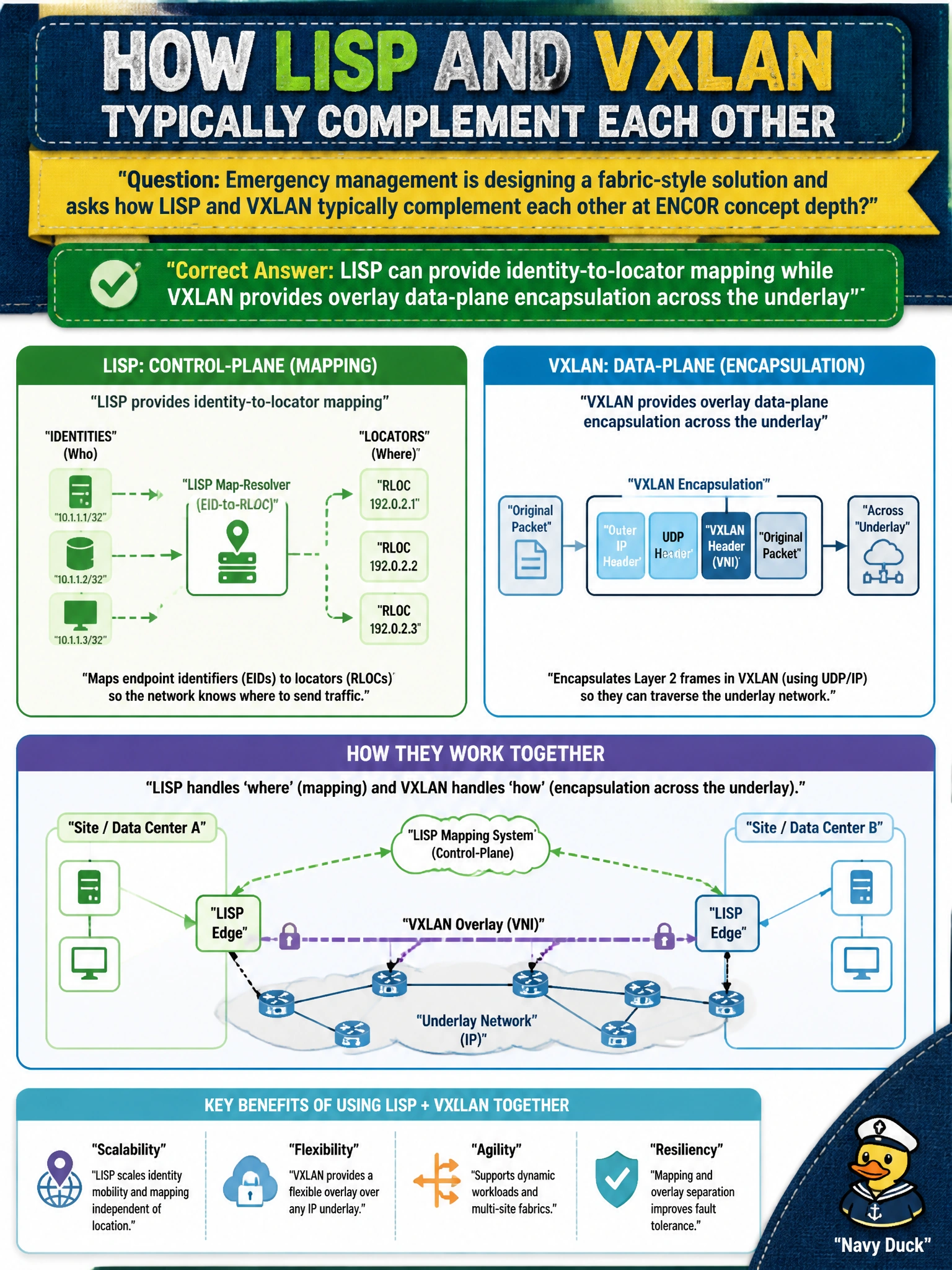
In fabric talk, LISP is often the brain that maps who-is-where, and VXLAN is the truck that carries the overlay across the underlay. Together they complement—catalog plus cargo—not two stickers for the same box.
Full Explanation
Emergency management designing a fabric-style solution should understand how LISP and VXLAN typically complement each other at ENCOR concept depth: LISP can provide identity-to-locator mapping while VXLAN provides overlay data-plane encapsulation across the underlay. They are complementary roles—mapping brain and encapsulation truck—not two marketing names for one protocol. That pairing matches common fabric teaching: resolve where an identity lives, then carry the overlay with VNIs over IP. LISP and VXLAN are not identical protocols that differ only in marketing names; mapping versus encapsulation are distinct functions. VXLAN does not map EIDs to RLOCs while LISP supplies the VNI encapsulation header—that reverses the usual role assignment taught at ENCOR depth. Neither technology is dismissed in Cisco fabric discussion in favor of HSRP alone; HSRP is first-hop redundancy, not a fabric overlay or mapping substitute. Exam caveat: complementary does not mean every deployment must run both, or that product packaging never blends control and data planes differently—answer from ENCOR conceptual roles unless the stem specifies a product quirk. Operational check: in an emergency-management fabric lab, show LISP or fabric mapping resolving identity to locator and VXLAN VTEPs encapsulating overlay traffic, then fail a locator and confirm mapping updates while VXLAN continues to carry the overlay on the new path.