
A municipal datacenter lab contrasts LISP terms with classic IP routing alone. How do EID and RLOC differ conceptually?
Select an answer to reveal the explanation.
Short Explanation
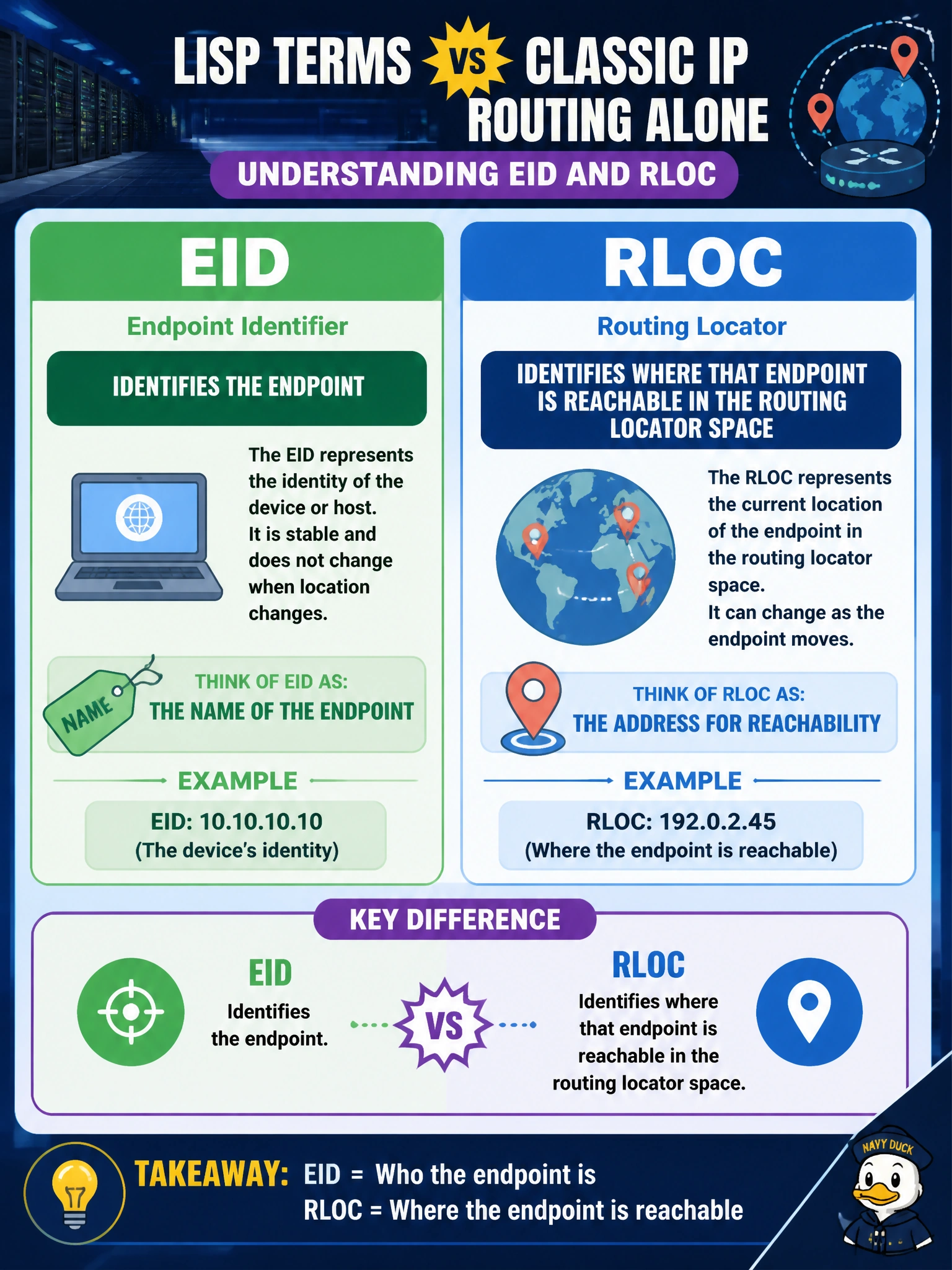
EID is who the endpoint is; RLOC is the street address of the door you deliver through. Classic routing often glues identity and location together—LISP vocabulary keeps those stickers separate on purpose.
Full Explanation
A municipal datacenter lab contrasting LISP terms with classic IP routing alone should treat EID and RLOC as separated identity and location. An Endpoint Identifier (EID) identifies the endpoint, while a Routing Locator (RLOC) identifies where that endpoint is reachable in the routing locator space. Classic routing often binds identity and location together in the same address; LISP vocabulary deliberately separates those roles so the lab can reason about mobility and mapping. EID and RLOC are not alternate names for the same OSPF area ID—that conflates IGP hierarchy with locator/ID separation. RLOC is not only a wireless SSID while EID is only a VLAN number; SSIDs and VLANs are different constructs unrelated to LISP's identity versus locator split. EIDs do not encrypt packets and RLOCs do not compress them before CEF lookup; crypto and compression are not EID/RLOC functions. Exam caveat: terminology clarity matters on the exam—candidates who treat EID as just another name for RLOC miss the separation that justifies map-and-encap. Operational check: pick a municipal lab host, document its EID versus the RLOC of its current VTEP or LISP site, move the host's locator in the lab, and confirm identity stays stable while the mapping's RLOC updates.