
Police HQ wants overlays that span sites across a Layer 3 underlay without stretching pure Layer 2 domains. Which network-virtualization approach matches that goal?
Select an answer to reveal the explanation.
Short Explanation
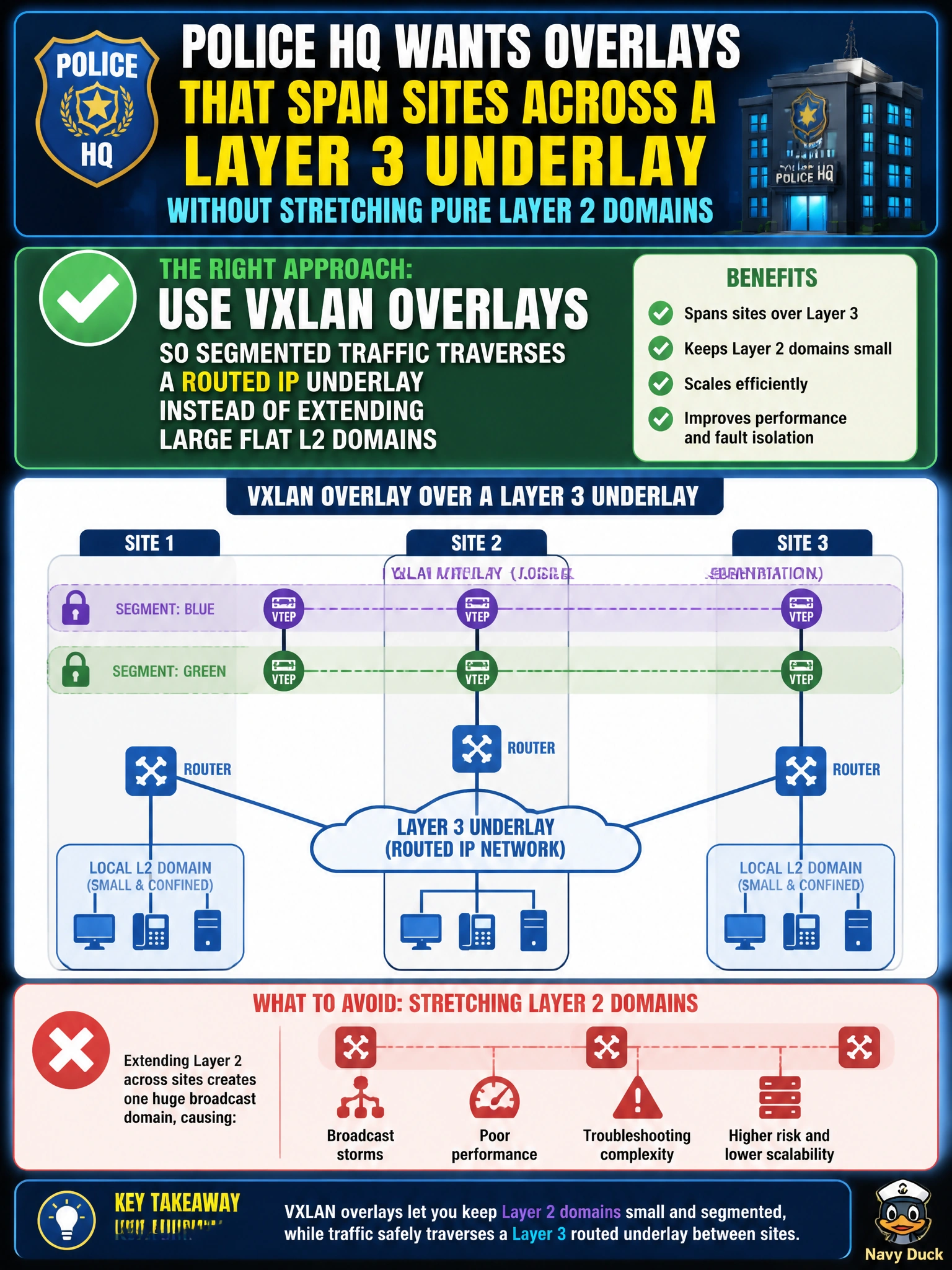
Police do not want one giant Layer 2 tarp stretched between precincts. VXLAN lets the overlay ride a normal routed underlay—like sending evidence bags by numbered courier routes instead of unrolling one shared hallway across the whole city.
Full Explanation
Police HQ that wants overlays spanning sites across a Layer 3 underlay without stretching pure Layer 2 domains should use VXLAN overlays so segmented traffic traverses a routed IP underlay instead of extending large flat L2 domains. VXLAN keeps segmentation in the overlay while the underlay remains normal IP routing between precincts—avoiding the fragility, failure domains, and operational pain of city-wide stretched VLANs for police workloads. Stretching a single VLAN across every site and disabling IP routing in the core is the anti-pattern the stem rejects and maximizes L2 risk. Relying only on RSTP diameter increases to replace any overlay encapsulation confuses loop-prevention tuning with network virtualization. Mandating Type 2 hypervisors on every endpoint to avoid underlay routing invents an endpoint virtualization requirement that does not create a proper multi-site overlay. Exam caveat: VXLAN avoids stretched L2 between sites when VTEPs and underlay routing are correct; poorly designed multicast, MTU, or flood modes can still create overlay pain that feels like L2 sprawl. Operational check: deploy VXLAN between police sites over the existing L3 underlay, confirm no need to extend the old VLAN across the WAN or core, and verify segmented precinct traffic stays within the intended VNI.