
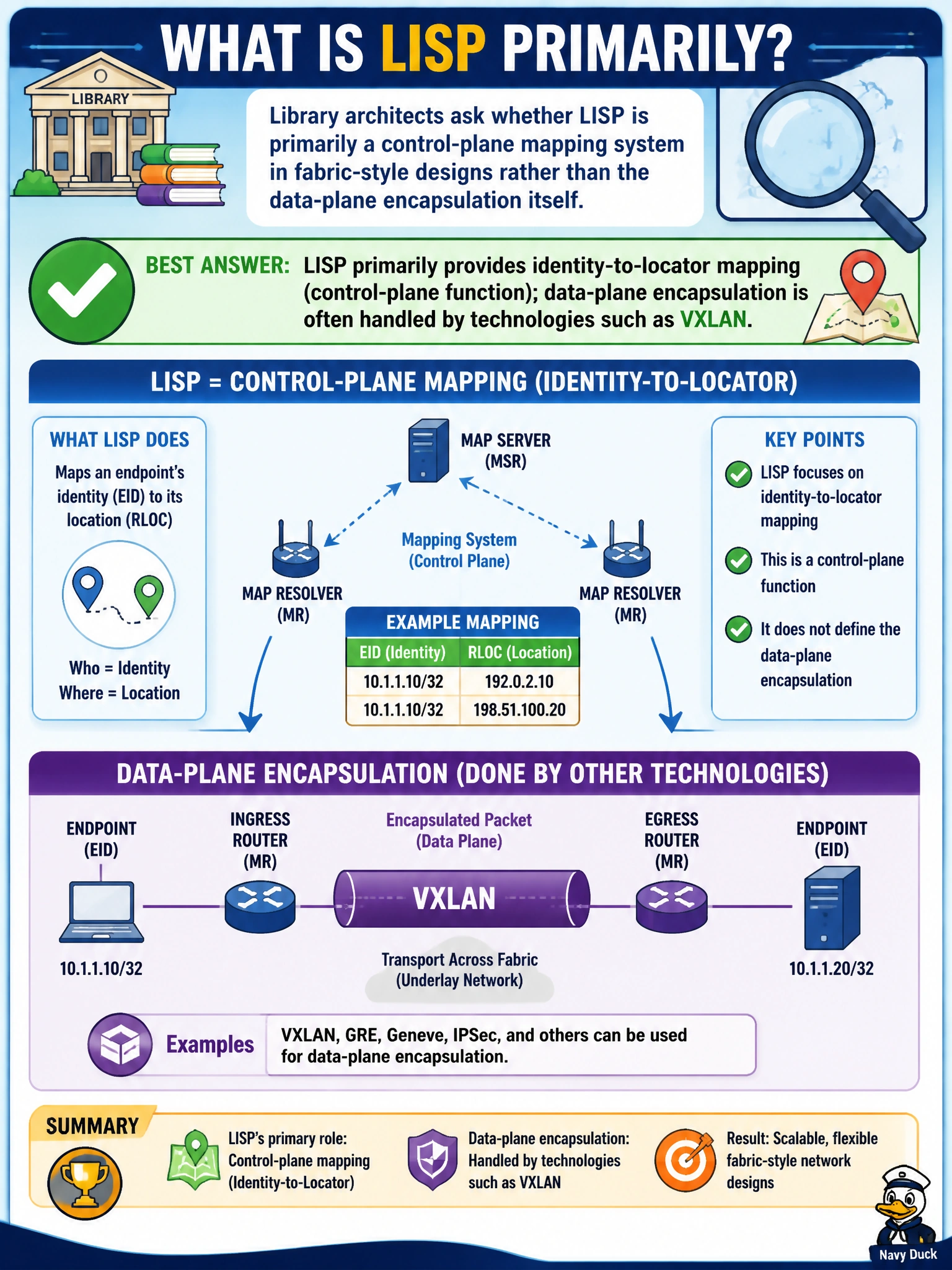
Library architects ask whether LISP is primarily a control-plane mapping system in fabric-style designs rather than the data-plane encapsulation itself. Which answer is best?
Select an answer to reveal the explanation.
Short Explanation
Think of LISP as the library card catalog that says which wing holds a title right now. The book cart that actually moves the book across the building is more like the data-plane encapsulation (often VXLAN). Catalog versus cart—different jobs.
Full Explanation
Library architects asking whether LISP is primarily a control-plane mapping system in fabric-style designs rather than the data-plane encapsulation itself should answer that LISP primarily provides identity-to-locator mapping as a control-plane function, while data-plane encapsulation is often handled by technologies such as VXLAN. In ENCOR fabric-oriented discussions, LISP is the catalog that says where an identity lives; VXLAN commonly supplies the truck that carries overlay frames across the underlay. LISP is not only a Layer 1 encoding for copper cables and never maps identities—that denies its mapping role entirely. LISP does not replace VXLAN headers byte-for-byte on every frame in all Cisco designs; encapsulation and mapping are complementary, not identical header swaps. LISP is not exclusively a CoPP policy template with no mapping database role; CoPP protects the control plane and is unrelated to EID-to-RLOC mapping databases. Exam caveat: role emphasis can vary by design documentation, but at ENCOR concept depth the mapping-versus-encapsulation split is the expected distinction—do not claim LISP alone is the entire fabric data plane. Operational check: in a library fabric lab, show where EID-to-RLOC mappings are resolved versus where VNI encapsulation occurs on the VXLAN VTEP path, and trace a packet to see mapping decide locator while VXLAN carries the overlay.