
Stadium multi-tenant networks are drowning in sprawling Layer 2 VLANs and evaluate VXLAN VNIs for segmentation. What contrast matters most?
Select an answer to reveal the explanation.
Short Explanation
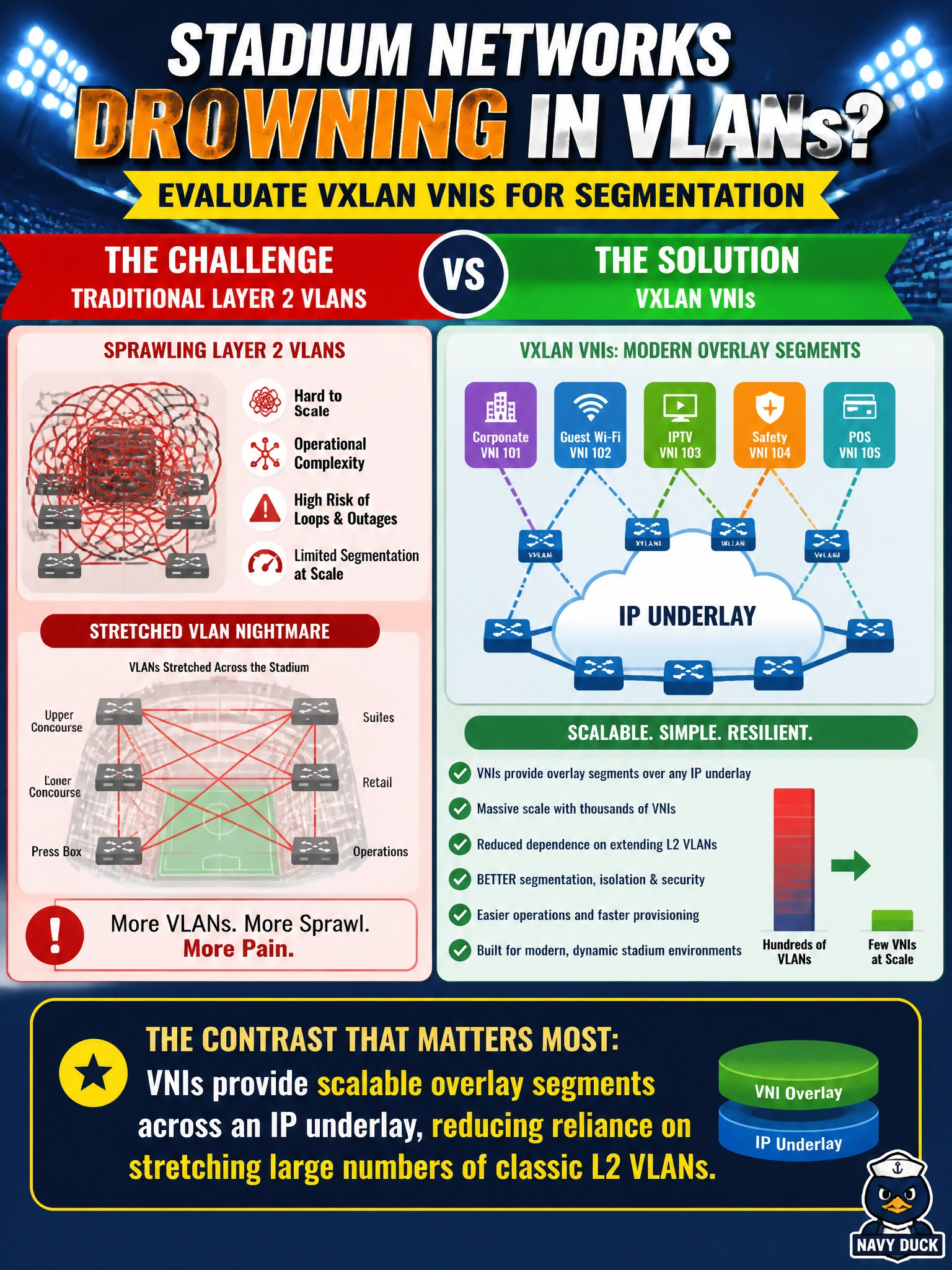
You can use VXLAN VNIs to carry scalable tenant segments over a routed IP underlay instead of stretching a spaghetti bowl of VLANs across the stadium. That means fewer giant Layer 2 hairballs and a more scalable overlay.
Full Explanation
In a stadium network with sprawling Layer 2 VLANs, the key contrast is between VLAN sprawl and VXLAN’s scalable overlay segments across an IP underlay. VNIs reduce reliance on stretching large numbers of classic Layer 2 VLANs through the fabric; they are forwarding and segmentation constructs in the VXLAN header path, not identifiers that exist only inside SNMP traps. Disabling all underlay routing permanently does not solve VLAN sprawl: it removes the IP fabric VXLAN needs to carry traffic between VTEPs. Nor do VNIs replace VLAN-based segmentation entirely or prevent multi-tenancy. A design can map VLANs to VNIs at the edge while gaining overlay scale and retaining VLANs for that purpose. The core lesson is scalable overlay segmentation over a routed underlay, not merely renaming labels while leaving the forwarding model unchanged. Exam caveat: VNIs reduce pressure to stretch endless VLANs, but edge VLAN-to-VNI mapping, MTU, and multicast or ingress-replication design still need to be correct for the overlay to work operationally. Practical check: replace one tenant’s sprawling stretched VLAN with a VNI-backed segment, confirm underlay routing between VTEPs, and verify tenant isolation and reachability without extending the old Layer 2 domain.