
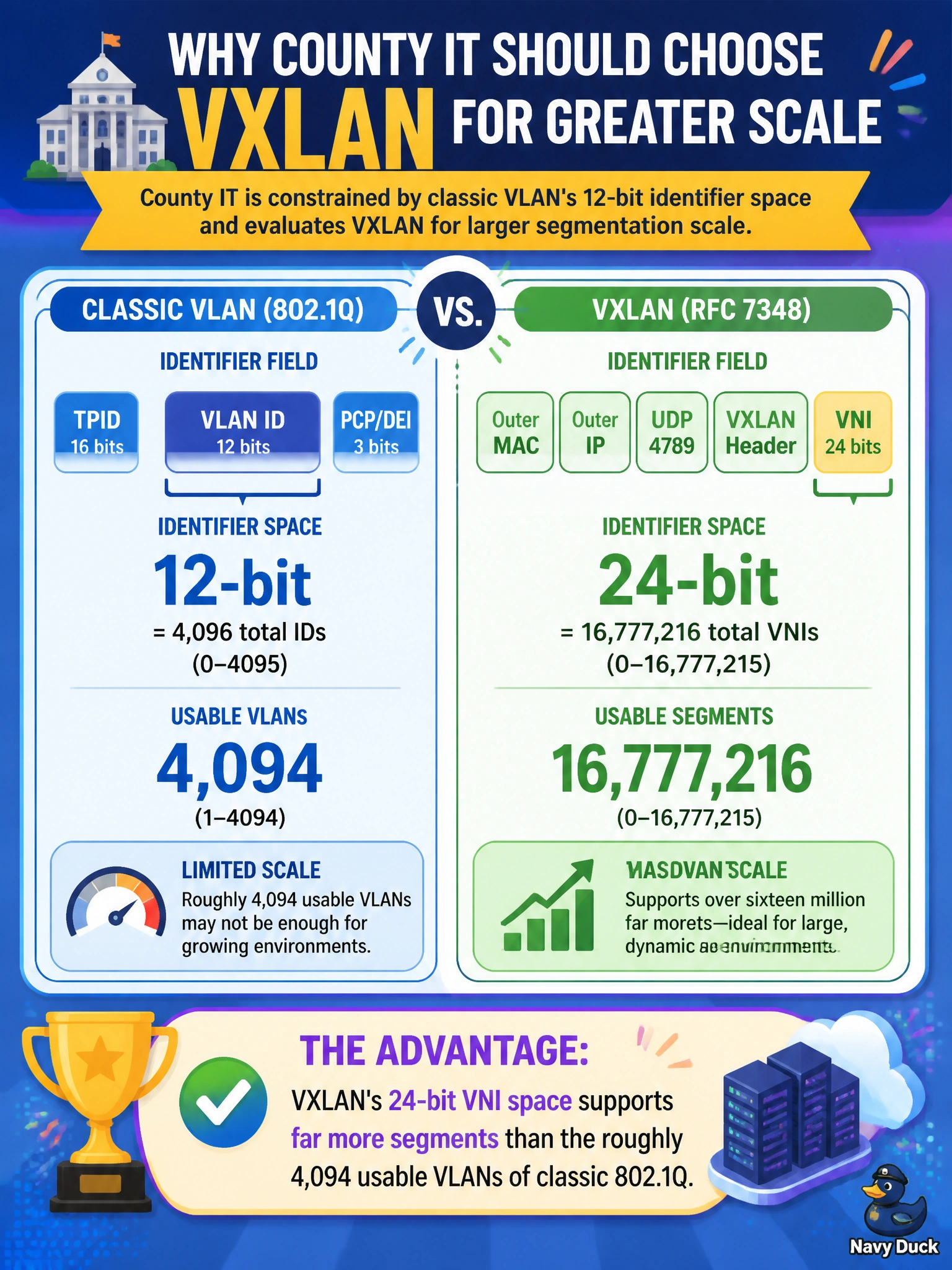
County IT is constrained by classic VLAN's 12-bit identifier space and evaluates VXLAN for larger segmentation scale. What advantage should they cite?
Select an answer to reveal the explanation.
Short Explanation
Classic VLANs top out around four thousand rooms in the building directory. VXLAN's VNI space is a much bigger directory—millions of segment IDs—so large multi-tenant county designs do not run out of numbers the way 12-bit VLAN tags do.
Full Explanation
County IT constrained by classic VLAN's 12-bit identifier space should cite VXLAN's larger segmentation scale. 802.1Q VLAN IDs are 12-bit (about 4094 usable), while VXLAN VNIs are 24-bit and therefore support far more segments than classic VLANs. For a county that has exhausted or fears exhausting VLAN ID space across tenants and services, that identifier-scale advantage is the concrete reason to evaluate VXLAN. VXLAN does not reduce segment IDs to 4 bits so fabrics stay smaller—that reverses the scale story. VXLAN does not eliminate the need for any underlay IP routing in the county core; VNIs ride an IP underlay and depend on underlay routing between VTEPs. VXLAN and VLAN identifier spaces are not identical with only the acronym differing; 24-bit versus 12-bit is a real architectural difference. Exam caveat: more VNI space does not automatically mean every platform or license supports the full theoretical range, and operational discipline for VNI naming and documentation still matters at county scale. Operational check: inventory current VLAN consumption versus projected segments, map tenant segments to VNIs in a pilot, confirm underlay MTU and VTEP reachability, and verify segmented county workloads forward on VNIs without reclaiming scarce VLAN IDs for every overlay.