
City fabric architects name the data-plane encapsulation used to carry overlay segments across an IP underlay. Which technology fills that role in common enterprise fabric designs discussed in ENCOR?
Select an answer to reveal the explanation.
Short Explanation
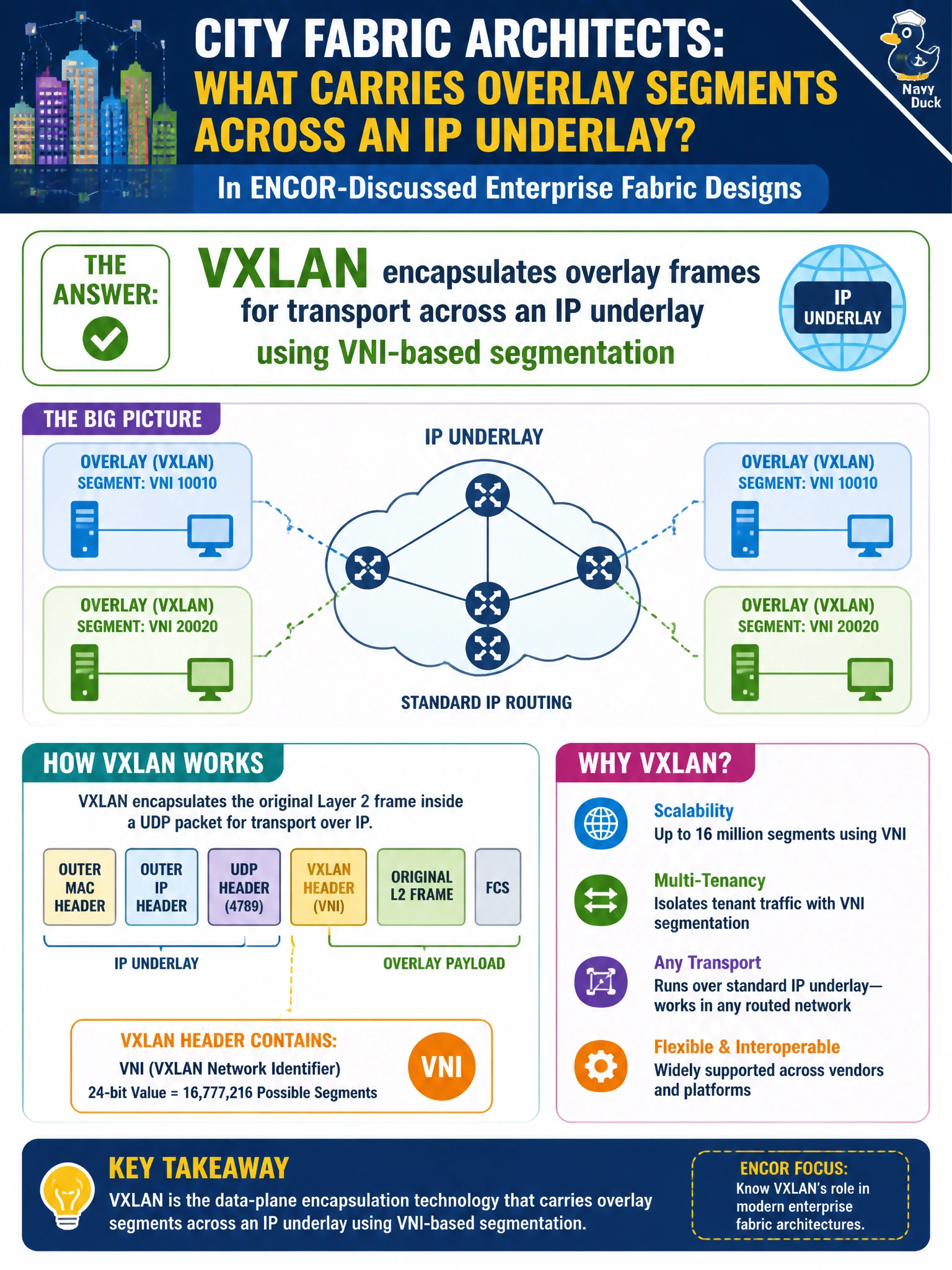
VXLAN is the shrink-wrap that lets city overlay segments ride across a normal IP underlay trucking network, labeled with VNIs so tenants stay sorted. HSRP, CoPP, and STP are different tools—they are not that overlay wrapper.
Full Explanation
City fabric architects naming the data-plane encapsulation that carries overlay segments across an IP underlay should identify VXLAN. In common enterprise fabric designs discussed in ENCOR, VXLAN encapsulates overlay frames for transport across an IP underlay using VNI-based segmentation. That is the data-plane vehicle that lets city fabric segments ride routed underlays instead of depending on stretched pure Layer 2 domains between buildings. HSRP alone does not encapsulate all overlay frames between distribution switches; HSRP provides first-hop redundancy, not overlay tunnel headers. CoPP does not replace data-plane encapsulation for multi-tenant overlays; CoPP protects the control plane from excessive traffic to the CPU. STP instances themselves do not form overlay tunnel headers; STP prevents Layer 2 loops and is not a VXLAN substitute. Exam caveat: VXLAN needs VTEPs, underlay IP reachability, and correct VNI mapping—naming VXLAN without those components does not produce a working city overlay. Operational check: confirm VTEPs encapsulate and decapsulate with the intended VNIs, verify underlay reachability between VTEP IPs, and test that segmented city workloads communicate within a VNI without requiring a stretched VLAN across the underlay.