
An airport team exploring fabric concepts asks what problem LISP addresses with locator/ID separation. Which statement is most accurate at ENCOR depth?
Select an answer to reveal the explanation.
Short Explanation
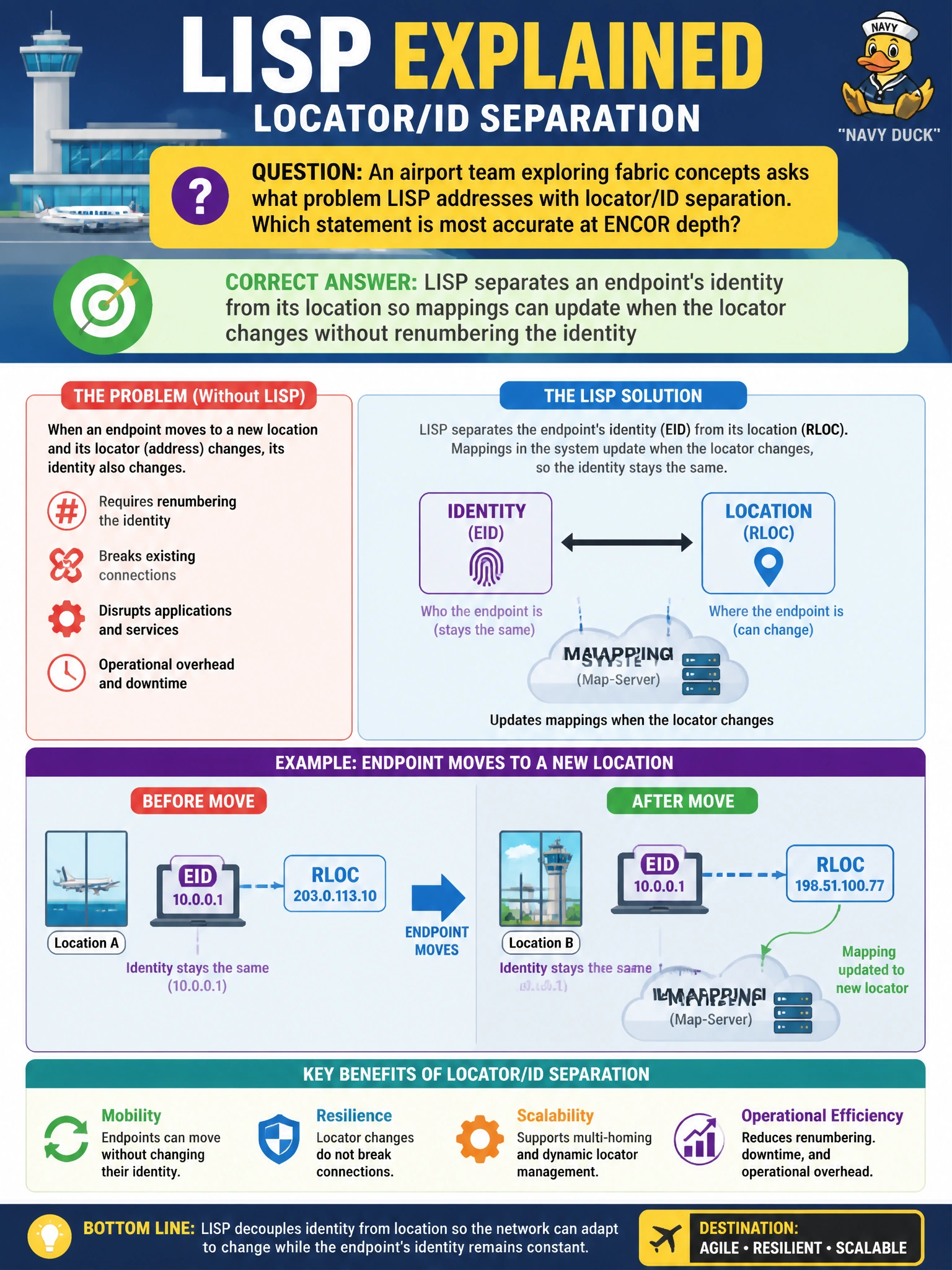
Think of LISP as keeping your employee badge number (who you are) separate from the building lobby you use today (where you are). When you move, the location mapping can change without reprinting your badge with a new identity.
Full Explanation
LISP addresses locator/ID separation by keeping an endpoint’s identity distinct from its routing location. When the locator changes, the mapping can update without renumbering the identity. At ENCOR depth, this supports mobility and location changes without rewriting endpoint identity across an airport fabric, which classic IP addressing alone may not handle cleanly. Replacing Ethernet with Token Ring on fabric edges is unrelated to locator/ID separation. Treating LISP solely as a wireless RF planning tool for AP density is also incorrect: RF planning does not update locator mappings for wired or fabric endpoints. LISP does not provide hop-by-hop encryption for VXLAN traffic or eliminate the need for IPsec between tunnel endpoints; confidentiality is a separate cryptographic concern. Exam caveat: locator/ID separation relies on a working mapping system, so stale or missing mappings can disrupt reachability even when underlay routing is healthy. Practical check: identify airport endpoint EIDs and their current RLOCs in the mapping system, change or fail a locator in a lab, confirm that the mapping updates, and verify that the endpoint remains reachable by identity without renumbering hosts or rewriting campus addressing plans.