
Airport operations is sizing a new production hypervisor cluster and needs to know whether the hypervisor should sit on bare metal or atop a general-purpose host OS. Which statement correctly distinguishes the models?
Select an answer to reveal the explanation.
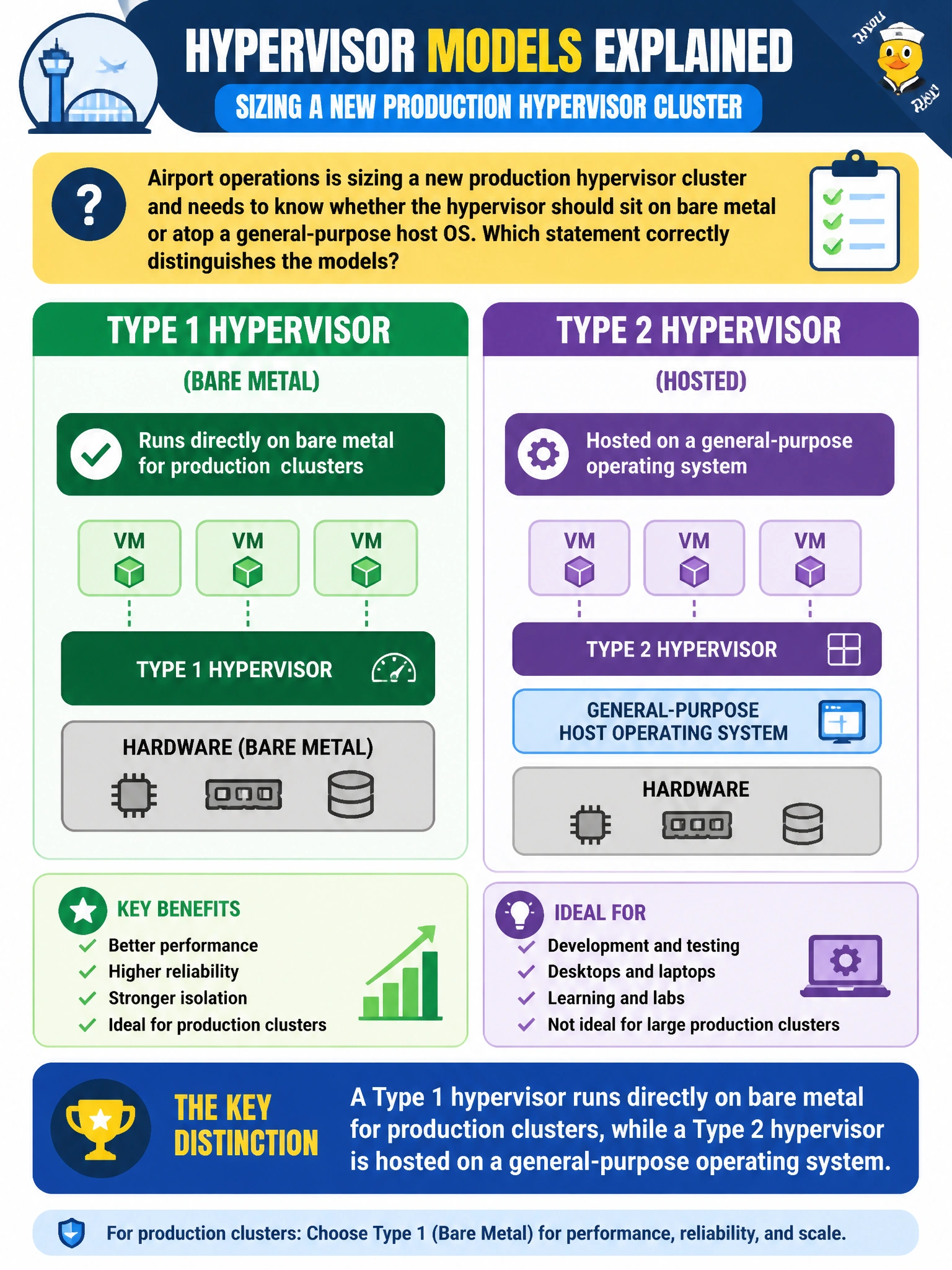
Short Explanation
Picture Type 1 as a dedicated stage bolted to the concrete floor—nothing between the show and the building. Type 2 is a stage set up inside someone else's theater (the host OS). For a real production airport cluster, you want the bolted-down stage.
Full Explanation
Airport operations sizing a production hypervisor cluster must place the hypervisor correctly in the stack. A Type 1 hypervisor installs directly on bare metal and is the usual production choice for efficiency, isolation, and lower overhead on airport workloads. A Type 2 hypervisor runs as an application on a general-purpose host OS and is common for labs or lightweight use, not as the default for a hardened production cluster. The distinction is placement—bare metal versus hosted on a host OS—not marketing labels or license trivia alone. Saying Type 1 always requires a full desktop OS underneath while Type 2 runs only on bare metal reverses the models and would mis-size the airport cluster. Claiming Type 1 and Type 2 differ only by license cost and never by stack placement ignores the architectural difference ENCOR expects candidates to know. Asserting Type 2 is mandatory for any virtual switch while Type 1 cannot provide vNIC connectivity is false: both models can support virtual switching and vNIC connectivity when configured; the switch feature is not exclusive to Type 2. Exam caveat: production preference for Type 1 does not mean Type 2 is illegal in every lab or pilot; it means the bare-metal model is the correct answer when the stem asks for production cluster placement. Operational check: inventory whether the airport hypervisor boots on bare metal or atop a general-purpose OS, confirm virtual-switch and vNIC support on the chosen model, and validate that production guests meet isolation and performance baselines before cutover.