
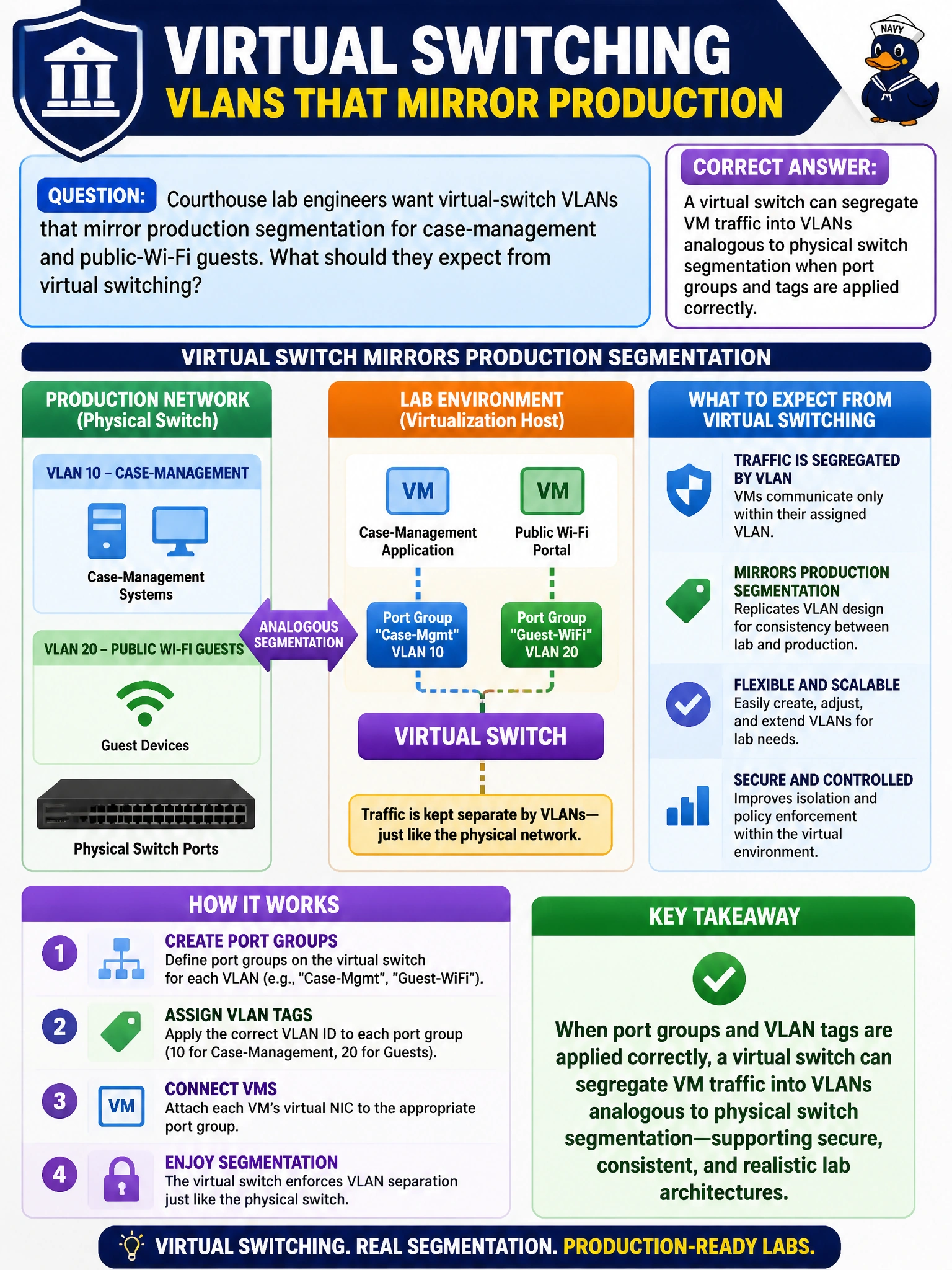
Courthouse lab engineers want virtual-switch VLANs that mirror production segmentation for case-management and public-Wi-Fi guests. What should they expect from virtual switching?
Select an answer to reveal the explanation.
Short Explanation
A virtual switch is still a switch—it can keep the case-management crowd on one VLAN and the lobby Wi-Fi crowd on another, just like the physical closet gear. Set the port groups right and the lab mirrors production instead of dumping everyone into one noisy room.
Full Explanation
Courthouse lab engineers who want virtual-switch VLANs to mirror production segmentation for case-management and public-Wi-Fi guests should expect a virtual switch to behave like a switch at Layer 2: it bridges VM vNICs and can apply VLAN tags and port-group policies so lab traffic stays segregated the same way physical closet gear would. When port groups and tags are applied correctly, case-management guests stay on their VLAN and lobby Wi-Fi guests stay on theirs, giving the courthouse a faithful segmentation mirror without dumping everyone into one broadcast domain. Virtual switches do not ignore VLAN tags and always flood every VM into one flat broadcast domain; that fails by concept whenever 802.1Q tagging and port-group VLAN assignment are supported and configured. VLAN segmentation on a virtual switch does not require replacing OSPF with static default routes only—OSPF and Layer 3 design are orthogonal to whether the vSwitch can tag and segregate Layer 2. Virtual switching also does not require every guest to run a Type 2 hypervisor inside the VM; nested Type 2 hypervisors are unrelated to mirroring production VLANs on the outer virtual switch. Exam caveat: capability exists when the platform and port groups support VLANs; misconfigured promiscuous mode, wrong VLAN IDs, or missing uplink trunking can still flatten or black-hole traffic. Operational check: assign courthouse case-management and guest Wi-Fi VMs to distinct port groups with the production VLAN IDs, verify tagged traffic on the uplink, and confirm that hosts in one segment cannot reach the other at Layer 2 without intentional routing or policy.