
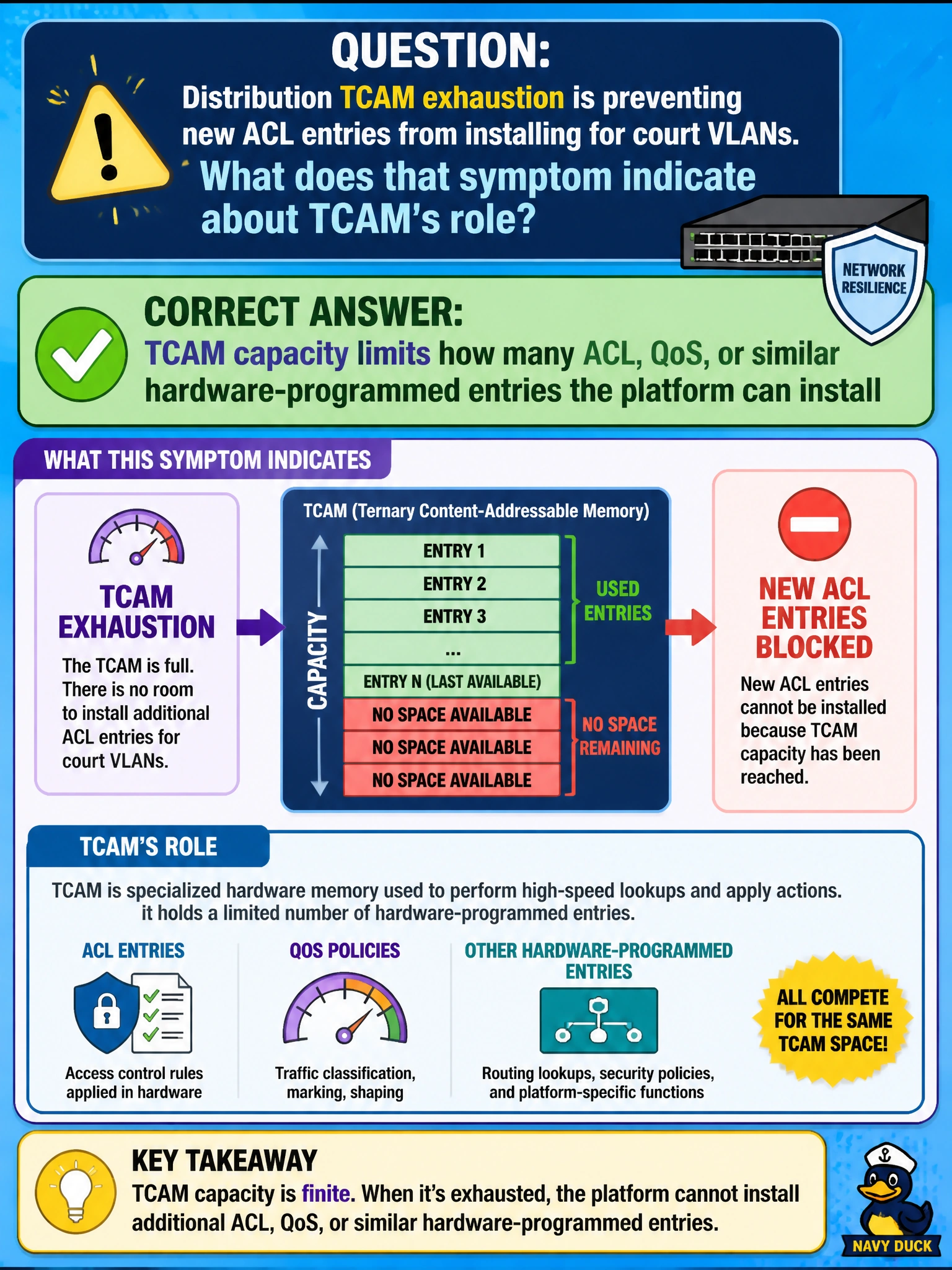
Distribution TCAM exhaustion is preventing new ACL entries from installing for court VLANs. What does that symptom indicate about TCAM's role?
Select an answer to reveal the explanation.
Short Explanation
TCAM is a finite parking garage for fancy hardware lookups. When every stall is full, the next ACL car gets turned away—even if the config looks perfect on paper. That is a capacity limit, not a bad Ethernet cable.
Full Explanation
TCAM is finite hardware memory used to program features that need fast ternary lookups, including ACLs and QoS. When distribution TCAM exhaustion prevents new ACL entries from installing for court VLANs, the symptom indicates that platform TCAM capacity limits how many ACL, QoS, or similar hardware-programmed entries can be installed. Operators must treat ACL scale as a hardware resource problem, not as unlimited software list space.
Saying TCAM only stores MAC addresses so ACL failures must be CAM aging problems swaps CAM and TCAM roles. Claiming TCAM is unlimited software memory so exhaustion always means a cable fault denies the hardware capacity model and misattributes the failure to Layer 1. Asserting TCAM exhaustion only affects NTP stratum selection on the core invents an unrelated time-protocol impact and ignores ACL/QoS programming.
Exam caveat: exhaustion items test whether you know TCAM bounds security/QoS hardware entries. Do not rebrand the symptom as CAM aging, cabling, or NTP.
Operational check: check TCAM utilization and ACL install failures on the distribution platform, consolidate or optimize ACL/QoS entries for court VLANs, and validate that newly required entries program successfully after reclaiming capacity.