
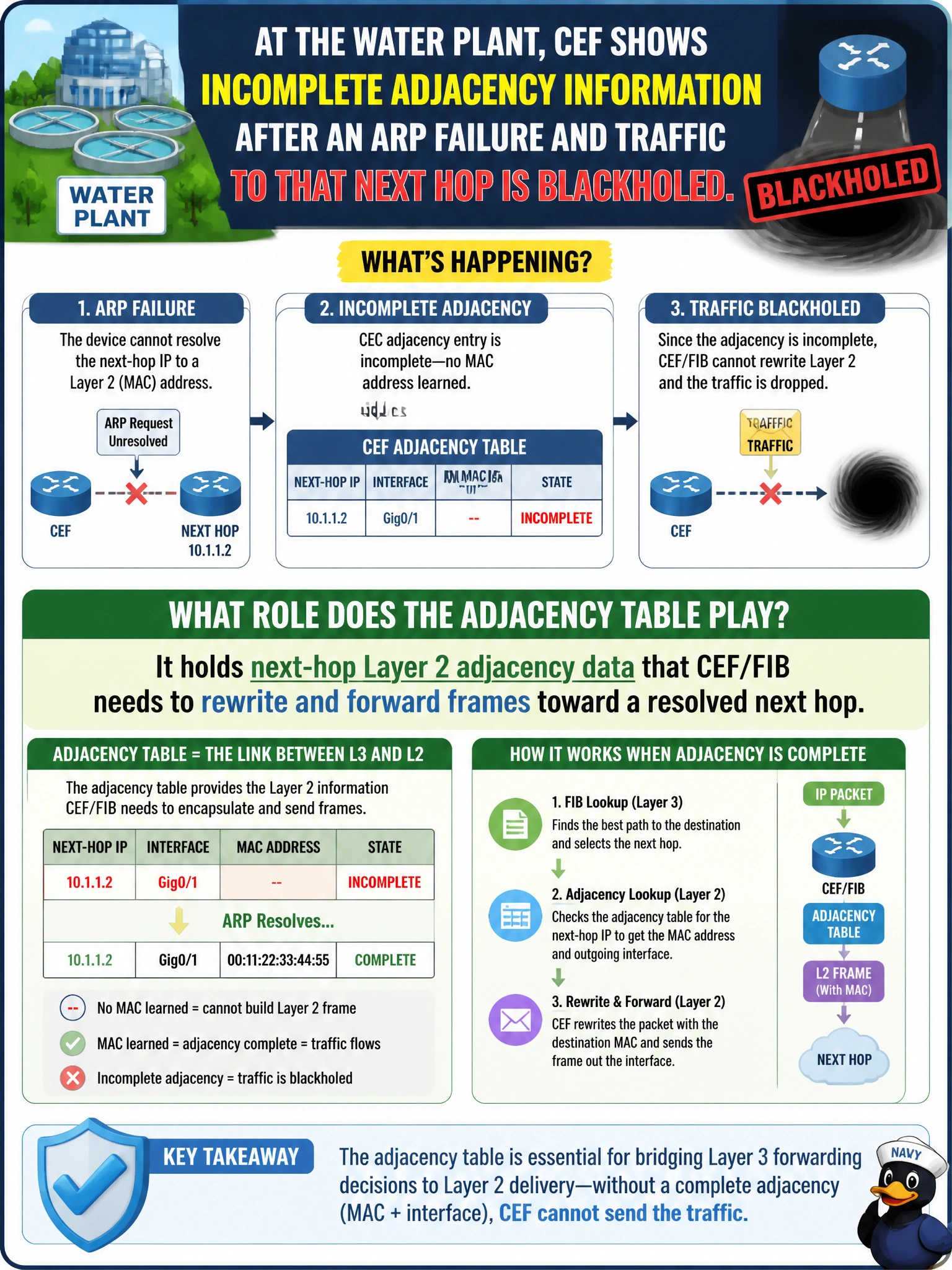
At the water plant, CEF shows incomplete adjacency information after an ARP failure and traffic to that next hop is blackholed. What role does the adjacency table play?
Select an answer to reveal the explanation.
Short Explanation
The FIB knows which next-hop IP should get the packet, but the adjacency table is the sticky note with the actual MAC and exit interface. If ARP never finishes, that sticky note is blank—and packets fall into a black hole.
Full Explanation
CEF needs more than a next-hop IP in the FIB; it also needs Layer 2 adjacency details to rewrite and send the frame. The adjacency table holds that next-hop Layer 2 information. At a water plant, incomplete adjacency after an ARP failure means CEF cannot complete the rewrite toward that next hop, so traffic can blackhole even when the FIB points at the correct IP. Restoring ARP resolution and adjacency completeness is therefore part of restoring forwarding, not merely re-adding a route.
Stating the adjacency table stores only BGP AS paths and never Layer 2 rewrite details confuses BGP path attributes with CEF adjacency. Saying it replaces DHCP option 150 for voice routers invents a VoIP provisioning role adjacency does not have. Equating it with the STP root bridge election database mixes Layer 2 spanning-tree state with CEF's next-hop rewrite database.
Exam caveat: incomplete adjacency plus blackholing is a strong hint that Layer 2 next-hop resolution failed beneath an otherwise present FIB route.
Operational check: inspect CEF adjacency state for the affected next hop, verify ARP resolution on the egress interface, correct Layer 2/ARP problems, and confirm adjacency becomes valid before retesting plant traffic.