
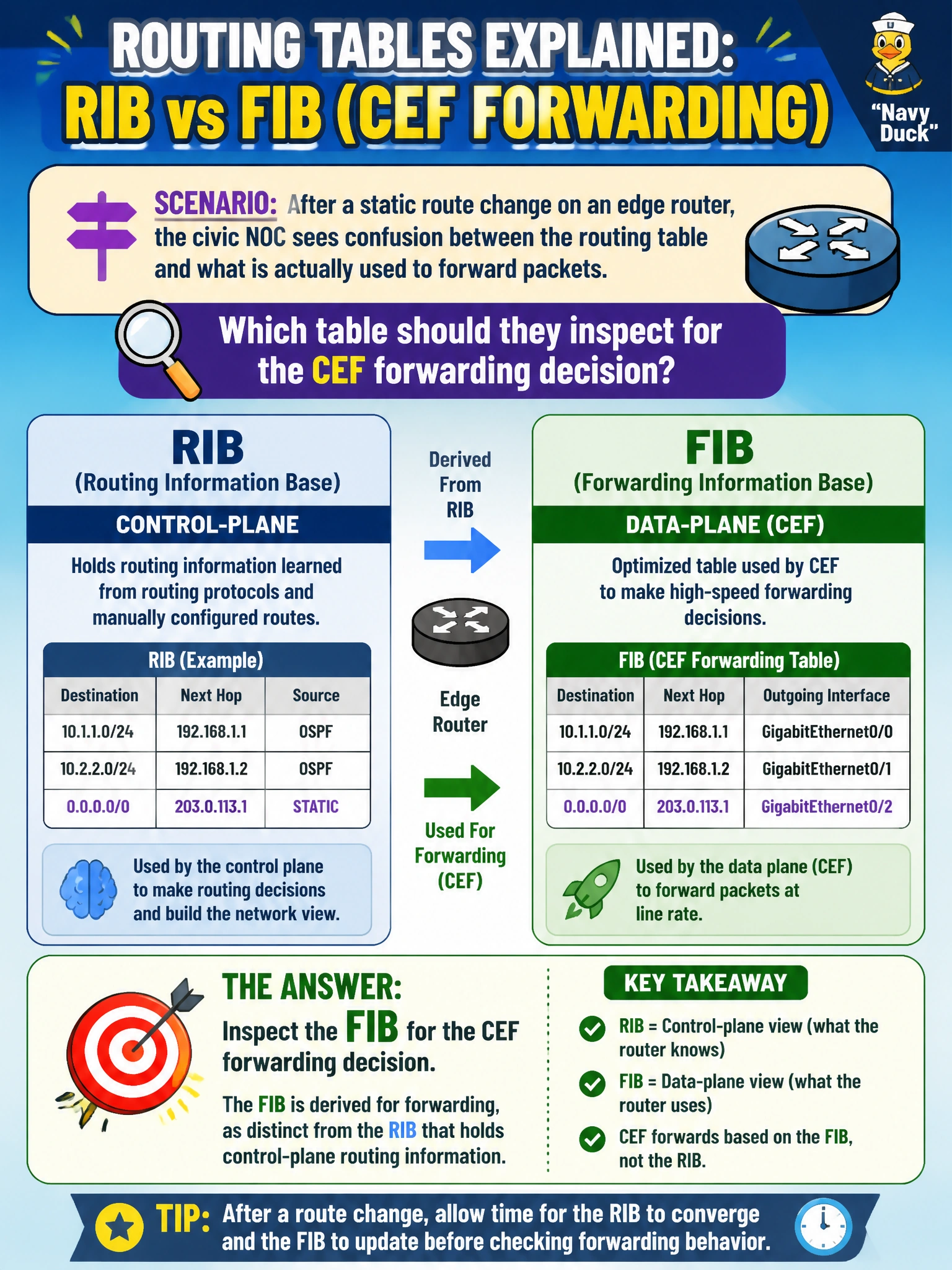
After a static route change on an edge router, the civic NOC sees confusion between the routing table and what is actually used to forward packets. Which table should they inspect for the CEF forwarding decision?
Select an answer to reveal the explanation.
Short Explanation
The RIB is the planning binder the routing protocols write in. The FIB is the laminated cheat sheet CEF actually uses to shove packets out the door. If forwarding looks wrong after a static change, check the cheat sheet—not just the binder.
Full Explanation
After a static route change on an edge router, civic NOC staff must distinguish the Routing Information Base from the Forwarding Information Base. The RIB holds control-plane routing information contributed by protocols and static configuration. CEF forwarding decisions are made from the FIB, which is derived for forwarding and paired with adjacency information. When operators are confused about what is actually used to forward packets, the FIB is the table to inspect for the CEF path, not merely the RIB entry that may or may not have programmed forwarding state as expected.
Inspecting only the CDP neighbor table because it supposedly overrides all Layer 3 forwarding misunderstands CDP as a discovery protocol, not the CEF forwarding plane. Looking only at the VLAN database because static routes supposedly install exclusively as SVIs confuses Layer 2 VLAN configuration with IP route installation and FIB programming. Treating the STP blocking port list as a replacement for the FIB on Cisco routers mixes Layer 2 loop prevention with Layer 3 CEF forwarding.
Exam caveat: RIB versus FIB is a classic ENCOR discriminator. Static route presence in the RIB does not always equal what CEF is using until the FIB/adjacency state is verified.
Operational check: compare the new static route in the RIB with the corresponding FIB entry and adjacency, perform a controlled traceroute or capture toward the destination, and confirm hardware/CEF counters move as expected rather than assuming the RIB change alone completed forwarding.