
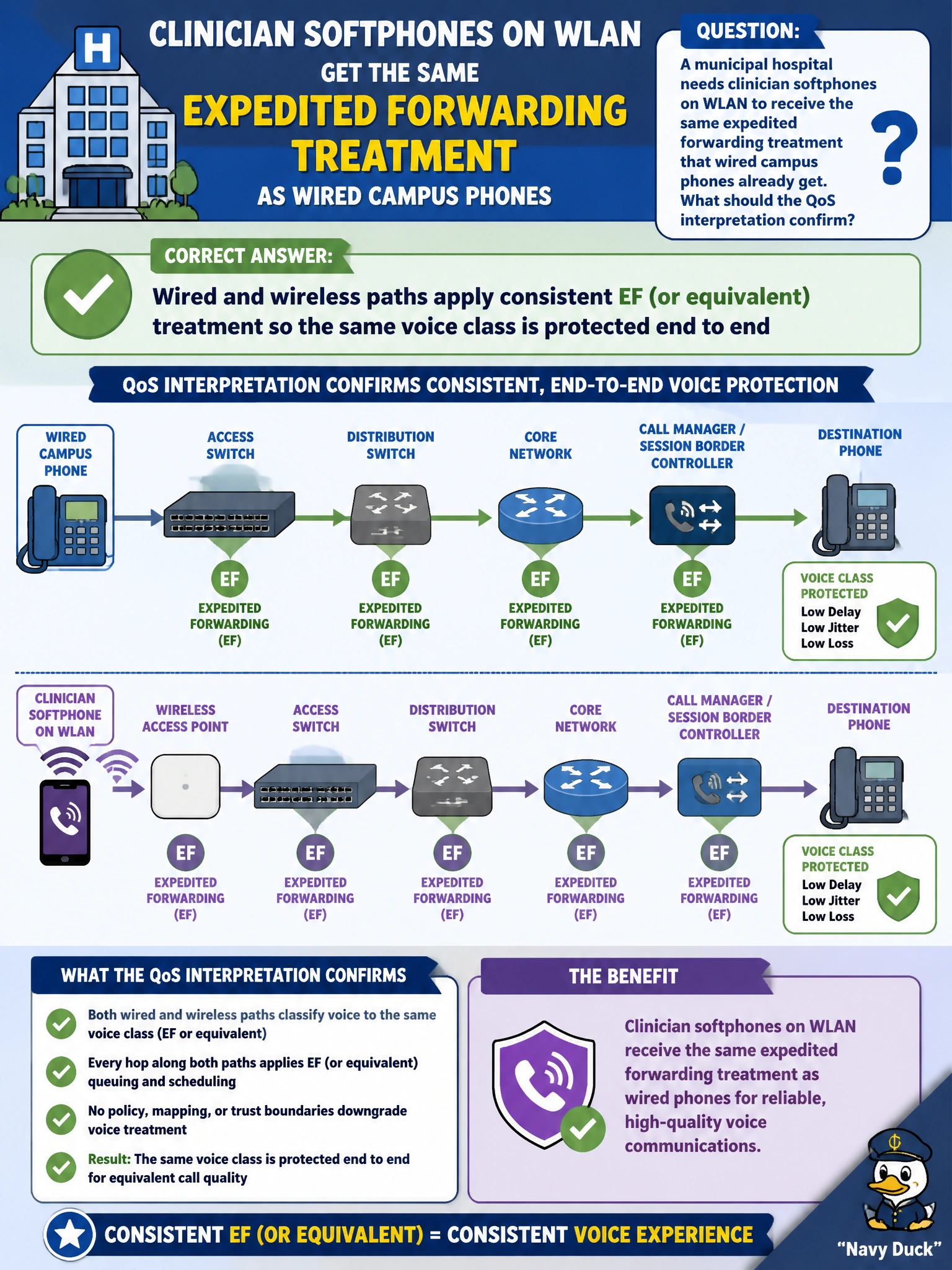
A municipal hospital needs clinician softphones on WLAN to receive the same expedited forwarding treatment that wired campus phones already get. What should the QoS interpretation confirm?
Select an answer to reveal the explanation.
Short Explanation
You want clinicians’ calls to get the same EF treatment whether they use wired phones or WLAN softphones. If WLAN voice is demoted to CS1 scavenger while wired voice keeps EF, you lose that end-to-end protection.
Full Explanation
Clinician softphones on WLAN need the same expedited forwarding treatment as wired campus phones to protect call quality consistently. The QoS interpretation should confirm that wired and wireless paths apply consistent EF, or equivalent, treatment so the same voice class is protected end to end. Markings must survive or be restored across AP/WLC/CAPWAP boundaries, and both paths must favor voice during congestion. Forcing wireless softphones to CS1 scavenger while wired phones keep EF misclassifies clinical voice as low priority and breaks parity. Requiring only the SSID name to match while allowing DSCP to be stripped on CAPWAP without impact ignores that wireless encapsulation and trust settings can erase markings. Treating EF as exclusive to wired Ethernet and claiming WLAN association necessarily prevents equivalent prioritization invents a media limitation: wireless designs can carry voice markings when configured correctly. Exam caveat: prioritize end-to-end class parity, not SSID cosmetics or WLAN voice demotion. Practical check: compare markings from a wired phone and WLAN softphone through the first campus hops, verify EF/UP mapping on the voice SSID, and confirm neither path is remarked to best-effort or scavenger before priority queues.