
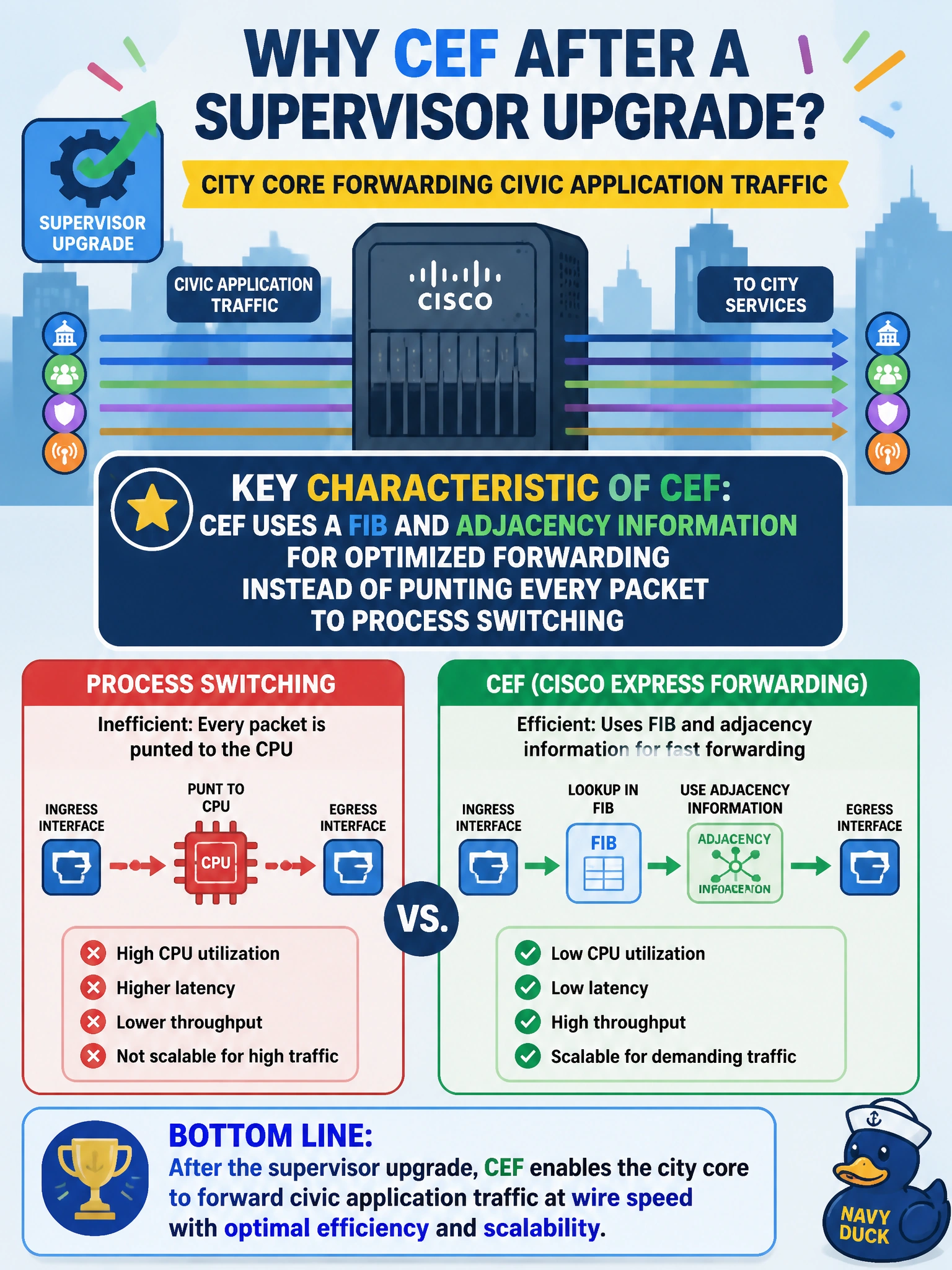
After a supervisor upgrade, the city core must forward civic application traffic with Cisco Express Forwarding rather than process switching. What is the key characteristic of CEF in that role?
Select an answer to reveal the explanation.
Short Explanation
Process switching is like asking the mayor to personally stamp every envelope. CEF is the mail-sorting machine that already built the address book (FIB) and next-hop stickers (adjacencies) so packets fly without waking the CPU for each one.
Full Explanation
Cisco Express Forwarding is the optimized IP forwarding model ENCOR contrasts with process switching. After a supervisor upgrade, the city core should forward civic application traffic using CEF's Forwarding Information Base and adjacency information rather than punting every packet to the CPU routing process. CEF precomputes forwarding state so most packets take a fast path: the FIB answers where to send the packet, and adjacency data supplies the Layer 2 rewrite details needed to transmit toward the next hop.
Describing CEF as looking up every packet by sending it to the CPU routing process as the primary path actually describes process switching, the model CEF avoids. Saying CEF replaces the MAC address table with OSPF LSAs on access ports confuses control-plane routing information, Layer 2 MAC learning, and CEF's FIB/adjacency structure. Claiming CEF disables the FIB so adjacency alone floods all frames inverts CEF design: the FIB is central, and adjacency complements it rather than replacing it with uncontrolled flooding.
Exam caveat: CEF questions often plant the process-switching definition under the CEF label. Prefer FIB plus adjacency for optimized forwarding.
Operational check: verify CEF is enabled on relevant interfaces, inspect FIB entries for civic prefixes, confirm adjacencies are complete for next hops, and watch CPU to ensure traffic is not unexpectedly punting to process switching after the supervisor upgrade.